Packing a power bank in the wrong bag can delay a trip or create a safety problem, especially when its watt-hour rating is unclear.
You can usually take a power bank on a flight only in your carry-on baggage, subject to watt-hour limits, airline approval rules, protection requirements, and the destination’s regulations. Never put a spare power bank in checked baggage.
Many travelers look only at the mAh number on the label. Airlines and aviation authorities use watt-hours, and a damaged or poorly protected battery can be refused even when its capacity seems ordinary. A quick check before leaving home is easier than solving the problem at the airport.
Where Should A Power Bank Go When Flying?
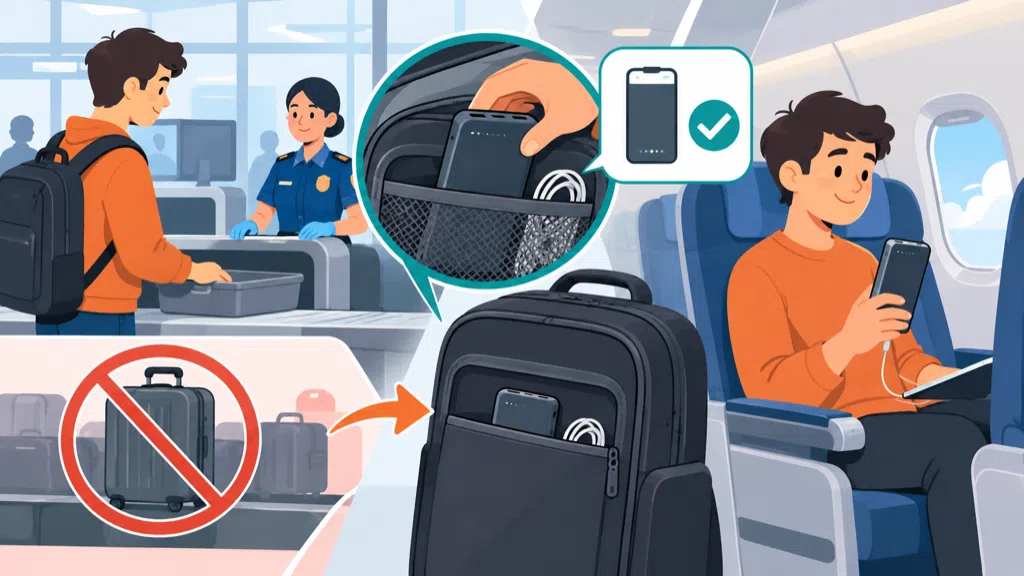
The safest starting point is simple: keep the power bank with you in the cabin and make it accessible for inspection or use.
Pack a power bank in your carry-on baggage, protect it from damage and short circuits, and remove it from a bag that is checked at the gate or planeside.
The Federal Aviation Administration says spare lithium batteries, portable rechargers, and power banks must remain in carry-on baggage rather than checked baggage.1 The reason is practical: if a battery overheats or produces smoke in the cabin, crew members can respond more quickly than they could to an incident in the cargo compartment.
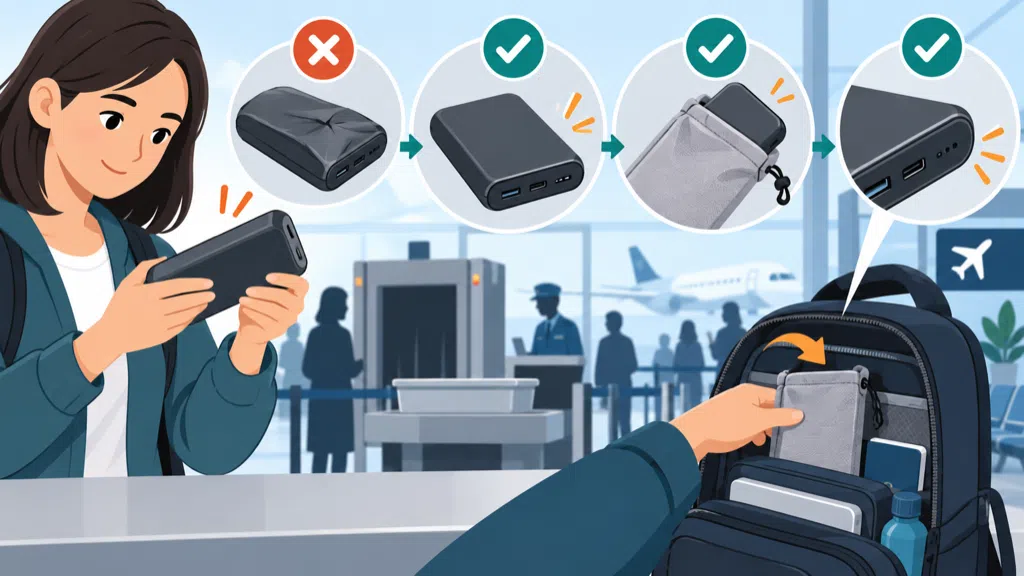
Keep the power bank where you can reach it. Do not bury it under heavy items, place it loose beside keys, or allow metal objects to touch its terminals. A separate pouch, original packaging, or terminal cover can reduce the chance of accidental short circuits.
If your carry-on bag is taken at the gate, remove the power bank before the bag goes into the aircraft hold. The FAA specifically advises passengers to keep spare batteries and power banks in the cabin when a carry-on is checked at the gate or planeside.2
Airlines can apply additional policies. Some carriers limit the number of power banks, restrict use or charging during the flight, or require them to be stored in an accessible location. Check the airline’s current dangerous-goods page before travel, especially when flying internationally or connecting between carriers.
| Packing situation | Safer action | Common mistake |
|---|---|---|
| Normal carry-on | Keep the power bank protected and accessible | Packing it loose with metal items |
| Checked suitcase | Do not place a spare power bank inside | Assuming the label makes it acceptable |
| Gate-checked carry-on | Remove the power bank before handing over the bag | Forgetting it in an outer pocket |
| Damaged power bank | Do not travel with it | Treating swelling or cracks as cosmetic |
| International connection | Check every airline and destination rule | Relying on one country’s policy |
| Unclear capacity | Confirm watt-hours before packing | Using mAh alone |
Do not carry a power bank that is swollen, cracked, leaking, recalled, unusually hot, or otherwise damaged. The FAA states that damaged or recalled lithium batteries and devices likely to create sparks or dangerous heat must not be carried aboard an aircraft unless made safe under the applicable rules.1
The same principle applies to a newly modified or repaired unit. If the enclosure is open, a terminal is exposed, or the battery pack is not securely assembled, it is not ready for air travel. Use a documented replacement or leave the item at home.
How Do I Check A Power Bank’s Flight Capacity?
The watt-hour rating is the key number for airline screening, and it may be printed on the label or calculated from voltage and ampere-hours.
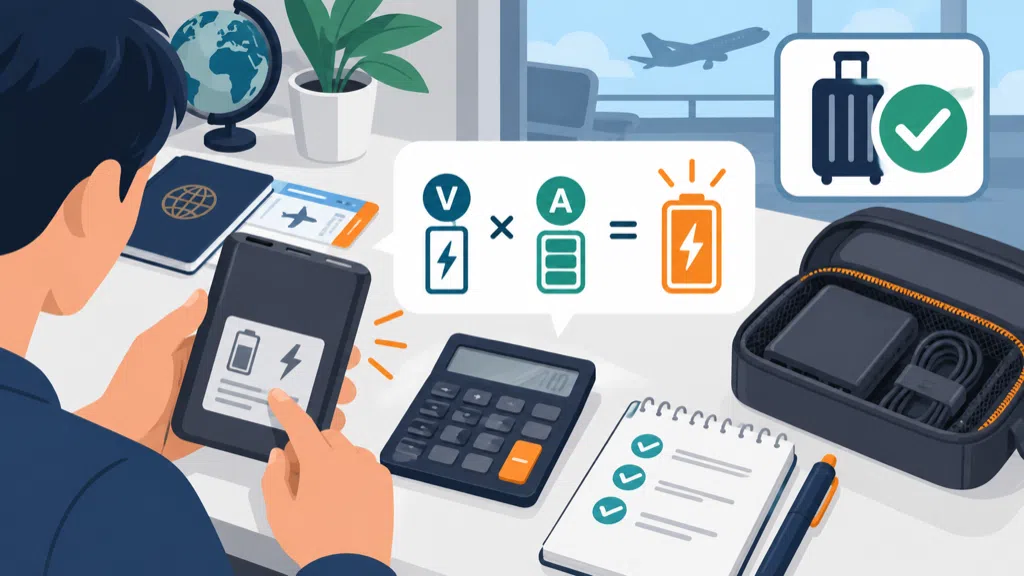
Calculate watt-hours by multiplying volts by ampere-hours, then compare the result with the airline and aviation authority limits. If the rating is between common allowance bands, obtain airline approval before traveling.
The FAA’s passenger guidance identifies power-bank rules by watt-hours. Batteries from 0 to 100 Wh are generally allowed in carry-on baggage, while 101 to 160 Wh may require air-carrier approval and are limited in quantity; batteries over 160 Wh are not allowed on passenger aircraft under the cited guidance.3
The product label may show milliampere-hours instead of ampere-hours. Convert mAh to Ah by dividing by 1,000, then multiply by the nominal voltage. For example, a label showing 20,000mAh at 3.7V represents about 74Wh on that nominal basis. The printed product rating or manufacturer documentation should take priority when available.
Do not confuse output voltage with the battery’s nominal voltage when doing the calculation. A USB-C power bank may advertise several output profiles, but the watt-hour calculation concerns the stored battery rating. If the label is missing or unclear, ask the manufacturer for a written specification.
| Label information | What to do | Why it matters |
|---|---|---|
| Wh printed clearly | Use that value for screening | It is the easiest reference |
| mAh and nominal V shown | Convert mAh to Ah, then multiply by V | Produces an estimated Wh value |
| Output watts only | Ask for battery Wh or pack rating | Output power is not stored capacity |
| No rating or unreadable label | Obtain manufacturer documentation | Airport staff may not accept guesses |
| 101–160 Wh range | Check the carrier approval process | Approval and quantity limits may apply |
| More than 160 Wh | Do not plan to carry it on a passenger flight | It may be prohibited |
Rules can change, and an airline can be stricter than the general authority guidance. Check the carrier before departure and again when the itinerary includes a codeshare or an international transfer.
A large power station is not automatically treated like a small phone power bank. Its stored energy, form factor, terminals, and intended use may place it under different rules. Read the authority’s item-specific guidance instead of assuming that every rechargeable product has the same allowance.
Manufacturers also have a responsibility to make the rating easy to find. A clear label with Wh, battery type, model identity, and contact information helps travelers and airport staff make a quick decision. Hiding the relevant number behind a marketing name creates avoidable support problems.
How Can Travelers Prepare A Power Bank For Screening?
Good preparation reduces uncertainty: inspect the unit, protect the terminals, keep the label visible, and confirm the airline’s current rules before leaving.
Before travel, inspect the power bank, verify its watt-hour rating, charge it safely, protect its ports and terminals, place it in accessible carry-on storage, and save the manufacturer’s specification if the label is incomplete.
Start with a physical inspection. Look for swelling, cracks, loose ports, exposed wires, a damaged shell, corrosion, or a smell that was not present before. Do not press a swollen battery back into shape or continue charging a unit that becomes abnormally hot.
Check the charging cable and accessories too. A loose cable in the same pocket can pull on the port or bring metal objects into contact with exposed contacts. Coil the cable separately and use a pouch that keeps the power bank from moving against hard objects.
Charge the unit before leaving, but do not leave it charging unattended overnight just before a flight. Use the recommended charger and inspect the power bank after charging. A normal battery should not become unusually hot, deform, or produce an unusual smell.
Keep the label and documentation visible. If the model has a printed Wh rating, do not cover it with a decorative sticker. If the rating is available only in a manual or product file, save a copy offline so that you can explain the specification if asked.
| Preparation step | Practical check | Action if it fails |
|---|---|---|
| Capacity | Confirm Wh or calculate it | Ask the manufacturer or do not pack it |
| Condition | Check for swelling, cracks, heat, or leaks | Do not carry the unit |
| Terminals | Prevent contact with metal objects | Use a pouch or protective cover |
| Bag location | Keep it in carry-on and accessible | Move it before security or gate check |
| Airline rule | Read the current carrier policy | Follow the stricter requirement |
| Connections | Check each airline on the itinerary | Confirm approval or quantity limits |
| Label | Keep model and rating readable | Save supporting documentation |
If security staff or airline personnel ask to inspect the power bank, answer directly and provide the rating. Do not argue from the mAh number if the requested information is watt-hours. The goal is to show that the product can be identified and handled safely.
For brands, travel readiness should be part of product development. The package should show the correct capacity basis, output information, warnings, and storage guidance. The product label, manual, website, and support team should use the same numbers.
Manufacturers should also consider the enclosure and transport condition. A power bank that survives normal desk use may still need protection against pressure in a bag, accidental button activation, and port contamination. A sturdy pouch and a clear storage recommendation can prevent avoidable incidents.
At EverGreat, we review travel-related claims with the product label, documentation, packaging, and intended market together. Airline requirements are not a marketing detail. They affect what customers can do with the product after purchase and how support teams should answer questions.
Conclusion
Take a power bank in carry-on baggage, verify its watt-hours and condition, protect it from short circuits, and confirm every airline’s current rules before flying.
-
Federal Aviation Administration, PackSafe for Passengers. ↩ ↩
-
Federal Aviation Administration, Lithium Batteries in Baggage. ↩
-
Federal Aviation Administration, Spare lithium-ion batteries and power banks guidance. ↩