A warm power bank can make users nervous. Some heat is normal, but too much heat deserves attention.
A power bank can get warm while charging because battery cells and charging circuits convert power and lose some energy as heat. It is not normal if the power bank becomes very hot, swells, smells burnt, charges slowly, or shuts down repeatedly.

Many customers ask me this after charging a power bank overnight or using a fast wall charger. The answer depends on how warm it gets and what else happens.
Is It Normal For A Power Bank To Get Warm While Recharging?
Yes, slight warmth is normal during recharging, especially with higher input power or a compact housing.
A power bank may get slightly warm while recharging because the charging IC, battery cells, and voltage conversion process generate heat. Mild warmth is common, but strong heat, swelling, odor, noise, or charging failure should be treated as unsafe.

Charging is not perfectly efficient. Energy moves from the wall charger, through the cable, into the charging circuit, and into the battery cells. Some energy becomes heat. A compact power bank has less surface area to spread that heat.
Fast charging can make this more noticeable. A power bank that accepts higher USB-C input can recharge faster, but the circuit and cells work harder. A good design manages that heat with proper components, firmware, PCB layout, and casing materials.
| Heat level | Likely meaning | What to do |
|---|---|---|
| Slightly warm | Usually normal | Keep airflow |
| Warm near USB-C port | Charging circuit active | Monitor |
| Too hot to hold | Unsafe condition | Stop charging |
| Heat with swelling | Battery risk | Isolate unit |
| Heat with odor | Possible failure | Stop using |
The charger used to recharge the power bank also matters. A weak adapter may charge slowly. A high-power adapter may trigger faster input if the power bank supports it. USB-IF provides compliance resources for USB products and charging behavior.1 For buyers, this means power claims should be tested with real adapters and cables.
Environment changes the result. A power bank charging on a bed, in direct sun, inside a bag, or near another heat source can become warmer than expected. Good user instructions should tell customers to charge on a hard surface with airflow.
For brands, heat complaints are emotional. A customer may not know whether 40 degrees Celsius is acceptable, but they know when a product feels scary. If the product gets warm in normal use, the manual should explain mild warmth without dismissing real warning signs.
In manufacturing, I do not judge heat by touch alone. I want temperature data. Test at different input powers, different room temperatures, and different battery levels. A power bank may heat most during a certain charge range, not always from empty to full.
EverGreat usually treats thermal testing as part of product validation, not a late-stage detail. Heat affects safety, charging speed, battery aging, and user trust.
What Problems Can Make A Power Bank Too Hot?
Excess heat can come from poor cells, weak circuit design, bad cables, high input power, blocked airflow, or internal damage.
A power bank may become too hot because of low-quality cells, poor PCB design, high charging current, damaged components, blocked ventilation, moisture, impact damage, or use with unsuitable chargers or cables. Stop charging if heat feels abnormal.
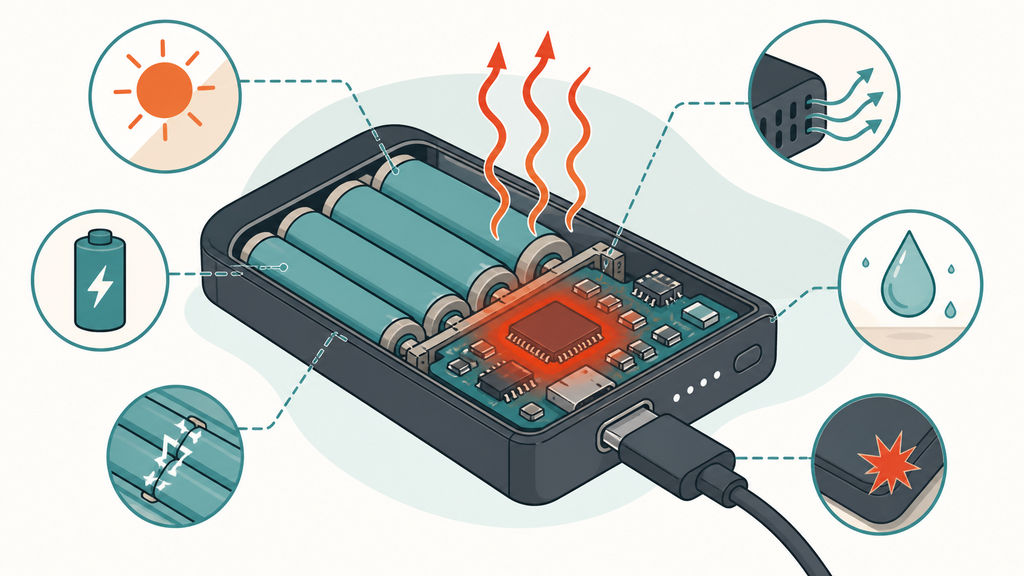
Excess heat is a symptom, not a single diagnosis. The cause may be the power bank, the wall charger, the cable, or the environment. That is why support teams need a clear troubleshooting path.
Battery quality is the first area I check. Inconsistent cells can heat unevenly, age quickly, or show voltage imbalance. A power bank may pass a quick function test but show problems during longer charging sessions. This is why incoming cell inspection and aging tests matter.
| Cause | Symptom | Buyer control |
|---|---|---|
| Poor cells | Uneven heat or low capacity | Cell supplier review |
| Weak PCB design | Hot circuit area | Thermal layout test |
| Bad cable | Slow or unstable charge | Cable validation |
| High input current | Faster heat rise | Firmware limits |
| Impact damage | Random heat | Drop and inspection test |
The U.S. Consumer Product Safety Commission warns that lithium-ion batteries can present fire and injury risks if damaged, overheated, or poorly handled.2 This is why I do not treat strong heat as a normal customer-service issue. If heat is abnormal, the user should stop charging.
UL Solutions also treats battery safety as a major testing and risk area.3 For B2B buyers, this is a reminder to review safety documentation, transport reports, cell data, and factory quality systems before placing large orders.
Moisture and impact are easy to overlook. A power bank dropped on the floor may look fine outside but have internal stress. A unit exposed to water may later heat during charging. Users may not connect the earlier accident to the later heat complaint.
Wireless power banks add another heat source. A magnetic wireless model may heat during output use and also during recharging, especially if pass-through use is allowed. Buyers should be careful with designs that charge the power bank while it wirelessly charges a phone. Convenience can increase thermal complexity.
The cable can also create problems. A poor USB-C cable may cause voltage drop or unstable negotiation. The power bank may charge slowly, retry, or heat at the connector. A bundled cable should be tested, not treated as an afterthought.
The practical rule is simple. Mild warmth can be normal. Strong heat, swelling, smell, smoke, repeated shutdown, or melted plastic is not normal.
How Should Brands Reduce Power Bank Heat Complaints?
Brands should validate cells, charging ICs, thermal design, cables, user instructions, and safety documentation before shipment.
Brands can reduce power bank heat complaints by testing temperature rise during recharging, using reliable cells, setting safe firmware limits, validating cables and adapters, checking enclosure materials, and writing clear instructions about airflow, heat, swelling, and damaged units.
Heat complaints are expensive because they affect trust. Even if the product is technically safe, a user who feels scared may return it, leave a bad review, or stop using the brand. Good design reduces both real risk and perceived risk.
I recommend testing heat in several conditions. Use the recommended adapter, a higher-power compatible adapter, a weak adapter, and the bundled cable. Test at low battery, mid battery, and near full battery. Test in a normal room and in a warmer environment.
| Test condition | Why it matters |
|---|---|
| Empty to full charge | Finds long-session heat |
| High input adapter | Checks fast-charge stress |
| Bundled cable | Matches customer setup |
| Warm room | Simulates summer use |
| Case surface temperature | Matches user perception |
Documentation should be specific. Tell users to charge on a hard surface, keep the unit away from heat, avoid charging under pillows or blankets, and stop using it if there is swelling, odor, smoke, or abnormal heat. Safety advice should sound practical, not frightening.
Air travel and shipping also matter. The FAA explains that power banks are considered spare lithium batteries for travel and must be carried in carry-on baggage.4 This reinforces why capacity labels, watt-hour calculations, and battery handling documentation matter for power bank brands.
For product development, shell design is important. A beautiful compact housing is not enough if it traps heat. Material choice, wall thickness, cell spacing, PCB component placement, and thermal protection all affect real performance.
EverGreat works with customers on these tradeoffs early. A buyer may ask for a smaller shell, faster input, higher capacity, and lower cost at the same time. Those goals fight each other. The manufacturer’s job is to show the tradeoff before the market shows it through complaints.
Customer support should collect batch codes, charger used, cable used, charging surface, room condition, and whether the unit was dropped or wet. Patterns can reveal whether the issue is user environment, accessory mismatch, or a production problem.
The strongest brand position is not “our power bank never gets warm.” That would not be honest. The stronger position is: mild warmth is expected, abnormal heat is taken seriously, and the product was designed and tested around real charging conditions.
Conclusion
A power bank can get mildly warm while charging, but strong heat, swelling, odor, or shutdowns require immediate caution.
-
USB-IF provides USB compliance information through its official compliance resources. ↩
-
The U.S. Consumer Product Safety Commission provides lithium-ion battery safety guidance through its battery safety resources. ↩
-
UL Solutions describes battery safety testing and risk areas in its battery safety services. ↩
-
The FAA explains lithium battery and power bank travel handling in its PackSafe guidance. ↩