A power bank can lose battery while sitting in a drawer, leaving you with an empty backup when you need it most.
A power bank can lose charge while unused because of normal battery self-discharge, the protection and monitoring circuit, indicator power, temperature, age, or a connected cable or device drawing current.
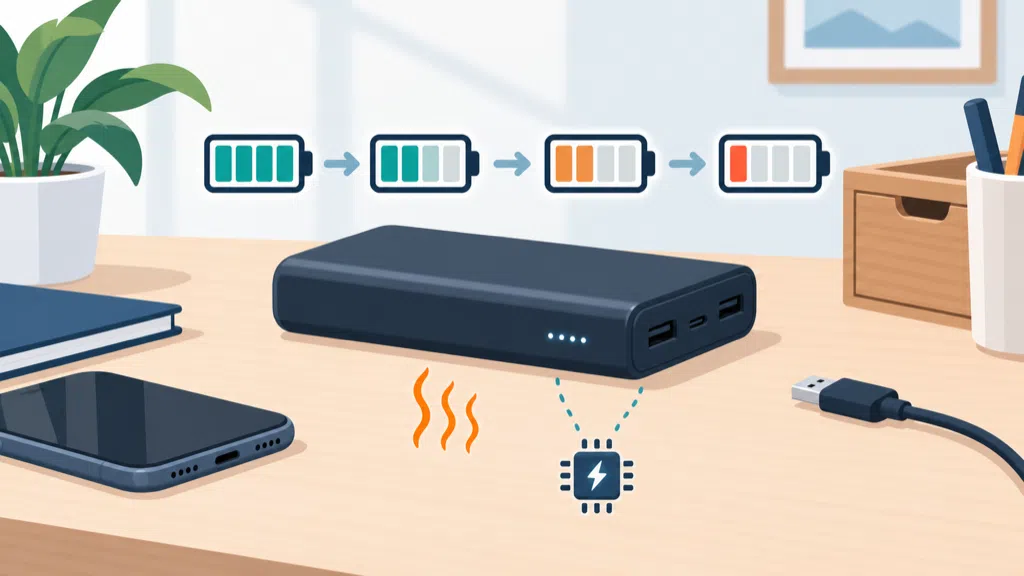
I often hear this complaint from users who charge a power bank, store it for weeks, and expect the percentage to remain unchanged. Some loss can be normal, but a fast drop usually deserves a closer check.
What Causes A Power Bank To Lose Battery In Storage?
A power bank loses some charge through battery self-discharge and the small amount of energy used by its protection, control, and indicator circuits.
The main causes are battery self-discharge, standby current from the electronics, an always-connected cable or accessory, temperature, aging, and a battery that was already damaged or poorly matched.
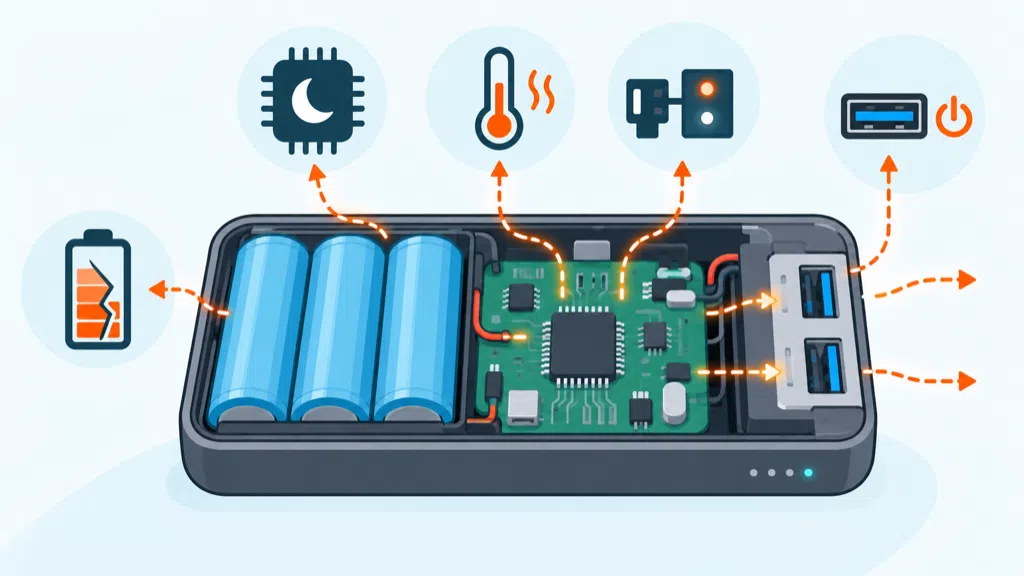
A lithium-ion power bank is not electrically asleep in the same way as an empty plastic case. The cells have internal chemical activity, and the protection circuit monitors conditions such as voltage and temperature. The display or indicator may also wake when a button is pressed or a cable is connected.
The amount of loss depends on the cell, circuit, firmware, product condition, storage temperature, and time. A small change over a long period is different from losing most of the battery in a few days.
A connected cable can create an unexpected load. Some devices draw a small current even when they are not actively charging. A cable can also trigger a power bank to detect a load or repeatedly wake its output circuit. Remove all cables and accessories before diagnosing standby loss.
| Possible cause | What it looks like | First check |
|---|---|---|
| Normal self-discharge | Gradual decline over weeks or months | Compare over the same storage period |
| Standby electronics | Slow but repeatable loss | Store with no cable attached |
| Connected device or cable | Faster drop after use or storage | Remove every accessory |
| Button or display wake | Indicator turns on in a bag | Check button protection and wake behavior |
| Heat exposure | Capacity drops faster in warm storage | Move to a cool, dry place |
| Aging cell | Runtime declines over time | Compare with earlier measured performance |
| Fault or damage | Rapid loss, heat, swelling, smell | Stop using and inspect safely |
Temperature affects the battery and the electronics. High heat can accelerate unwanted reactions and may increase the rate of capacity loss. Very cold conditions can temporarily reduce available performance even if the stored energy has not disappeared. A power bank that seems empty in the cold may recover some apparent capacity after returning to a moderate environment, but that does not make damage safe.
The enclosure and protection circuit matter. A high-quality battery pack uses cells and a control system selected to work together. Poor cell matching, leakage current, contamination, or a defective protection component can cause abnormal drain. Users cannot diagnose the internal cause safely by opening the product.
Safety should come first. The FAA notes that lithium-ion batteries can overheat and enter thermal runaway if damaged, overheated, exposed to water, overcharged, improperly packed, or affected by a manufacturing defect.1 If a stored power bank is swollen, smoking, leaking, unusually hot, or physically damaged, stop using it and follow local battery disposal guidance.
The label can also create a measurement misunderstanding. A power bank may show four LEDs after charging, but the indicator is an estimate. The lights may remain unchanged for a while and then drop quickly under load. A digital percentage can look more precise but still depends on the battery-management system and operating conditions.
A power bank that loses a small amount of charge while unused is not automatically defective. The practical question is the rate, repeatability, and condition of the product.
Is Some Battery Loss Normal For An Unused Power Bank?
Some gradual loss is expected, but a power bank that becomes nearly empty quickly, heats up, swells, or smells unusual should not be treated as normal storage behavior.
Normal storage loss is usually gradual and does not create heat, odor, swelling, or erratic behavior. Rapid loss or physical warning signs indicate that the product should be removed from service and assessed.
Battery age changes the experience. Rechargeable cells are consumable components. Repeated cycles, long periods at high charge, high temperature, and normal calendar aging can reduce available capacity. A power bank may still turn on while delivering less runtime than when new.
The circuit also has a quiescent load. Protection and monitoring electronics need some energy to remain ready. A product with a display, wireless charging system, multiple ports, or extra features may have more standby behavior than a simple power bank. The correct value must be measured on the actual design.
Manufacturing variation matters too. The cell, protection board, connector, button, display, and firmware must work as a system. A small leakage current that is harmless in one design may become a major storage problem in a compact product with a smaller battery.
| Pattern | More likely explanation | Recommended response |
|---|---|---|
| Small decline over a long period | Normal storage and standby behavior | Recharge before planned use |
| Drop only with a cable attached | Accessory or output wake | Remove cable and retest |
| Large decline in a few days | Fault, load, or high standby current | Stop normal use and contact support |
| Loss after hot storage | Heat exposure or accelerated aging | Inspect condition and avoid reuse if damaged |
| Short runtime but stable storage | Reduced capacity from age or cycles | Consider replacement |
| Swelling or strong odor | Potential battery failure | Stop using and seek safe disposal |
The storage state matters. Leaving a power bank fully charged for a long time may place more stress on the cells than storing it at a moderate level, but the best storage guidance depends on the manufacturer’s design and instructions. Users should follow the product manual rather than applying one universal number to every power bank.
The physical environment matters as well. Avoid direct sun, hot vehicles, damp areas, and locations where the power bank can be crushed. Do not store it with loose metal objects that can contact ports or connectors. Keep it in a place where a change in shape or temperature can be noticed.
The safety standard is not a promise that every product will last forever. IEC 62133-2 defines safety requirements and tests for portable sealed secondary lithium cells and batteries under intended use and reasonably foreseeable misuse.2 Product quality still depends on cell selection, circuit design, assembly, inspection, storage, and user handling.
For brands, storage loss is an after-sales issue as much as a battery issue. A customer may buy a power bank for occasional emergency use. If it is empty when needed, the customer experiences the product as unreliable even if it worked correctly on the day of purchase.
This is why validation should include standby tests. Charge production-intent samples, disconnect all accessories, record the battery state, store them under controlled conditions, and measure the result at set intervals. Repeat with the display active, output ports used, and different cell suppliers when relevant.
A practical warranty analysis separates normal aging from abnormal drain. Support teams should ask how long the product was stored, whether a cable remained attached, where it was kept, whether it became hot, and whether the indicator changed before the problem appeared.
How Can Users And Brands Reduce Unused Power Bank Drain?
Users can reduce storage loss by disconnecting accessories, avoiding heat and damage, checking the product periodically, and following the manufacturer’s storage instructions.
To reduce unused power bank drain, store the product in a cool, dry, protected place with no cable attached, inspect it periodically, recharge it before travel, and replace it if it shows damage or abnormal behavior.
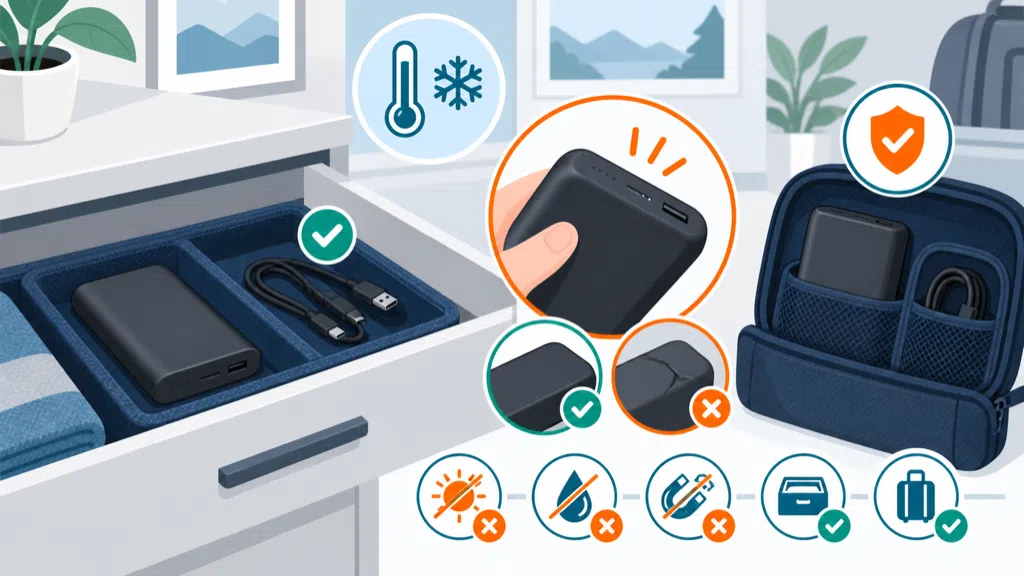
A simple storage routine prevents many complaints. Disconnect the phone, earbuds, cable, and adapter. Press the indicator button once to check the approximate state, then store the power bank where it cannot be crushed or exposed to heat. Do not place it in a car for long periods if the environment becomes hot.
Before travel, test the power bank with the cable and device you actually plan to use. A light indicator is not proof that the product can deliver the expected runtime. A short charging test can reveal a damaged cable, dirty connector, or power bank that no longer holds useful capacity.
The FAA says power banks are spare lithium-ion batteries that must be carried in carry-on baggage, and that passenger rules include Wh limits and airline-specific restrictions.3 A power bank stored for a long time should be checked before a trip, not placed in luggage at the last minute. Damaged or recalled batteries should not be carried aboard an aircraft.1
| User habit | Why it helps |
|---|---|
| Remove all cables after use | Prevents hidden loads and wake events |
| Keep away from heat | Reduces battery stress |
| Protect ports and buttons | Prevents damage and accidental activation |
| Check before travel | Finds loss before the product is needed |
| Follow the manual | Applies the maker’s intended storage guidance |
| Stop after swelling or odor | Reduces safety risk |
Brands can reduce complaints by setting realistic storage expectations. The manual should explain that a power bank can lose some charge over time and should be checked before emergency or travel use. It should also say what symptoms require the customer to stop using the product.
The product design can help. A sleep mode can reduce standby current. A protected button can prevent accidental wake-up. A clear indicator can show whether the output is active. A low-drain controller and well-matched cells can improve the storage experience, but every feature should be tested on the final product.
Quality-control teams should add storage drain to the validation plan. Measure no-load current, active-indicator current, and output wake behavior. Test with and without cables. Record the battery state over time. Check samples from different production lots instead of relying on one engineering unit.
Supplier documents should be specific. Ask how standby current is measured, what conditions apply, how the product enters sleep, and whether a connected cable can keep the output active. If the product has a screen, wireless coil, or multiple controllers, ask how each feature affects storage.
A pilot run is useful because assembly variation can affect buttons, connectors, display boards, and protection circuits. The engineering design may show good standby performance while a production issue leaves some units with abnormal drain. Include a no-load storage check in the pilot quality plan.
For OEM and ODM projects, EverGreat usually helps customers choose between a simple low-drain design and a feature-rich design. A digital display, wireless output, built-in cable, or multiple ports can improve usability, but each feature must enter sleep correctly. The best product is the one that remains dependable between uses.
When a power bank loses charge, users should first remove cables and observe the pattern. Brands should then separate normal storage behavior from abnormal current draw, battery aging, heat exposure, or physical damage. That approach solves the real problem without creating false expectations.
Conclusion
A power bank can lose some charge while unused, but rapid loss, heat, swelling, or odor is abnormal. Store it safely, check it before use, and test standby drain in production.
-
Federal Aviation Administration, PackSafe lithium battery guidance. ↩ ↩
-
International Electrotechnical Commission, IEC 62133-2 safety requirements. ↩
-
Federal Aviation Administration, Airline passengers and battery guidance. ↩