Many buyers start sourcing and quickly hit unexpected issues. They feel frustrated when their great ideas crash in reality. I will show you why and how to avoid these common traps.
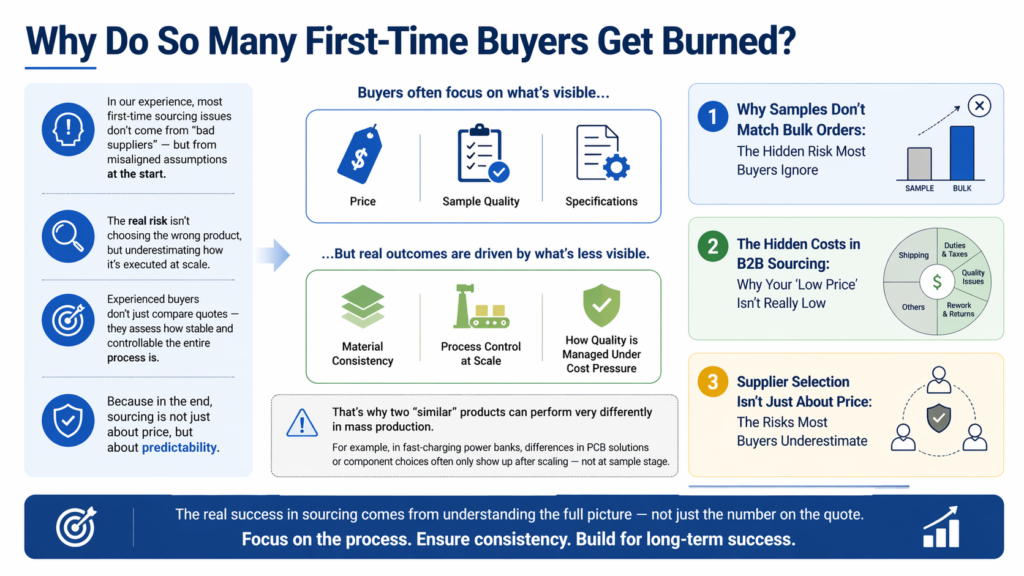
First-time buyers often get burned because they focus only on visible factors like price and sample quality. The real problems arise from less visible issues such as inconsistent materials, poor process control at scale, and how quality holds up under pressure. Understanding this shift is key to successful sourcing.
I remember when I first started in this industry; I thought a good sample meant a good product. But I quickly learned that the path from a perfect sample to thousands of perfect products is full of hidden traps. This is where most first-time buyers stumble, overlooking the critical details that truly define a reliable sourcing partnership. First-time importers often face unexpected operational and regulatory complexities, leading to issues like incomplete documentation, misclassifying goods, or underestimating the total cost of importing. Many new importers fail not due to their product, but because they underestimate these complexities.
Why Samples Don’t Match Bulk Orders: The Hidden Risk Most Buyers Ignore?
You get a perfect sample; you’re excited. Then the bulk order arrives, and it’s not the same. This mismatch can ruin your launch and reputation. Let me explain why this happens and what to look for.
Samples often differ from bulk orders because they are made under ideal conditions, using premium materials and focused attention. In mass production, variations creep in due to material inconsistencies, relaxed process control, or cost-cutting measures. The hidden risk is assuming sample quality translates directly to scale.
When I get a sample, I am always impressed. It looks great, feels solid. But I know this is only one piece. What happens when you make ten thousand? The challenge is that samples are often hand-picked or produced in small batches. This means suppliers can use their best materials and give them extra attention. It is like making a special dish for one guest compared to cooking for a big party. The big party has more chances for things to go wrong. The disparity between a perfect sample and a bulk order is a recognized issue in manufacturing, stemming from a fundamental shift from artisanal precision (samples) to industrial efficiency (mass production). Samples receive significantly more individual attention, with workers spending 60+ minutes on one sample versus 10-15 minutes per unit in bulk production.
Material Consistency Matters
One big reason for issues is material consistency. A small batch might use material from a perfect roll. But what about the next 100 rolls? Suppliers might switch to cheaper sources or use slightly different batches. For example, in power banks, a PCB solution in a sample might use one brand of capacitor. In bulk, they might use a cheaper, less stable brand. This change affects performance later. Low-cost sourcing frequently involves a compromise on quality, with suppliers using inferior or inconsistent materials to maintain lower price points. Inconsistent quality arising from variations in raw materials is a common quality issue in manufacturing.
Process Control at Scale
Another issue is process control. When a factory ramps up production, things move faster. This speed can lead to errors. Maybe the soldering is not as clean, or components are not placed perfectly. When I talk about process control, I mean the steps a factory takes to make sure every unit is the same. Without strong control, quality drops. Robust process control is critical for maintaining consistent product quality in mass production by monitoring and regulating key variables in real time. Automated control systems can eliminate errors, optimize energy costs, increase safety, and ensure quality standards are met, leading to reduced production costs. Without real-time Statistical Process Control (SPC), minor variations in batch production can quickly escalate into major deviations.
Quality Under Cost Pressure
Finally, there is cost pressure. After a buyer places a big order, they often negotiate for a lower price. This pressure can push a supplier to cut corners. They might reduce inspection steps or use cheaper labor. This is why two products, looking similar, can perform very differently. For example, a customer pushing for a significantly lower price for stainless steel bottles resulted in reduced wall thickness and skipped copper plating, leading to complaints about performance later. This highlights how cost pressure can directly sacrifice performance for factory margins.
| Factor | Sample Stage | Mass Production Stage |
|---|---|---|
| Material Usage | Often premium, carefully selected | Can vary, cheaper alternatives possible |
| Production Speed | Slow, precise, high attention | Fast, efficiency-driven, higher error potential |
| Quality Checks | Intensive, often by senior staff | Standardized, sometimes rushed, less frequent |
| Cost Influence | Minimal, focus on perfection | High, pressure to reduce costs |
The Hidden Costs in B2B Sourcing: Why Your ‘Low Price’ Isn’t Really Low?
You found a super low price, celebrating a win. Soon, you realize it is costing you more than you saved. This "deal" can quickly become a financial nightmare. Let’s uncover these hidden costs.
A "low price" in B2B sourcing often hides significant costs like quality failures, production delays, shipping errors, and unexpected rework. These unseen expenses, often from poor communication or insufficient quality control, quickly erode any initial savings. True cost includes predictability and consistent quality, not just the unit price.
When I look at a quote, I do not just see the number. I see a story behind it. A very low price often raises a red flag for me. It means someone might be cutting corners somewhere. This is not about being expensive. It is about being realistic. If a price seems too good to be true, it probably is. I have seen buyers learn this the hard way, thinking they got a great deal only to pay much more later.
Unpacking the True Cost of Sourcing
A supplier offering a very low price might be using substandard materials. For example, a power bank needs good quality cells and a reliable PCB. Cheaper versions fail faster, overheat, or do not deliver the promised charge. This leads to customer complaints, returns, and damage to your brand. These issues are not visible at the time of purchase. They appear later. This costs you more in refunds and lost customers.
The Price of Lax Quality Control
Low prices can also mean less robust quality control. Factories that offer rock-bottom prices often skip key inspection steps or hire less skilled workers. This results in a higher defect rate in your bulk order. When I say defect rate, I mean how many units you get that are not usable. Each defective unit means lost profit. You might also need to spend money on re-inspection or re-production. This delays your product launch.
Hidden Operational Costs
Beyond product defects, there are operational costs. Poor communication from a low-cost supplier can lead to misunderstandings. This causes production delays. Delays mean lost sales opportunities. Shipping errors, customs issues, or even a lack of proper certifications can add unexpected expenses. All these things add up. They turn a seemingly low initial price into a very high total cost. A "low price" often conceals numerous significant costs, an important concept captured by the "Total Cost of Ownership" (TCO) framework. TCO includes not just the purchase price but also acquisition, usage (inventory, conversion, scrap, warranty), and end-of-life costs (disposal).
| Hidden Cost Category | Example in Sourcing | Impact on Your Business |
|---|---|---|
| Quality Failures | Defective products, short lifespan | Returns, warranty claims, damaged brand reputation |
| Production Delays | Unmet deadlines, slow communication | Missed sales, inventory shortages, market opportunity loss |
| Rework/Scrap | Units needing fixing, unusable products | Increased labor costs, material waste, time delays |
| Logistics Issues | Incorrect shipping, customs problems, documentation errors | Extra fees, storage costs, further delays |
| Brand Damage | Customer complaints, negative reviews | Loss of trust, reduced future sales |
Supplier Selection Isn’t Just About Price: The Risks Most Buyers Underestimate?
You’re comparing quotes, looking for the best price. Focusing only on price hides bigger risks that can sink your project. This narrow view leaves you vulnerable to costly surprises. I will show you what else truly matters.
Supplier selection that prioritizes only price overlooks critical factors like a supplier’s material consistency, process control capabilities, and quality management systems. Buyers underestimate the risks of poor execution at scale, which leads to inconsistent products and unpredictable outcomes. True selection focuses on predictability and a stable production process.
I have met many buyers who only looked at the bottom line. They compared prices and picked the cheapest one. But I learned that the supplier’s price is just one piece of the puzzle. The real value comes from their ability to deliver consistent quality, on time, every time. This is about predictability. It is about trusting that what you ordered is what you will get, consistently. This trust is built on more than just a low price.
Beyond the Price Tag: What Really Defines a Good Supplier
When I evaluate a supplier, I look beyond the sample. I ask about their material sourcing. Do they have a stable supply chain? Do they test incoming materials? This is crucial for things like power banks, where battery cells and PCB components must be reliable. I also examine their quality control process. Do they have clear inspection points at every stage? How do they handle defects during production? These details show me how consistent their output will be.
Process Control at Scale: The Hidden Predictor
A key differentiator for experienced buyers is understanding a supplier’s process control at scale. It’s not enough to make one good unit. Can they make thousands without significant variation? I look for evidence of robust manufacturing processes. This includes documented procedures, trained staff, and proper equipment calibration. For example, in fast-charging power banks, minor differences in PCB solutions or component choices can lead to major performance issues when scaling. Only strong process control prevents these problems.
The Value of Predictability
Ultimately, sourcing is about predictability. Can you predict the quality of your next batch? Can you predict delivery times? A reliable supplier gives you this predictability. They have stable processes. They manage quality even under cost pressure. This means fewer surprises for you. It means a smoother launch, happier customers, and a stronger brand. Choosing a supplier based on price alone is a gamble. Choosing one based on their ability to deliver predictably is a smart investment. Supplier selection should extend beyond price to strategically evaluate factors such as a supplier’s quality management system, certifications (e.g., ISO 9001), defect prevention, inspection processes, and historical performance data, consistent and reliable delivery, lead times, on-time rates, and responsiveness to delays, the supplier’s financial health impacts their ability to meet long-term commitments, R&D teams, engineering support, and problem-solving skills, especially for new product development, adherence to industry-specific regulations, ethical business practices, and sustainability/ESG performance, and clear, responsive, and proactive updates. Predictability in the supply chain is crucial for optimizing production efficiency, reducing costs, improving customer satisfaction, and managing risks.
| Key Supplier Assessment Areas | What to Look For | Why It Matters |
|---|---|---|
| Material Sourcing | Stable sources, incoming material checks | Ensures consistent product quality and reliability |
| Process Control | Documented procedures, trained staff, equipment maintenance | Reduces variations, improves efficiency, minimizes defects |
| Quality Management | In-process inspections, final QA, defect handling | Guarantees products meet specifications consistently |
| Communication | Clear, responsive, proactive updates | Prevents misunderstandings, reduces delays, builds trust |
| Financial Stability | Healthy business operations, not overly reliant on one buyer | Minimizes risk of production halts or sudden closure |
| Technical Capability | R&D team, engineering support, problem-solving skills | Supports product development, innovation, and issue resolution |
Conclusion
First-time buyers often miss what really drives product success: predictability. I learned that reliable sourcing is about understanding hidden factors like process control and consistent quality, not just the upfront price.