Your power bank can get really hot, right? This heat can damage it and even shorten its life. I believe it is time to understand why this happens and what new tech is keeping things cool.
Power banks get hot because of energy loss and resistance during charging. Modern thermal designs, especially liquid cooling, now make them safer and more efficient. These new methods help manage heat better, keeping devices running smoothly.
I know many of us have felt a power bank get warm. This issue has driven huge changes in how these devices are built. Let’s look at how thermal design has changed and what this means for your gadgets today.
Why Do Power Banks Get Hot During Charging?
Feeling your power bank heat up during use can be a bit concerning, can’t it? I have often wondered why this happens.
Power banks generate heat mainly because of energy not being fully used and electrical resistance. When electricity changes form or flows through parts, some energy turns into heat. This is especially true with fast charging, making the device warm.
I have seen firsthand how much heat a power bank can produce. This heat comes from a few main places. When energy moves inside a power bank, it changes form. For example, the battery cells usually work at around 3.7 volts. But to charge your phone, the power bank must change this to 5 volts, 9 volts, or even more. This change is never perfect. Some energy always gets lost, and this lost energy becomes heat. We call this "energy conversion inefficiency." Another big reason is electrical resistance. All the parts inside—the battery cells, the charging circuits, and even the connectors—resist the flow of electricity a little bit. When electricity pushes through this resistance, it creates heat. This effect gets much worse with fast charging. When you charge something quickly, more electricity flows, and this means much more heat. It’s also important to remember that environmental factors can play a role; high ambient temperatures, poor ventilation (like charging in a backpack), or direct sunlight all contribute to heat buildup. As lithium-ion batteries age, their internal resistance increases, causing them to generate even more heat, exacerbating the problem, especially in older devices. I believe Joule’s law explains this well: heat goes up a lot when the current goes up. If you charge your phone while also charging the power bank, or if the power bank is in a warm place without much air, the heat problem gets even worse. This extra heat can make the power bank work less well, slow down charging, wear out the battery faster, and even create safety risks if not handled correctly. While slight warmth (30-40°C) during fast charging is generally normal, temperatures above 50°C are considered excessively hot and warrant unplugging. Temperatures exceeding 60°C are dangerous and require immediate cessation of use, as excessive heat can lead to battery damage, thermal runaway, or even fire.
Here is a breakdown of the main reasons:
| Reason | Explanation | Impact |
|---|---|---|
| Energy Conversion Loss | Power banks change voltage to match your device. This process is not 100% efficient. | Lost energy turns into heat, making the power bank warm. |
| Electrical Resistance | Internal parts like battery cells and circuits resist electric flow. | Resistance causes heat, especially during high-current fast charging. |
| Simultaneous Use | Charging the power bank while it is also charging another device. | Increases the workload, leading to more heat generation. |
| Poor Ventilation | Lack of airflow around the power bank. | Traps heat inside, preventing it from escaping and raising temperatures. |
| High Current Fast Charging | Sending more electricity through the circuits to charge devices faster. | Greatly increases heat production due to higher electrical resistance and conversion losses. |
How Has Power Bank Cooling Technology Evolved Over Time?
Have you ever stopped to think about how power banks stay cool? It’s a journey of smart engineering!
Power bank cooling has progressed from simple graphite sheets to advanced liquid systems. This evolution was necessary to handle more power and faster charging. Each step has brought better ways to move heat away from sensitive components.
From my perspective, watching power bank technology grow has been fascinating. I remember when power banks were simpler, and so were their cooling methods. As devices needed more power and faster charging, the ways we cool them had to change too. It has been a steady climb in complexity and effectiveness. Early power banks used very simple methods, like thin graphite sheets. These sheets could spread heat out passively. They were light and cheap, but they could only handle so much heat. As power banks got stronger and fast charging became normal, these graphite sheets were not enough. Beyond graphite, modern power banks utilize various thermal management materials such as aluminum heat sinks, thermal conductive silicone, graphene, heat-resistant insulation foam, and aluminum alloy shells to dissipate heat and optimize performance. Then came heat pipes. These were a big step forward because they used phase-change heat transfer. This means a liquid inside the pipe would turn into a gas, move heat, and then turn back into a liquid. This was much better at moving heat from hot spots to cooler areas. Later, vapor chambers appeared. These were like bigger, flatter heat pipes, functioning similarly to flat, large heat pipes, spreading heat across a wider area more uniformly via a liquid-to-vapor phase change. They spread heat across a larger area more evenly and could handle even more heat. Many mid-to-high-end power banks use these, especially in compact devices like smartphones where space is critical. But the newest and most advanced step is micro-pump liquid cooling. This is an active system. Instead of just spreading heat, it actively pumps liquid to carry heat away. This is a huge leap in how well we can cool power banks today.
Here is how power bank cooling has developed:
| Stage | Technology | How it works | Pros | Cons |
|---|---|---|---|---|
| Early Solutions | Graphite Sheet | Thin films that spread heat outwards passively. | Simple, lightweight, low cost. | Limited heat handling for modern fast charging. |
| Mid-Tier Improvement | Copper Heat Pipe | Uses liquid evaporation and condensation to move heat from hot spots. | Better directional heat transfer. | Can be bulky, less effective for large areas. |
| Advanced Passive Cooling | Vapor Chamber (VC) | Larger, flat heat pipes for two-dimensional heat spreading. | Superior uniformity, higher capacity. | Still passive, limits high heat flux. |
| Current Frontier | Micro-Pump Liquid Cooling | Active system with piezoelectric micro-pumps circulating coolant through channels. | Highest efficiency, active heat removal. | More complex, higher initial cost. |
What Makes a Power Bank Run Cooler and Safer Today?
Want to know the secret to cooler, safer power banks? I believe it is all about the latest cooling tech!
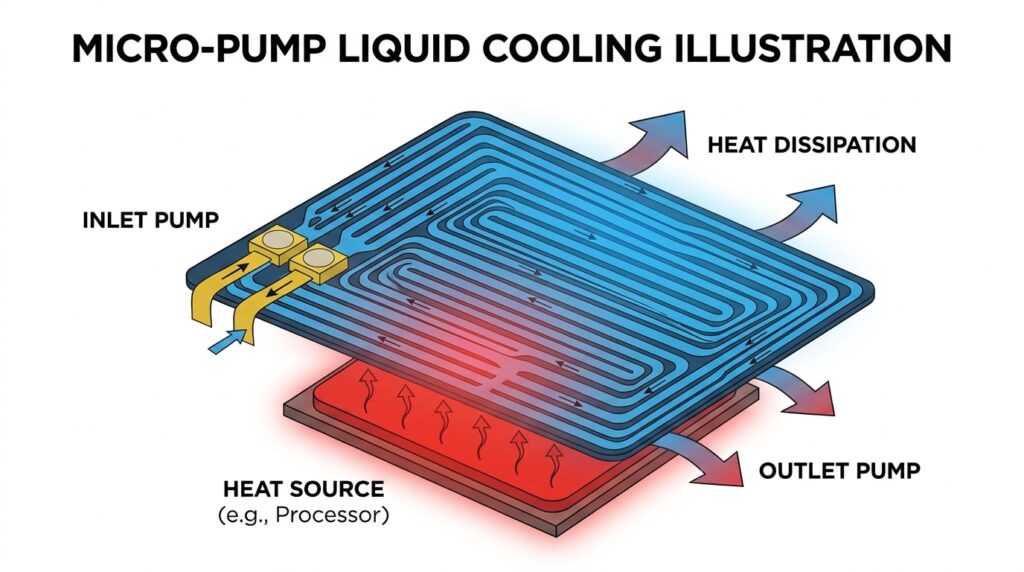
Today’s top power banks use piezoelectric micro-pump liquid cooling systems for better thermal control. These active systems circulate liquid through tiny channels, efficiently moving heat away. This results in stable, lower operating temperatures and improved safety.
I have always been impressed by how technology adapts to new challenges. Today, the best power banks use something truly advanced: piezoelectric micro-pump liquid cooling systems. These are not passive systems that just spread heat; these actively move it away. I think of them as tiny, efficient air conditioners for your power bank. This active system has three main parts. First, there is the piezoelectric micro-pump itself. This small pump is the engine of the cooling system. These pumps operate on the inverse piezoelectric effect, where an applied electric field deforms a ceramic material. This deformation causes fluid to move through micro-channels, with one-way valves ensuring directional flow to actively remove heat. Second, there is a flexible liquid cooling membrane. This is a thin sheet with tiny channels inside, filled with a special coolant. Lastly, there is a liquid cooling driver chip. This chip is the brain, controlling the pump. For example, Awinic’s AW86320CSR chip is very good at this. It is a high-voltage, ultra-low-power driver. It has a boost circuit that can go up to 180V and creates the exact electrical signals needed to make the micro-pump work efficiently. The micro-pump works using what we call the "inverse piezoelectric effect." When you apply an electric field to a special ceramic material, it changes shape. It might expand or shrink. This ceramic is connected to a metal part. When the ceramic moves, it flexes this metal part, changing the size of a pump chamber. This creates a sucking or pushing action on the liquid. One-way valves make sure the liquid only flows in one direction through the tiny channels. This constant flow removes heat from the hottest parts of the power bank and moves it to cooler areas to be released. Some power banks, particularly those supporting high-power wireless charging or used in portable energy storage, may incorporate other forms of active cooling like miniature fans to manage heat, indicating a broader trend towards active thermal management. This smart system is a game-changer. Beyond cooling materials, intelligent Battery Management Systems (BMS) are crucial. They monitor and control battery charge, discharge, and temperature, acting as safeguards against overheating and thermal runaway, ensuring both safety and longevity.
Here are the key advantages I see in this new liquid cooling technology:
Superior Heat Dissipation Efficiency
Active liquid circulation is much better at removing heat. It has a higher heat transfer coefficient. This means it can handle the intense heat from high-wattage fast charging and large-capacity batteries much more effectively than older methods. Liquid has higher heat-carrying capacity and thermal conductivity than air, enabling more efficient heat removal, which is crucial for high-power scenarios. I have observed that this is crucial for the powerful devices we use today.
Ultra-Thin and Flexible Design
The cooling membrane is light, bendable, and small. This makes it easy to put into thin power bank designs. Micropump and micro-channel designs allow for extremely slim profiles (micropumps can be few millimeters thick, heat exchange structures as low as 0.35 mm), enabling integration into thin and flexible device designs without adding bulk. It adds no extra bulk, which is important for keeping our gadgets sleek and portable. I believe this design flexibility is a major benefit.
Extremely Low Power Consumption and Silent Operation
The piezoelectric pump uses very little energy, only a few milliwatts. It also makes almost no noise or vibration. This helps save battery life and means you will not even notice it is working. I appreciate that it helps keep my devices quiet and long-lasting.
Intelligent and Precise Temperature Control
The driver chip allows for real-time and very accurate temperature management. It can adjust how the cooling works to keep temperatures just right. This not only makes the power bank safer but also extends its life. Advanced driver chips enable real-time, precise temperature management, adjusting cooling to maintain optimal operating temperatures, which extends battery life and enhances safety. I think this intelligent control is what truly sets it apart.
Conclusion
Power bank cooling has come a long way. From simple graphite to active liquid systems, the goal is always better performance and safety. I believe this evolution supports powerful, portable, and reliable charging for everyone.