A magnetic power bank should feel secure. When it slides, falls, or charges poorly, the problem is often alignment.
A magnetic power bank may not stick well because the phone lacks magnetic support, the case is too thick, magnets are weak or misaligned, the camera bump creates a gap, or the power bank surface is slippery. Strong magnets alone do not guarantee stable charging.

I have seen this become a major return reason for brands. Users call it a magnet problem, but the root cause can be mechanical, electrical, or expectation-related.
Why Do Some Magnetic Power Banks Slide Or Fall Off?
Magnetic power banks slide when magnetic force, surface friction, weight balance, and phone-case alignment do not work together.
A magnetic power bank can slide or fall off when the phone or case does not support the magnetic ring, the case is too thick, the power bank is heavy, the surface is smooth, or the magnet layout does not align with the phone coil.

Magnetic attachment is not only about magnet strength. It is a system. The phone, case, magnet ring, power bank weight, surface finish, and coil position all affect the result. If one part is wrong, the user feels the product is weak.
Qi2 introduced magnetic alignment as a major improvement for wireless charging. The Wireless Power Consortium explains Qi2 as a standard built around improved alignment for better wireless charging experiences.1 That alignment helps, but the accessories around the phone still matter.
| Cause | User symptom | Product lesson |
|---|---|---|
| Non-magnetic phone | No firm attachment | Explain compatibility |
| Thick case | Weak hold | Test case thickness |
| Misaligned magnet ring | Slides or heats | Check tooling position |
| Heavy power bank | Falls during movement | Balance capacity and weight |
| Smooth surface | Slips sideways | Improve texture |
Many users expect any magnetic power bank to work with any phone. That is not true. Some phones need a magnetic case. Some cases claim magnetic support but place the ring poorly. Some rugged cases create a large gap that reduces both magnetic hold and wireless charging efficiency.
Weight is another tradeoff. A 10,000mAh magnetic power bank sounds attractive because the capacity is high. But more cells add weight. A heavier pack puts more shear force on the magnetic connection, especially when the user holds the phone upright. The product may pass a flat desk test and still feel unstable in daily use.
Surface finish matters too. A very smooth plastic shell can slide more easily. A soft-touch or textured contact surface can improve real-world grip, but it may cost more and require durability testing. If the texture wears quickly, the benefit disappears.
For brands, the right question is not “how strong are the magnets?” The better question is: which phone models, cases, and use positions does this product need to support? A desk charger and a handheld magnetic power bank face different forces.
EverGreat usually recommends testing magnet hold in realistic positions: flat, vertical, one-hand use, pocket movement, and light shake. That gives buyers a better picture than a simple magnetic pull number.
The test should also include repeated attachment. A new sample may feel good during the first trial, but surface wear, dust, and case variation can change the experience after normal use.
Can A Phone Case Make Magnetic Charging Worse?
Yes, a case can weaken the magnetic hold and reduce charging stability if it is thick, non-magnetic, or misaligned.
A phone case can make magnetic charging worse when it adds distance, blocks alignment, uses a weak magnetic ring, contains metal in the wrong place, or prevents the power bank from sitting flat. Case compatibility should be tested before launch.
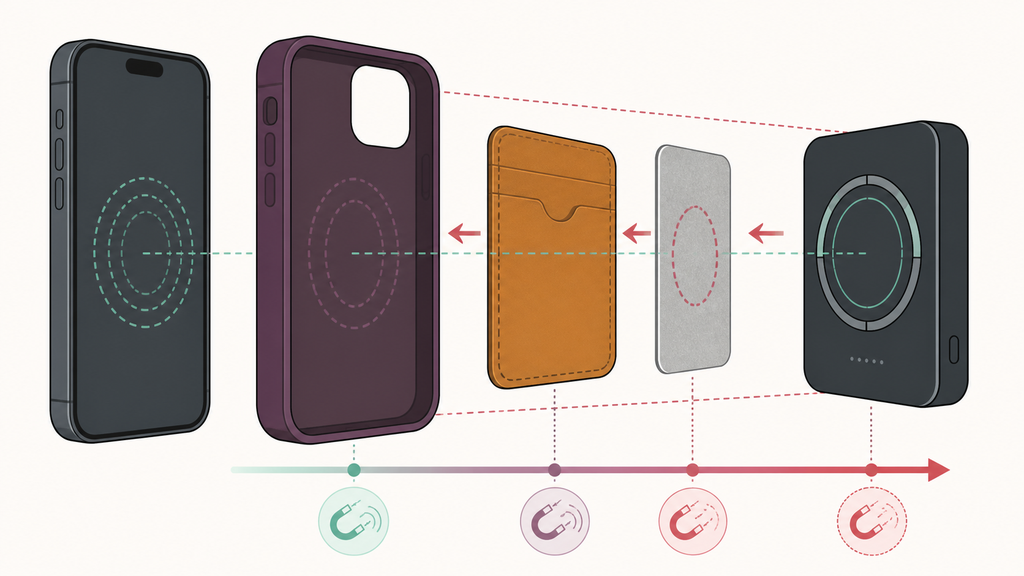
The case is often the hidden variable. A bare phone may hold well. The same phone with a thick case may slide. A magnetic case may help, but only if the ring position matches the phone and charger design.
Apple explains that MagSafe and magnetic accessories use aligned magnets to attach accessories and support wireless charging.2 The principle is simple: alignment makes the system more predictable. But users can break that predictability with the wrong case, metal plate, wallet accessory, or ring grip.
| Case condition | Effect on magnetic power bank | Advice |
|---|---|---|
| Thin magnetic case | Usually better | Test with target phones |
| Thick rugged case | Weaker hold | Avoid broad claims |
| Metal plate case | Charging conflict | Warn users |
| Wallet case | Gap and object risk | Remove before charging |
| Misaligned ring | Heat or weak charging | Reject case compatibility claim |
Wireless charging also has thermal implications. If the power bank attaches poorly, the coils may be off center. Poor alignment can create heat and slow charging. The user may think the battery pack is defective, while the real cause is a case alignment issue.
Brands should be careful with the phrase “MagSafe compatible” or “Qi2 compatible.” These words carry expectations. If the product is not certified or does not support the claimed behavior, the listing can create trust problems. The WPC maintains the Qi ecosystem and certification program, so buyers should understand what they can claim.1
From a manufacturing viewpoint, magnet placement must be controlled tightly. A small tooling shift can reduce both hold and charging alignment. During mass production, the inspection process should include magnet polarity, ring location, charging coil location, and shell assembly accuracy.
The support team should ask users about the case immediately. Did the product work without the case? Is the case magnetic? Does the phone have a metal plate for a car mount? Does the camera bump prevent flat contact? These questions solve many complaints quickly.
For private-label brands, I recommend making the case limitation visible on the product page and manual. Users are less frustrated when the limits are clear before purchase. They are more frustrated when a product promises universal magnetic hold and then falls off during normal use.
What Should Buyers Check Before Sourcing Magnetic Power Banks?
Buyers should check magnet layout, pull force, case compatibility, charging alignment, temperature, weight, surface grip, and certification claims.
Before sourcing magnetic power banks, buyers should test magnetic hold with real phones and cases, verify coil alignment, measure charging heat, balance capacity with weight, check magnet polarity, and confirm whether Qi or Qi2 claims are supported by real documentation.
A magnetic power bank has more design interactions than a standard power bank. It must store energy, convert power, wirelessly charge, attach securely, avoid overheating, and still feel comfortable behind a phone. That is a lot to ask from a compact product.
I like to start with a use-case decision. Is the product for desk charging, travel backup, retail bundles, or premium phone accessories? A slim 5,000mAh pack may feel better for handheld use. A 10,000mAh pack may be better for travel but harder to keep attached.
| Buyer check | Why it matters |
|---|---|
| Magnet polarity | Prevents reversed or weak attachment |
| Coil alignment | Reduces heat and charging failure |
| Weight balance | Improves handheld comfort |
| Case test matrix | Reduces returns |
| Thermal test | Protects user experience |
Battery safety still matters. A magnetic wireless power bank combines lithium cells and wireless charging heat in a thin housing. The U.S. Consumer Product Safety Commission warns that lithium-ion batteries can present fire and injury risks when damaged, overheated, or poorly handled.3 Buyers should take thermal design seriously.
Certification planning should happen early. Depending on the target market and claims, a magnetic wireless power bank may need battery transport documents, safety testing, EMC or RF compliance, and Qi or Qi2 certification review. These are not details to add after packaging is printed.
Sample testing should include real charging sessions. Attach the power bank to a phone, charge under different battery levels, check surface temperature, move the phone, and test with common cases. The product should not only charge on a lab bench. It should survive the way users actually hold it.
EverGreat often helps customers decide the balance between capacity, thickness, magnet feel, and certification cost. A stronger specification may cost more, but weak magnetic performance can cost more later through returns and bad reviews.
For brands, the best product page is specific. Say which phone types and cases work best. Explain that thick, non-magnetic, wallet, or metal cases may interfere. A clear limit is better than a broad promise.
Conclusion
Magnetic power banks fail when alignment, case thickness, weight, grip, or claims are wrong. Test the full phone-case-product system.
-
The Wireless Power Consortium explains Qi2 and certification through its official Qi wireless charging resources. ↩ ↩
-
Apple explains MagSafe accessory behavior in its MagSafe accessory guidance. ↩
-
The U.S. Consumer Product Safety Commission provides lithium-ion battery safety guidance through its battery safety resources. ↩