Many buyers choose the biggest wattage number, then discover higher cost, more heat, or users who cannot feel the difference.
For phones, 20W-30W is enough for many users. Tablets often need 30W-45W. Small laptops may need 45W-65W, while larger laptops may need 100W or more. The right wattage depends on device support, USB-C PD design, battery capacity, cable rating, and heat control.
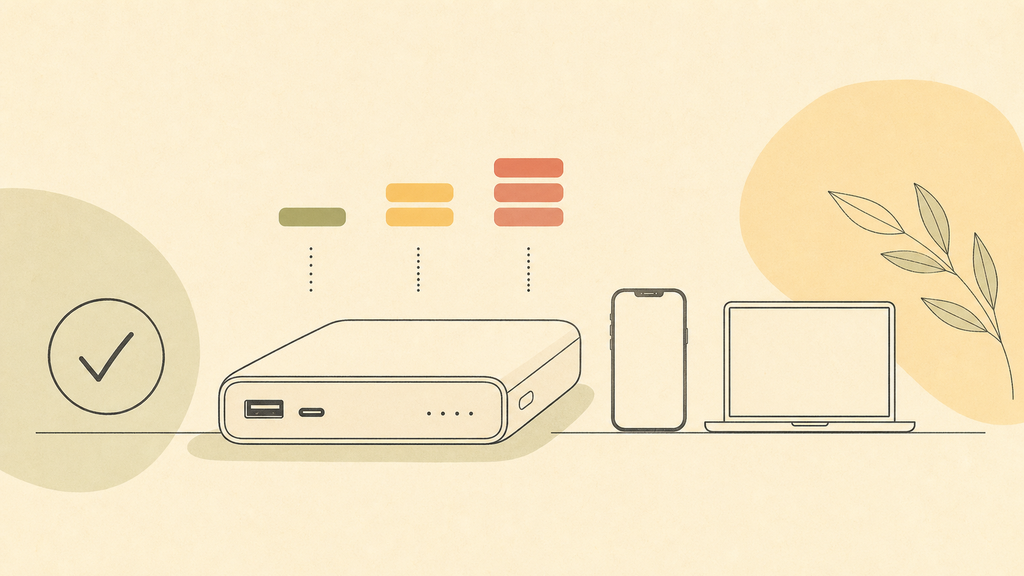
Power bank wattage looks simple on a product page, but it is really a product-positioning decision. If you are sourcing for a retail line, private-label project, promotional gift, or travel accessory range, the best wattage is not always the highest one. It is the wattage your target users can actually use, at a cost and reliability level your brand can support.
What Wattage Is Enough For Phones, Tablets, And Laptops?
Customers often ask for a "fast charging power bank" without defining the device. That makes supplier comparison messy and risky.
Phones are usually well served by 20W-30W, tablets by 30W-45W, and many USB-C laptops by 45W-65W. Higher-performance laptops may require 100W or above. Always match wattage to the device class, charging protocol, and expected user scenario.
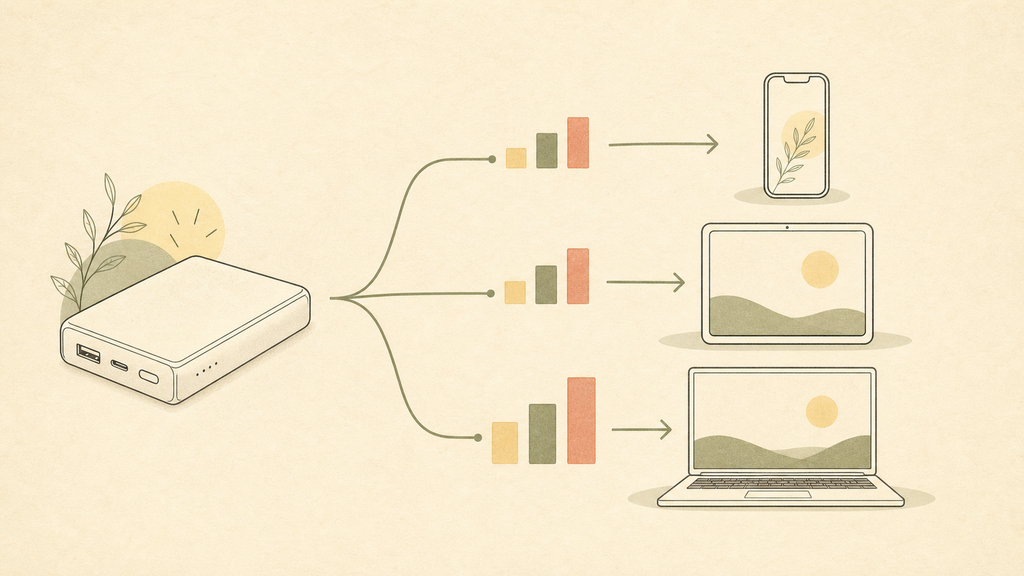
The first mistake is treating wattage as a universal speed label. It is not. Wattage is power: volts multiplied by amps. A power bank can advertise 65W, but a phone will only draw the level it supports through the charging protocol and cable. USB Power Delivery is designed for negotiated charging between the charger, cable, and device, and the USB-IF now describes USB PD as supporting up to 240W in the broader specification ecosystem.1 That does not mean every power bank should be 240W. It means the product system must be designed and tested for the power level it claims.
For many iPhone users, a 20W-class USB-C power source is already enough to enable fast charging on supported models, according to Apple’s own guidance.2 In the Android market, some devices support higher proprietary charging speeds, but that often depends on brand-specific protocols. If your product is meant to be widely compatible across phones, 20W-30W USB-C PD is still a practical mainstream range.
Tablets sit in the middle. A compact tablet may charge acceptably at 20W, but larger tablets and professional-use tablets feel better with 30W-45W. Laptops are where the decision becomes more serious. A thin office laptop may charge slowly at 30W, work normally around 45W, and perform better at 65W. A larger laptop may need 100W or more to avoid battery drain during use.
| Target device | Practical output range | Best fit |
|---|---|---|
| Smartphones | 20W-30W | Daily carry, retail accessories, gifts |
| Tablets | 30W-45W | Education, business travel, family use |
| Small USB-C laptops | 45W-65W | Office work, remote work, travel |
| Higher-power laptops | 100W+ | Professional users, heavier devices |
In my experience, the right question is not "Can we make it higher wattage?" The better question is "Which device experience are we promising?" A 10,000mAh 20W model can be excellent for a phone-focused product line. A 20,000mAh 65W model can be better for travel and office users. A 100W model needs stronger cells, thermal control, cable planning, and a customer who understands why it costs more.
For B2B buyers, I usually recommend building a wattage ladder instead of one universal product. For example, a brand can offer a 20W compact model for daily phone users, a 45W model for mixed phone and tablet use, and a 65W or 100W model for laptop users. This makes the range easier to explain, easier to price, and easier for customers to choose.
Is Higher Wattage Always Better For A Power Bank?
Higher wattage sounds premium, but it can create cost and reliability problems if the product is not designed around it.
Higher wattage is not always better. It can increase heat, component cost, cell requirements, cable requirements, and testing complexity. A device only draws the power it supports, so unused wattage may add cost without improving the real charging experience.
A 100W power bank is not just a 20W power bank with a bigger number printed on the box. The internal cell configuration, battery management system, USB-C controller, MOSFETs, inductors, PCB layout, enclosure design, and firmware behavior all matter. At higher output, small design weaknesses become easier to expose. Heat is one of the most common issues. A product may pass a simple charging test on a desk, but behave differently inside a bag, in a warm room, or during simultaneous charging and discharging.
There is also an efficiency tradeoff. Higher voltage conversion can be efficient when the circuit is well designed, but no conversion is perfect. If the user charges a phone that only needs 20W from a 100W-capable power bank, the device will not magically charge four or five times faster. The phone negotiates its own power level. The extra capability may still be useful for a laptop user, but it is wasted for a phone-only audience.
Capacity must also match the wattage promise. A low-capacity, high-wattage product can look exciting on paper but disappoint in use. For example, a small 5,000mAh power bank with a high output rating may not deliver that high output for long before voltage, temperature, or battery protection limits become visible. A 20,000mAh 65W model usually makes more sense for laptop travel because the capacity better supports the use case.
Air travel is another practical constraint. In the United States, the FAA explains lithium battery limits in watt-hours, and spare lithium batteries, including power banks, must be carried in carry-on baggage rather than checked baggage.3 For most consumer power banks, 100Wh is an important design boundary for travel-friendly products. This is why many travel power banks stay around 20,000mAh-27,000mAh depending on cell voltage and labeling method.
From a manufacturing perspective, higher wattage also changes quality control. A 20W model may need standard temperature, port, and cycling checks. A 65W or 100W model needs more attention to sustained-load testing, port-sharing behavior, cable compatibility, enclosure temperature, input charging heat, and protection recovery after faults.
| Higher wattage benefit | Hidden tradeoff |
|---|---|
| Supports laptops and premium positioning | Higher BOM cost and stricter component selection |
| Better for multi-device users | More complex power allocation between ports |
| Stronger retail claim | More heat and tougher reliability testing |
| Higher average selling price | Needs clearer user education and cable guidance |
I have seen buyers request 100W because competitors use it in listing titles. Sometimes that is the right move. But sometimes a clean 45W or 65W model with stable output, good temperature behavior, and honest capacity creates fewer after-sales problems and better reviews. The product should win in real use, not only in the specification table.
What Should Buyers Check Before Choosing Power Bank Wattage?
Choosing wattage too early can lock a project into the wrong cost, size, and certification direction.
Before choosing power bank wattage, buyers should define target devices, output wattage, input wattage, USB-C PD support, cable rating, capacity, heat performance, safety protections, travel limits, and test standards. The best specification starts from the user scenario, not from a competitor listing.

The most useful sourcing brief starts with the target user. Is the product for commuters who only charge phones? Is it for students with tablets? Is it for business travelers who carry USB-C laptops? Is it for a promotional campaign where price and logo area matter more than premium output? These questions change the correct wattage immediately.
Output wattage is only one side. Input wattage matters too. A 20,000mAh power bank with 65W output but slow input charging may frustrate users who expect the power bank itself to recharge quickly. For travel and office users, I often look at both output and input as part of the same experience. A balanced product might support 65W output and 45W or 65W input, depending on cost target and thermal design.
Cable rating is another common blind spot. A product can support high wattage, but if the included cable is not rated properly, the experience may fail or the power bank may not reach the advertised output. For a retail product, the cable, manual, packaging claim, and test report should all tell the same story. If the product says 100W, the accessory set and documentation should support that promise.
Buyers should also check how ports behave together. Many power banks advertise a maximum output from one USB-C port, but total output drops when two or three devices are connected. That is normal, but it must be clearly planned. A 65W single-port claim may become 45W plus 20W in dual-port use, or another allocation depending on the design. If your customers charge a laptop and phone together, this detail matters more than the headline number.
Here is a practical checklist I would use before confirming a power bank project:
| Checkpoint | Why it matters |
|---|---|
| Target devices | Prevents over-specification or under-performance |
| Output wattage | Defines charging speed and device category |
| Input wattage | Affects how quickly the power bank recharges |
| Capacity and Wh | Impacts runtime, size, cost, and airline positioning |
| USB-C PD profiles | Determines real compatibility with common devices |
| Cable rating | Protects the advertised wattage claim |
| Thermal test | Reduces overheating complaints and returns |
| Port-sharing logic | Clarifies multi-device charging behavior |
| Certification plan | Avoids late-stage compliance delays |
Battery care should not be ignored either. Apple notes that lithium-ion batteries are affected by factors such as temperature and charging habits.4 The same general idea applies to power bank design: heat control and responsible charging behavior help protect the user experience. A supplier should be able to explain temperature protection, over-current protection, short-circuit protection, and how the product behaves after a fault.
For EverGreat projects, we usually guide customers by working backward from the market channel. A supermarket accessory line may need simple 20W and 30W choices with strong packaging clarity. A consumer electronics distributor may need 45W and 65W models for a broader device mix. A premium travel brand may need 100W, but only if the enclosure, cell selection, cable, and testing plan support that positioning.
The best buying decision is rarely "choose the highest wattage we can afford." It is usually "choose the wattage our customer will understand, use, and trust." That approach creates cleaner product ranges, fewer support questions, and stronger repeat orders.
Conclusion
Choose power bank wattage by device, capacity, heat, cable, and use case. The best product is powerful enough, not unnecessarily overbuilt.
-
USB Implementers Forum, USB Charger (USB Power Delivery). ↩
-
Apple Support, Fast charge your iPhone. ↩
-
Federal Aviation Administration, PackSafe – Lithium Batteries. ↩
-
Apple, Batteries – Maximizing Performance. ↩