A small charger can create big trouble when power claims, heat control, and certificates do not match the real product.
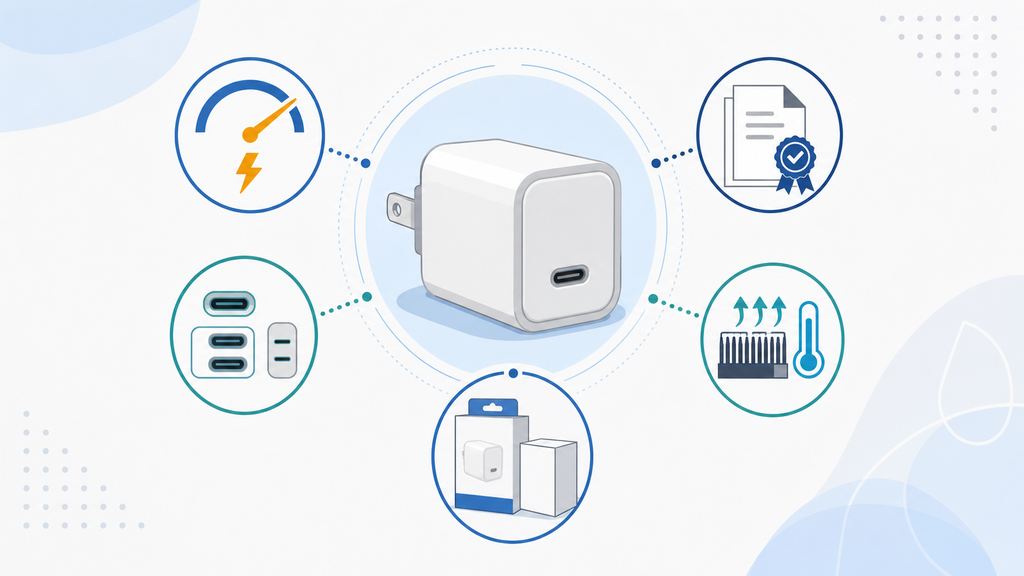
Importers should choose GaN wall chargers by matching power level, port mix, safety design, efficiency documents, and market certification before packaging or purchase orders are confirmed. GaN can support compact high-power designs, but the supplier’s engineering control matters more than the material name.
I often see buyers treat GaN as a simple upgrade word. The smarter question is whether the complete charger design can survive real customer use, retail review, and repeat orders.
What Power And Port Mix Should Buyers Choose?
Too much power raises cost, size, and heat, while too little power makes the charger hard to sell.
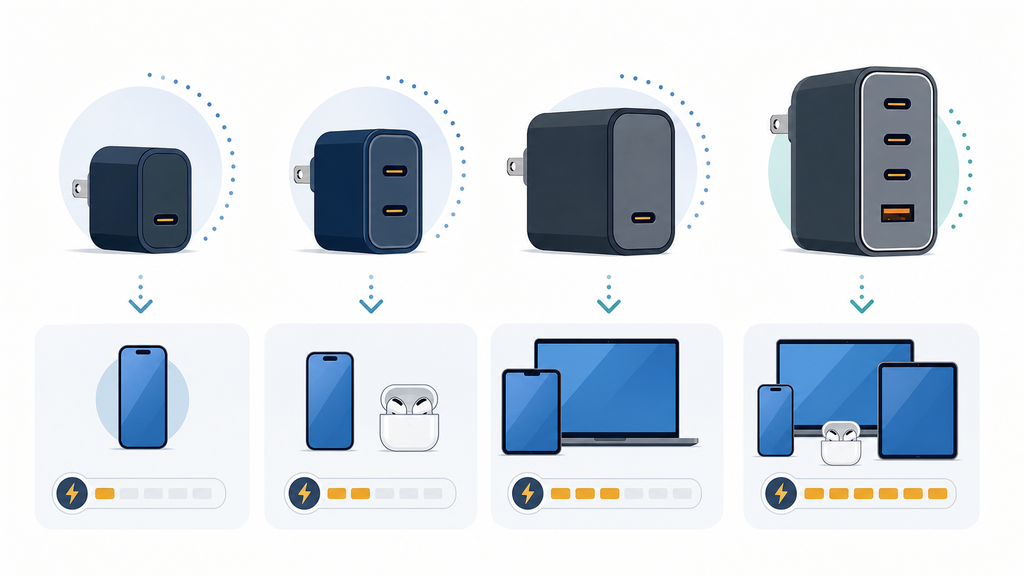
Buyers should choose power and port mix according to the target devices, retail price point, plug market, and customer use case. A 20W charger, 35W dual-port charger, 65W laptop charger, and 100W travel charger solve different buyer problems.
In my experience, the first mistake is choosing the highest wattage because it looks stronger on a product page. That can work for a premium laptop accessory, but it can fail for a promotional product, supermarket SKU, or basic phone bundle. Importers need to start with the actual user situation. Is the customer charging one phone at night? A phone and earbuds at a desk? A laptop, phone, and tablet during travel? Each case changes the best design.
GaN matters because gallium nitride is a wide-bandgap semiconductor material1. In practical charger design, that can help engineers build smaller and more efficient power conversion systems than older silicon-only designs. But GaN is not magic. Layout, transformer selection, thermal path, firmware, port negotiation, and housing design still decide the final result. I have seen customers ask for a tiny 100W charger because competitors show one online. After we discuss heat, plug strength, certification cost, and return risk, many choose 65W or 67W because it fits their channel better.
USB-C also changed buyer expectations. The official USB-IF program describes certified USB chargers under USB Power Delivery, including newer high-power ranges for suitable devices and cables through Certified USB Fast Charger and USB Power Delivery guidance2. This does not mean every private label charger should chase the maximum number. It means the supplier must understand PD profiles, PPS behavior, cable limits, and how ports share power when more than one device is connected.
| Buyer Scenario | Practical Power Choice | Main Tradeoff |
|---|---|---|
| Phone accessory bundle | 20W to 30W | Low cost, less differentiation |
| Desk or travel phone kit | 35W to 45W dual port | Better value, more port logic |
| Laptop and phone charger | 65W to 67W | Strong demand, higher heat control need |
| Premium travel charger | 100W or above | Strong headline, higher test and return risk |
The port mix should also match customer habits. A single USB-C port is simple and clean. A USB-C plus USB-A design can support older cables, but it may feel less future-ready in premium retail. Two USB-C ports can look modern, but buyers must check how the charger divides power. A 65W charger that becomes 45W plus 20W may be good. A charger that drops unpredictably may create customer complaints.
Before choosing a design, I suggest buyers ask three questions. What devices will customers charge most often? What retail price can the channel support? What will the packaging promise when two ports are used at the same time? These questions prevent a small specification decision from becoming a large after-sales problem.
Which Certifications And Documents Matter Before Shipment?
A charger can look ready for sale, yet still be blocked by missing reports, wrong labels, or weak market documents.
Importers should confirm safety certification, energy efficiency compliance, plug and label requirements, test reports, and shipment documents before mass production. The exact documents depend on the destination market and sales channel.
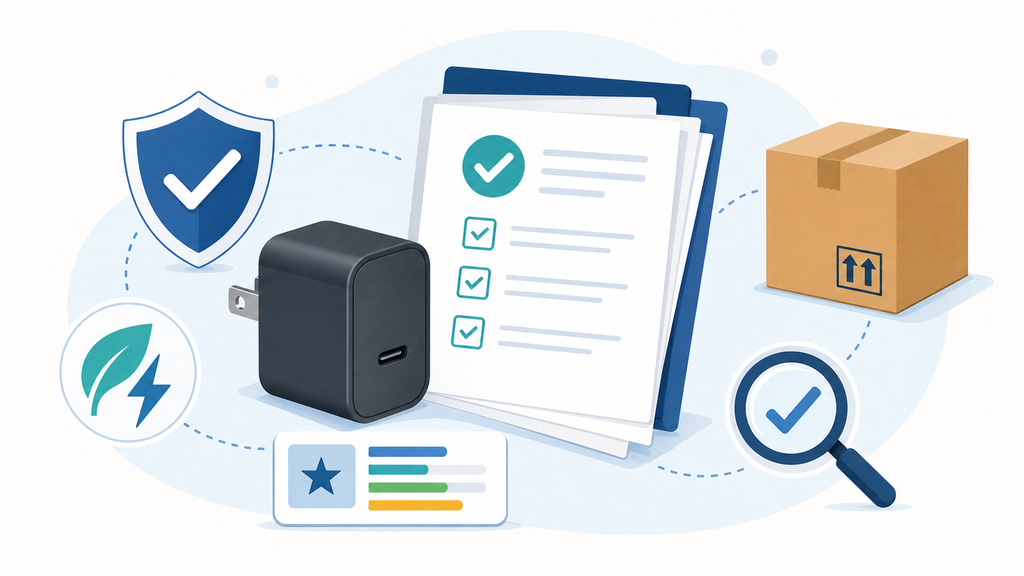
Many customers ask me whether one certificate is enough. Usually, the answer is no. A wall charger touches the AC mains, so safety review is more serious than for a simple cable. The required path depends on the destination country, plug type, product rating, sales channel, and retailer policy. For the United States, buyers often discuss UL or ETL safety paths and energy efficiency requirements. For the EU, buyers usually discuss CE, LVD, EMC, RoHS, ERP or external power supply efficiency, and now USB-C common-charger expectations for relevant device ecosystems.
The European market deserves special attention because buyers often confuse charger rules with device rules. The European Parliament explained that the EU common charger law requires USB-C for many portable electronic devices and applies from late 2024 for many categories, with laptops following later, under the common charger decision3. This does not turn every charger into the same product. It does push the market toward USB-C, clearer charging information, and less confusion for users. Importers selling chargers into Europe should make sure their product positioning, package wording, and technical documents do not conflict with the direction of the market.
Energy efficiency is another area buyers should not treat as a final checkbox. The U.S. Department of Energy maintains rules for external power supplies4, and many markets have similar efficiency or standby-power expectations. A private label charger that looks cheap at the quotation stage may become expensive if the efficiency design is weak, the test sample does not match mass production, or the nameplate rating is careless.
| Document Area | What Buyers Should Check | Why It Matters |
|---|---|---|
| Safety report | Model number, plug type, rating, factory information | Avoids using documents from a different product |
| Efficiency report | No-load power, active efficiency, tested configuration | Supports market access and retailer review |
| EMC testing | Real casing, cable, and PCB version | Reduces interference and approval risk |
| Label artwork | Input, output, certifications, warnings | Prevents customs, retailer, or platform rejection |
| BOM control | Key components, transformer, GaN IC, fuse, capacitor | Keeps mass production aligned with tested samples |
I have worked on projects where the sample looked excellent, but the documentation was not ready. That creates pressure because the buyer already designed packaging and promised a launch date. The better method is to confirm the certification path before final artwork. Ask the supplier which model has been tested, whether the private label version changes any electrical or mechanical details, and whether the factory can provide matching declarations and reports.
Buyers should also avoid vague phrases such as "CE available" or "UL standard design." These phrases can hide big differences. A real document package should connect the exact model, rating, plug, factory, and market. If a supplier cannot explain this clearly, the buyer should slow down.
How Can Buyers Reduce Heat, Return, And Compatibility Risk?
Customer returns often start from small gaps between marketing claims and real charging behavior.
Buyers can reduce risk by testing heat rise, port negotiation, multi-device charging, cable compatibility, plug strength, and long-run performance before mass production. The goal is not only passing certification, but preventing daily-use frustration.
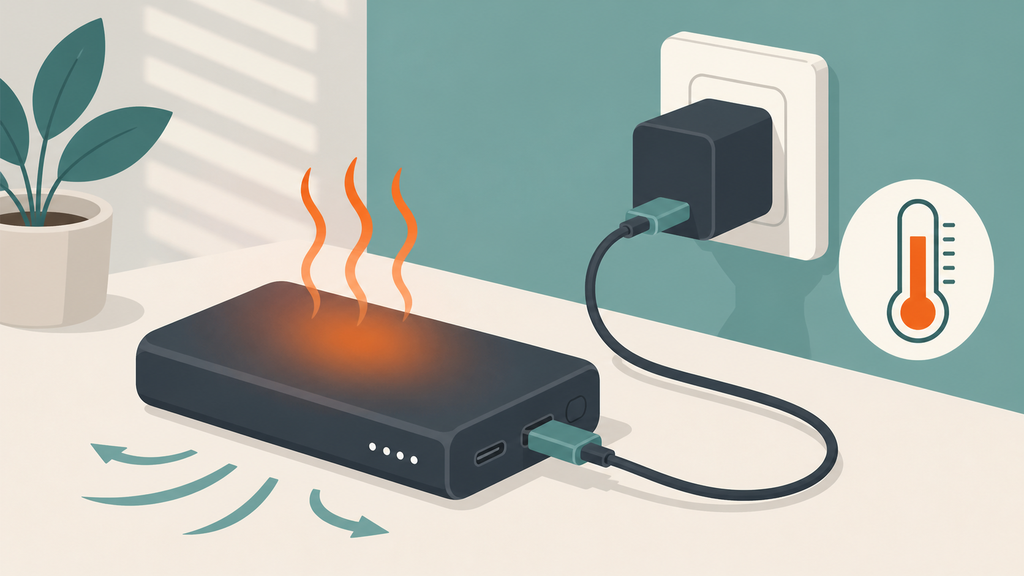
GaN chargers often sell because they are compact. That creates a useful benefit, but it also creates buyer risk. A smaller case has less room to move heat. A high-power charger may pass a short sample check and still feel too hot in a customer’s hand after heavy use. Buyers should not only ask whether the charger passed safety testing. They should ask how it behaves during a two-hour laptop charge, during dual-port use, inside a hot room, and after many plug-in cycles.
I often find that return risk comes from unclear compatibility. A buyer may advertise "fast charge for laptop and phone" but use a port-sharing design that cannot support the expected laptop power when a phone is also connected. Another buyer may choose a charger with PPS support but fail to explain that real charging speed also depends on the phone model, cable, battery level, and temperature. These are not supplier tricks. They are normal limits of charging systems. The problem starts when packaging promises more than the product can deliver.
Private label buyers should build a small test plan before confirming the order. Test with the actual cables customers will use. Test with common phones, tablets, earbuds, power banks, and laptops in the target region. Check the surface temperature after sustained charging. Check whether the charger resets when a second device is plugged in. Check whether the plug feels stable in the wall. Check whether the plastic housing, ultrasonic welding, and pin assembly feel strong enough for the retail price.
| Risk | Practical Test | Buyer Decision |
|---|---|---|
| Heat complaints | Run full-load and dual-port tests in realistic room temperature | Adjust size, power, or thermal design |
| Slow charging complaints | Test target devices with supplied or common cables | Improve claims and package wording |
| Laptop incompatibility | Test PD profiles with real laptops | Change power level or product positioning |
| Plug damage | Repeat insertion and basic drop handling checks | Improve mechanical structure |
| Retail rejection | Review documents before packaging print | Fix labels before mass production |
Manufacturing control matters as much as sample performance. I want to know whether the supplier locks the BOM, how incoming key components are inspected, and whether the production line checks output voltage, load behavior, insulation, and appearance. A charger is not only an electronic board. It is a mains product used by ordinary people every day. Small changes in components, soldering, housing material, or assembly can affect safety and user confidence.
For EverGreat projects, I prefer to discuss the commercial plan before the charger model is chosen. A distributor may need a reliable 65W SKU with strong documents and stable supply. A promotional company may need a lower-wattage model with clean branding and fast delivery. A premium brand may need a compact multi-port GaN charger with more testing, better packaging, and stricter sample approval. The right product is the one that matches the buyer’s channel, not only the strongest number on the specification sheet.
Conclusion
Choose GaN chargers by matching real use, verified documents, thermal design, and honest claims before mass production starts.
-
This source supports the basic material background for GaN as a wide-bandgap semiconductor. ↩
-
This official USB-IF page supports the discussion of USB Power Delivery, certified chargers, and higher-power USB-C charging. ↩
-
This official EU legislative news source supports the market context around USB-C common charger rules. ↩
-
This U.S. Department of Energy page supports the point that external power supplies can be subject to energy conservation requirements. ↩