Pass-through charging sounds convenient, but many users do not know when it is safe. The wrong product can overheat, slow down, or age faster.
You can charge a power bank while using it only if the power bank supports pass-through charging. Even then, it may charge slower and run warmer. Use a quality charger and cable, keep it in open air, and stop if the power bank becomes hot, unstable, swollen, or smells unusual.
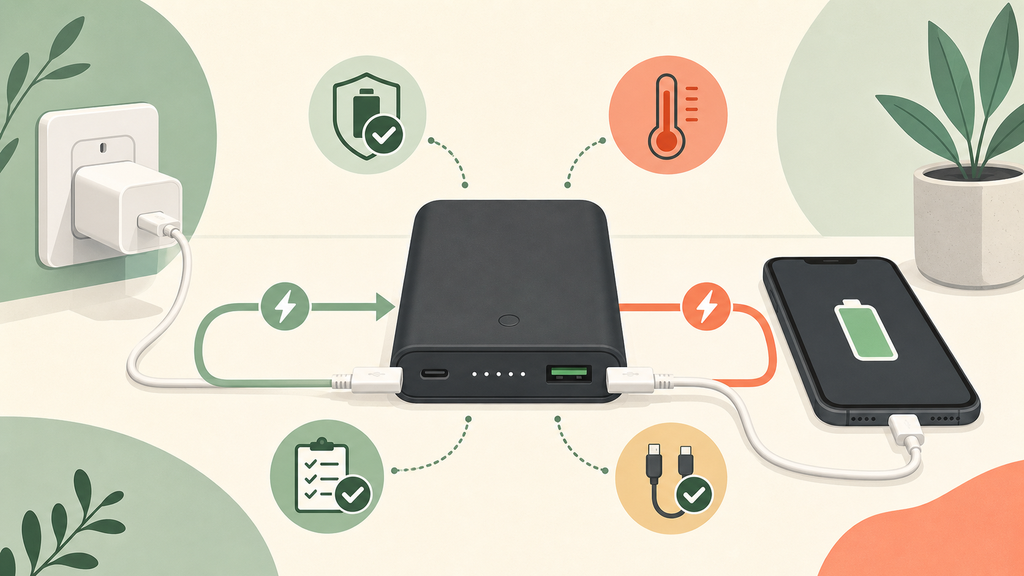
Many customers ask this before travel, camping, trade shows, and emergency kits. The real question is not whether a power bank can pass energy through. It is whether the product is designed and tested to do it safely.
What Is Pass-Through Charging On A Power Bank?
Users often assume every power bank can charge and discharge at the same time. That assumption creates heat complaints, slow charging, and product returns.
Pass-through charging means a power bank can receive power from a wall charger while also sending power to another device. It requires proper circuit design, thermal control, power allocation, and protection logic.
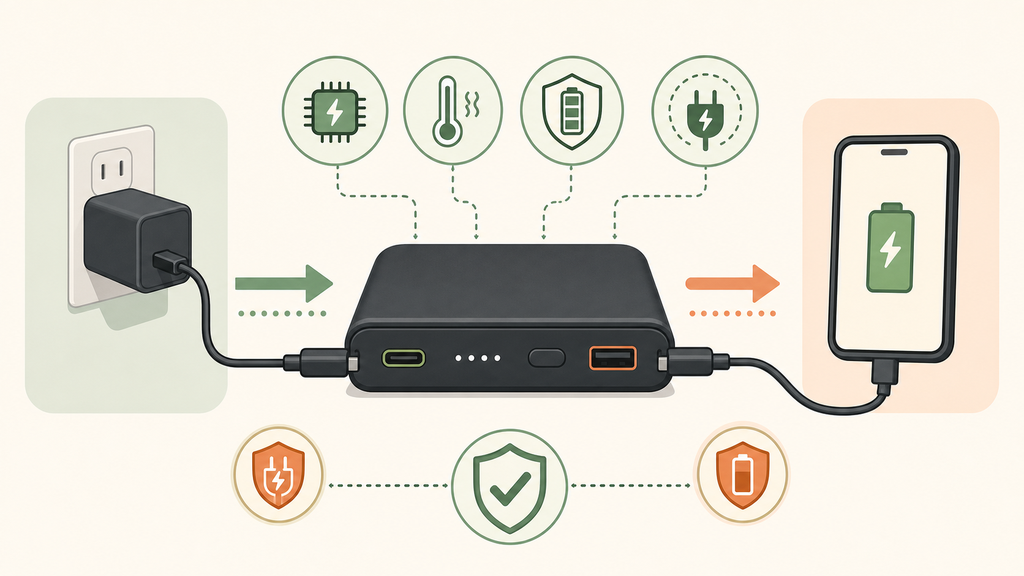
In a normal power bank, energy flows in one direction at a time. The power bank charges its internal battery, or it discharges energy to a phone, tablet, speaker, or other device. Pass-through charging adds a more complex power path. The input power must be managed while the output port also remains active.
This sounds simple from the outside. In engineering, it is not. The battery management system has to decide how much input power goes to the internal cells, how much goes to the connected phone, what happens when the phone requests fast charging, and when to reduce power because of heat. If the design is weak, the user may see charging interruptions, higher temperature, slower speed, or early battery wear.
USB Power Delivery is designed around negotiated power between devices, so USB-C products should not simply push uncontrolled wattage into the connected device.1 But negotiation alone is not the whole product. The power bank still needs a good charging IC, protection design, firmware logic, cell quality, port layout, and thermal structure.
| Charging Mode | What Happens | User Experience |
|---|---|---|
| Input only | Power bank battery charges | Usually stable and predictable |
| Output only | Power bank charges a device | Normal portable charging |
| Pass-through | Input and output work together | Convenient but warmer and slower |
| Unsupported pass-through | Output may stop during input | User thinks product is defective |
| Poorly designed pass-through | Heat or unstable charging | Higher complaint risk |
The biggest misunderstanding is that pass-through charging is not the same as a wall charger. A wall charger sends power directly to a phone. A pass-through power bank has an internal battery and power management circuit in the middle. That extra layer creates heat and efficiency loss.
I often find that customers want pass-through because it sounds like a premium feature. For some products, it is valuable. For others, it adds cost and risk without much user benefit. A small promotional power bank may not need pass-through. A travel power bank for hotel rooms, airport delays, or backup kits may benefit from it if the design is reliable.
For B2B buyers, the product page should be precise. Do not say “supports charging while charging” unless the exact model has been tested. Also explain limits: some power banks support pass-through only at low output power, only through specific ports, or only when using a charger above a certain wattage.
Clear wording prevents one of the most common support problems: users expect full-speed fast charging in every direction at the same time.
Is Pass-Through Charging Safe For Battery Health?
Pass-through charging can be safe, but heat is the deciding factor. If the power bank becomes hot, convenience is no longer worth the tradeoff.
Pass-through charging can add battery stress because the power bank is charging, discharging, and managing heat at the same time. Quality products reduce the risk with protection circuits, temperature control, and conservative power limits.
Apple explains that lithium-ion batteries work best within recommended temperature ranges and that extreme heat can permanently reduce battery capacity.2 The same general battery principle matters for power banks. Lithium-ion and lithium-polymer cells do not like unnecessary heat, especially when charging.
UL Research Institutes also emphasizes the importance of buying and using lithium-ion battery products carefully, including following manufacturer instructions and stopping use if a battery overheats, swells, or leaks.3 That warning is practical. Users should not treat a hot power bank as normal just because the percentage is still rising.
In manufacturing tests, pass-through charging should be checked under realistic conditions, not just once on a cool bench. I want to see behavior when the power bank is near empty, near full, connected to a fast charger, connected to a low-power charger, charging one phone, charging two devices, and sitting in a warm room. The product may pass one condition and fail another.
| Risk Factor | Why It Matters | Better Practice |
|---|---|---|
| Heat buildup | Speeds cell aging and can trigger protection | Keep the product uncovered |
| Weak charger input | Not enough power for input and output | Use a suitable wall charger |
| Poor cable | Voltage drop and connector heat | Use a rated cable |
| High output load | More conversion heat | Avoid gaming or heavy phone use |
| Full battery storage | Adds long-term stress | Avoid storing fully charged in heat |
| Cheap cell quality | Less margin under stress | Audit the cell supplier |
For everyday users, I would use pass-through only when it solves a real problem. It is useful at night in a hotel when one outlet must charge both the power bank and phone. It is useful during travel when you want one cable chain on a desk. It is less useful as a daily habit if you have enough outlets.
For brands, the question is not “Can we add pass-through?” It is “Can we support pass-through without creating heat complaints?” A good design may intentionally reduce output power while the battery is charging. That can feel slower, but it protects the product. If the manual explains this, users are less likely to complain.
Battery health is always a tradeoff between convenience, heat, charge level, and cycles. Pass-through charging is not automatically bad, but it should be used with a product designed for it.
What Should Buyers Check Before Choosing A Pass-Through Power Bank?
The supplier sample may look fine in one short demo. The real test is whether it behaves well across chargers, cables, temperatures, and user habits.
Buyers should check whether pass-through charging is officially supported, which ports work, what input and output limits apply, how hot the shell gets, which cells are used, and whether the supplier can provide safety, transport, and performance test data.
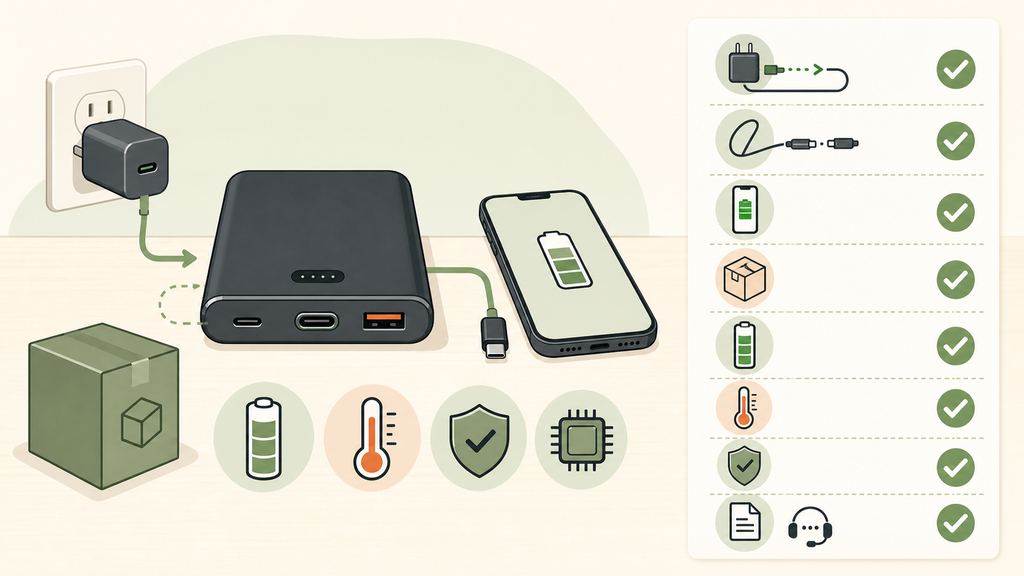
Airline and transport rules also matter for power banks. The FAA says spare lithium batteries and power banks must be carried in carry-on baggage, not checked baggage, and lithium-ion batteries are generally limited by watt-hour ratings.4 For brands selling travel power banks, capacity, labeling, and documentation are not optional details.
In my experience, pass-through projects need a tighter specification than standard power banks. The buyer should define the target use case first. Is the product for travel retail, outdoor backup, school programs, promotional gifts, or high-end electronics channels? A pass-through feature that makes sense for a 20,000mAh travel model may not make sense for a low-cost giveaway.
| Buyer Check | What To Ask Supplier | Why It Matters |
|---|---|---|
| Official support | Does this exact model support pass-through? | Avoids false listing claims |
| Port behavior | Which input and output ports work together? | Prevents user confusion |
| Power limits | What is max input and output during pass-through? | Sets speed expectations |
| Temperature | What is shell temperature under load? | Reduces safety complaints |
| Cell supplier | What cells are used and documented? | Protects quality consistency |
| Protection design | What happens under overload or short circuit? | Reduces fault risk |
| Transport docs | Are UN38.3 and shipping documents ready? | Supports logistics |
The most common mistake is testing only with one phone and one charger. Real users mix accessories. They use old wall chargers, long cables, laptop adapters, car chargers, and multi-port hubs. If the power bank behaves unpredictably with common combinations, support costs rise.
Another mistake is overselling simultaneous fast charging. A power bank may support 30W output alone but reduce output during pass-through. That is not necessarily a defect. It may be a smart thermal decision. The product page should say this plainly.
I also suggest checking the user interface. When input and output are active, can the user understand what is happening? Does the indicator show charging status clearly? Does the power bank restart if the phone disconnects? Does it stop output when the internal battery is too low? These small behaviors shape customer reviews.
EverGreat often helps customers decide whether pass-through belongs in the product roadmap at all. Sometimes the best answer is a simpler power bank with better cells and clearer labeling. Sometimes the right answer is a higher-quality travel model with conservative pass-through limits and stronger testing.
The best pass-through power bank is not the one that promises the biggest numbers. It is the one that keeps charging predictable, cool, documented, and easy for users to understand.
Conclusion
Use pass-through charging only on supported power banks. Test heat, ports, chargers, cables, and documentation before turning convenience into a product promise.
-
USB Implementers Forum, USB Charger (USB Power Delivery). ↩
-
Apple, Batteries – Maximizing Performance. ↩
-
UL Research Institutes, Lithium-Ion Battery Safety. ↩
-
Federal Aviation Administration, PackSafe – Lithium Batteries. ↩