Wireless charging feels convenient, but many users worry that the extra heat will quietly damage their phone battery.
Wireless charging is not automatically bad for your battery, but excessive heat can speed up battery aging. A good wireless charger, proper alignment, a suitable adapter, and a thin case help reduce heat and make wireless charging safer for daily use.

The real question is not whether wireless charging is good or bad in a simple way. The better question is when it creates too much heat, how users can reduce that heat, and how brands should design wireless chargers that customers can trust.
Why Does Wireless Charging Create More Heat?
Wireless charging transfers power through coils, so it is less direct than plugging in a cable.
Wireless charging creates more heat because energy transfers through electromagnetic coupling between coils instead of direct metal contact. Misalignment, thick cases, weak adapters, foreign objects, and poor charger design can increase power loss and heat during charging.

A wired charger sends power through a cable and connector. A wireless charger sends power from a transmitting coil in the pad to a receiving coil in the phone. That process is convenient, but it is more sensitive to distance and alignment. If the coils are not centered, more energy can be lost as heat.
This is why some users notice that their phone feels warmer on a wireless pad than on a cable. Some warmth is normal. The concern is excessive heat, repeated heat, or heat caused by poor placement. Apple explains that iPhone may get slightly warmer while charging wirelessly, and charging can be limited above certain temperatures to protect the battery.1
Case design matters. A slim plastic case may be fine. A thick rugged case, metal plate, wallet case, ring stand, or magnetic accessory can increase distance or interfere with charging. The user may think the charger is slow, but the real problem may be that the phone and coil are separated by too much material.
Qi2 and magnetic alignment exist partly because placement matters. The Wireless Power Consortium says Qi2 uses a magnetic power profile to improve alignment and charging efficiency.2 Better alignment does not make heat disappear, but it can reduce one common cause of energy loss.
| Cause of heat | What happens | Practical check |
|---|---|---|
| Misalignment | Energy transfer becomes inefficient | Recenter the phone |
| Thick case | Distance between coils increases | Remove or change the case |
| Metal accessory | Charger may pause or heat | Remove metal plates or rings |
| Weak adapter | Charger may work unstably | Use the recommended adapter |
| Poor design | Heat rises too quickly | Choose a tested charger |
In manufacturing, this is why I pay attention to more than rated wattage. A 15W wireless charger with poor coil design can create more frustration than a lower-watt charger with stable alignment and good thermal behavior. Real comfort depends on the complete system.
For brands, heat is not only a technical topic. It affects reviews. A customer may write "this charger gets hot" even if the product is still within a safe limit. Clear instructions, better alignment, and realistic power claims reduce that complaint.
Does Wireless Charging Shorten Battery Life?
Battery aging is mostly about chemistry, cycles, time, state of charge, and temperature.
Wireless charging can shorten battery life faster if it causes frequent high heat, but normal wireless charging with a well-designed charger should not damage the battery immediately. Heat management matters more than the word wireless.
Apple explains that lithium-ion batteries are affected by chemical age, charge cycles, and temperature, and that avoiding extreme ambient temperatures helps protect battery performance.3 This applies to both wired and wireless charging. Heat is the shared enemy.
Wireless charging may create more heat in some situations. The phone may sit on a pad for many hours. The phone may be inside a thick case. The charger may be on a bedside table under a blanket. The user may stream video or run navigation while charging. These habits matter as much as the charging method.
It is also important not to exaggerate. A phone battery is a consumable part. It will age whether the user charges by cable or wirelessly. A good wireless charger does not instantly ruin the battery. The risk is gradual aging from repeated heat and poor charging habits.
| Habit | Battery impact | Better choice |
|---|---|---|
| Wireless charging with good alignment | Usually acceptable | Keep phone centered |
| Charging through thick case | More heat risk | Use a compatible case |
| Charging under pillow or blanket | High heat risk | Keep charger ventilated |
| Gaming while wirelessly charging | More heat | Use wired charging or pause charging |
| Overnight wireless charging | Depends on heat and phone management | Use a stable certified charger |
I often see brands make the wrong promise. They say "fast wireless charging" and stop there. But customers care about comfort and battery health too. A product that charges slightly slower but stays cooler can create better long-term satisfaction.
For EverGreat wireless charger projects, I usually suggest testing phone temperature during long charging sessions. Test with a case. Test in a warm room. Test with the recommended adapter. Test with common phone models. These practical tests tell more than a single maximum-wattage claim.
Buyers should also think about product category. A bedside charger should be quiet, stable, and cool. A car wireless charger must handle sunlight and vibration. A foldable travel charger must manage coil placement across multiple devices. Battery health concerns change with each use case.
What Should Buyers Check Before Choosing Wireless Chargers?
The right wireless charger should protect the user experience, not only advertise wattage.
Buyers should check Qi or Qi2 compatibility, coil alignment, heat rise, foreign object detection, adapter requirements, case compatibility, charging stability, magnet strength, surface material, and clear user instructions before choosing wireless chargers.
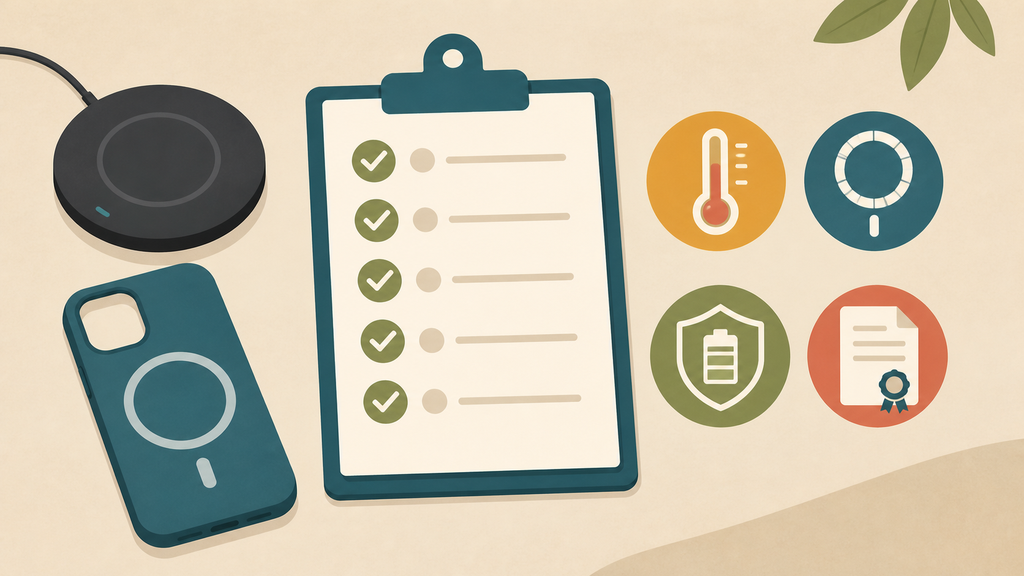
The first checkpoint is compatibility. If a product claims Qi, Qi2, magnetic charging, or fast wireless charging, the supplier should explain what phones were tested and what adapter was used. A claim without a test condition is incomplete.
The second checkpoint is heat rise. Buyers should not accept only "15W" or "fast charge" on a quote sheet. Ask how hot the phone and charger become during a full charging session. Ask what happens with a phone case. Ask whether charging pauses when the phone gets warm.
The third checkpoint is foreign object detection. Coins, keys, metal plates, or magnetic accessories can sit between the phone and charger. A good charger should react safely when abnormal metal objects are present. This protects users and reduces support risk.
The fourth checkpoint is instruction clarity. Many wireless charging problems are user behavior problems. If the manual says only "place phone on charger," it misses important points. The manual should mention alignment, case thickness, metal objects, adapter requirements, and ventilation.
| Buyer checkpoint | What to ask supplier | Why it matters |
|---|---|---|
| Qi or Qi2 claim | Which standard and certification path? | Supports compatibility |
| Heat rise | What temperatures appear under load? | Protects battery confidence |
| Alignment tolerance | How easy is placement? | Reduces start-stop charging |
| Case testing | What thickness was tested? | Prevents real-use failures |
| FOD behavior | How does the charger react to metal? | Supports safety |
| Adapter requirement | What input is needed? | Prevents weak-power complaints |
I have worked with buyers who wanted the highest wattage first. After testing, some chose a more balanced model because it stayed cooler and worked better with common cases. That is a smart decision. The customer does not review the internal specification sheet. They review the daily experience.
EverGreat can support OEM and ODM wireless charger projects by helping buyers define target phones, power level, packaging claims, and test conditions before production. This is especially useful for startups because wireless charging looks simple but has many hidden compatibility details.
I also suggest keeping the sales promise simple. If a charger is designed for comfortable overnight use, do not market it like a maximum-speed charging station. If it is designed for fast magnetic charging, make sure the included instructions explain adapter requirements and case limits. The more honest the promise is, the fewer battery-health concerns customers bring to support.
The best wireless charger for battery confidence is stable, well-aligned, well-ventilated, and honest about its limits. It should make daily charging easier without making users worry every time the phone feels warm.
Conclusion
Wireless charging is not automatically bad for batteries. Excessive heat is the real concern, so choose aligned, tested, and well-documented chargers.
-
Apple Support, How to wirelessly charge your iPhone. ↩
-
Wireless Power Consortium, Qi Wireless Charging. ↩
-
Apple, Batteries – Maximizing Performance. ↩