Do you struggle with devices dying when you need them most? I certainly do. It is frustrating to run out of power on the go. Modern life demands more from our portable charging solutions.
No, 100W power banks are not high-end anymore; they are the new standard for portable charging. They provide necessary power for hungry laptops. They also recharge themselves very fast. This makes them essential for busy users who need quick, reliable power.
I remember a time when a 100W power bank felt like a luxury item, something only a few professionals might consider. However, the world of technology moves fast. What was once premium is now becoming expected. As our devices demand more, our charging solutions must keep pace. I have seen this shift firsthand in my daily work. The real question is not if you need one, but what kind of 100W power bank works best for you.
What devices require a 100W power bank?
Are your essential devices always running out of power? I face this all the time. Low power can stop your work or fun. You need enough power for your crucial tech.
Many modern devices need 100W power banks for optimal charging. This includes most USB-C laptops, high-end tablets, and some smartphones. These power banks ensure fast, stable power delivery.
When I think about power banks, I usually think about charging my phone. But today, the needs are much greater. My laptop is critical for my work, and it needs a lot of power. Many USB-C laptops today ask for 65W to 100W input for good charging. A 100W power bank delivers this power well. This means broad compatibility and stable performance. If your laptop needs 65W, a 60W power bank might work, but it might not be enough under heavy use. A 100W unit gives me peace of mind. It ensures my laptop charges fast and properly. Ultrabooks typically require between 45W and 65W, while gaming and workstation laptops can need between 90W and 240W. Using an underpowered charger can reduce battery charging speed and even CPU/GPU performance. High-performance tablets, like some iPad Pro models, also benefit hugely from higher wattage. The iPad Pro M4, for example, can utilize up to approximately 35W for charging. While it comes with a 20W charger, using a higher wattage charger (30W or greater) can improve charging speeds. Even some advanced smartphones with super-fast charging modes can use more power than standard banks offer. Some of the fastest charging smartphones include the Motorola Edge 50 Ultra (125W), OnePlus 13 (100W), and Realme GT 7 Pro (120W), although charging speeds can vary based on the region due to voltage differences. Using a 100W power bank means I am ready for almost any device I carry. It covers a wide range of gadgets. It also future-proofs my charging setup.
Why 100W is becoming the standard for portable charging?
Do you get tired of slow charging? I certainly do. Waiting hours for power is not practical. Fast power is now a necessity for everyone.
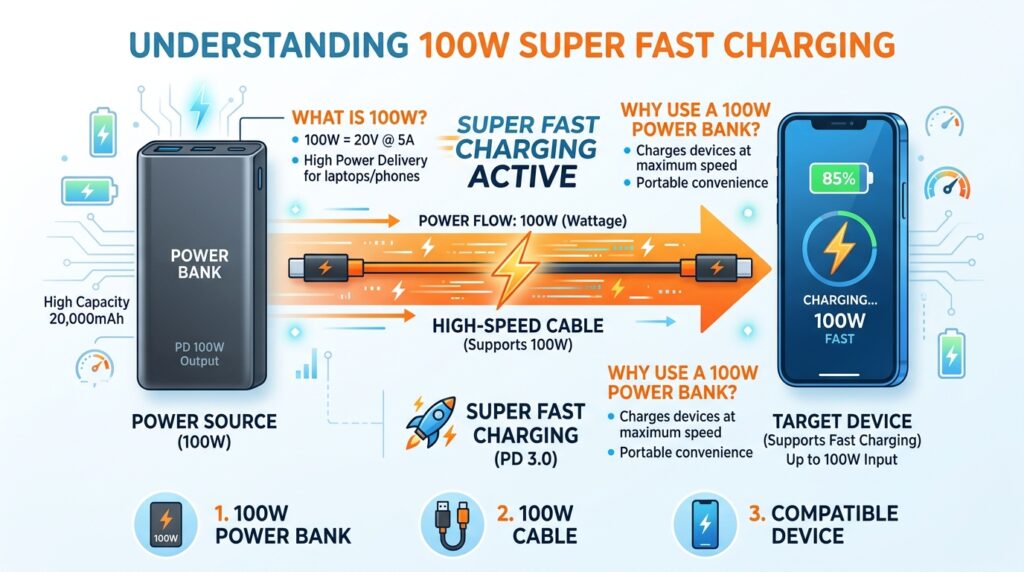
100W is becoming standard due to two main reasons. First, it powers high-demand devices like laptops efficiently. Second, it allows for significantly faster recharging of the power bank itself, saving valuable time.
The idea that 100W power banks are "high-end" is quickly fading away. I have seen how quickly things change. When 100W first came out, it felt like a special feature. This was because it could charge powerful devices like laptops. That is still true today. Many USB-C laptops need 65W to 100W power. A 100W power bank ensures wide device compatibility. It also gives steady performance. The global power bank market is projected to grow, driven by the increasing adoption of smartphones and other electronic devices, further solidifying the need for faster and more powerful charging solutions. One report projects the market to reach USD 31.97 billion by 2031, with a CAGR of 8.04%. But there is another big reason, and it is often missed. This is the dramatically faster recharging of the power bank itself. Older power banks could take many hours to recharge. They might only accept 18W or 30W input. With high-power USB-C input (often 60W–100W), a power bank recharges much faster. I have seen my own power bank go from nearly empty to full in a fraction of the time. This cuts down on waiting. It makes the product far more useful. Recharge times vary based on capacity, input rating, and charger. A 10,000mAh power bank can take 4-6 hours with a standard 10W charger, but only 3-4 hours with an 18W fast charger. A 20,000mAh power bank may need 8-12 hours with a standard charger, but 5-6 hours with a fast charger. Some premium power banks support 100W input and can recharge in around 2 hours. This is true for frequent travelers like me. It is also true for business users and anyone who relies on their power bank daily. The shift changes how we use these devices. A power bank is no longer something you plug in overnight. It becomes a device you can quickly top up. I can charge it between meetings, flights, or short breaks. So, 100W started as a "high-end" output. But now it is becoming a new baseline. It is not just for powering laptops. It gives a faster, more efficient, and more convenient charging experience overall. This shows me that users look for total charging efficiency. This includes how fast the power bank itself can be ready again.
What should you consider when choosing a 100W power bank?
Are you unsure what makes a good power bank? I sometimes feel overwhelmed by options. Picking the right one matters. You want a choice you will not regret making.
When choosing a 100W power bank, consider battery capacity, port types (USB-C PD), actual output/input wattage, safety features, and brand reliability. Look for models that offer fast self-recharging capabilities.
I have learned that not all 100W power banks are the same. When I choose one, I look for several key things. First, battery capacity is very important. This is measured in milliamp-hours (mAh) or watt-hours (Wh). A higher number means more charges for your devices. For a laptop, I usually want at least 20,000mAh. This ensures a full charge or more. Second, check the port types. USB-C Power Delivery (PD) is a must-have for 100W charging. It allows for high wattage output and input. Make sure it has at least one USB-C PD port that can deliver 100W output. Also, look at the input wattage. As I mentioned, fast self-recharging is a big benefit. A power bank that accepts 60W or 100W input will be ready much faster. This is better than one that only takes 30W. Third, safety features are non-negotiable for me. Good power banks have protection against overcharging, over-discharging, short circuits, and overheating. This keeps my devices and me safe. Look for certifications like UL (Underwriters Laboratories), CE (European Conformity), FCC (Federal Communications Commission), and RoHS (Restriction of Hazardous Substances). UL2056 is a dedicated safety standard for power banks. These certifications ensure the product has undergone rigorous safety testing to protect against overheating, electrical fires, and device damage. Fourth, consider the size and weight. A 100W power bank can be powerful, but it should still be portable enough for your needs. I prefer models that balance power with a compact design. Finally, brand reliability matters. I look for brands known for quality and good customer support. This gives me confidence in my purchase. Also remember to use high-wattage USB-C cables (rated for 100W or more) to ensure optimal charging speeds. Standard cables may only support up to 60W. Higher wattage chargers allow devices to charge faster, but only if the device can handle it, because the device and charger will negotiate a safe power level through USB Power Delivery (PD).
Conclusion
100W power banks are no longer premium; they are essential. They power demanding devices and recharge quickly. This makes them the new baseline for efficient portable charging.