USB-C should work both ways. When one side works and the other fails, the cable, port, or connector may be damaged.
A USB-C cable may only charge one way because of damaged connector pins, dirt in the port, poor cable construction, loose plug fit, or a faulty device port. True USB-C is reversible, so one-way charging is usually a sign of wear, contamination, or low-quality manufacturing.

I like this question because it exposes a common misunderstanding. USB-C is reversible in shape, but the internal contacts still need to be clean, aligned, and correctly wired.
Is USB-C Supposed To Charge In Both Directions?
Yes, USB-C plugs are designed to be reversible, so the cable should work in either orientation when everything is healthy.
USB-C is designed as a reversible connector, so a cable should normally charge no matter which side faces up. If it only works one way, check for lint, bent contacts, worn connectors, poor cable quality, or a damaged phone or charger port.

USB-C became popular partly because users no longer needed to think about plug direction. The connector shape allows insertion either way. The USB Implementers Forum manages USB specifications and compliance programs for USB products.1 In a properly made cable and healthy port, orientation should not decide whether charging works.
But reversible does not mean indestructible. A USB-C connector has multiple contacts inside a small shell. If some contacts are dirty, bent, worn, or poorly soldered, one orientation may still touch enough pins while the other orientation fails. The user sees a simple symptom: flip the plug and it works.
| Symptom | Likely cause | First check |
|---|---|---|
| Works only one side | Pin or contact issue | Inspect cable plug |
| Works after wiggling | Loose fit | Try another cable |
| Works in one device | Device port issue | Compare devices |
| Charges slowly one way | Poor contact | Clean port carefully |
| Disconnects often | Wear or dirt | Replace cable if needed |
Lint is a common cause. A phone lives in pockets and bags. Small debris can collect inside the port. The plug may not seat fully, so one orientation makes better contact than the other. Users should be careful when cleaning ports. They should not use metal objects that can damage contacts.
Cable quality also matters. Some low-cost cables look fine outside but use weak connectors, poor strain relief, or inconsistent soldering inside. A cable may pass a quick charge test at the factory, then fail after bending near the plug. This is why bend tests and insertion tests matter in manufacturing.
For brands, one-way charging complaints are painful because users rarely describe the issue technically. They may say “the cable is bad,” “the charger is broken,” or “my phone port is loose.” Support needs a troubleshooting path that separates cable, charger, and device port.
For users, the first step is simple. Try another cable with the same charger and phone. Then try the same cable with another device. If the problem follows the cable, replace it. If the problem follows the phone, inspect the port or seek service.
What Cable Defects Cause One-Way USB-C Charging?
One-way charging can come from poor soldering, damaged pins, weak connector shells, bad strain relief, or non-compliant cable design.
Cable defects that cause one-way USB-C charging include broken internal wires, poor connector soldering, damaged pins, weak plug shells, bad strain relief, and incorrect wiring. These problems can appear after repeated bending, pulling, pocket dust, or low-quality production.
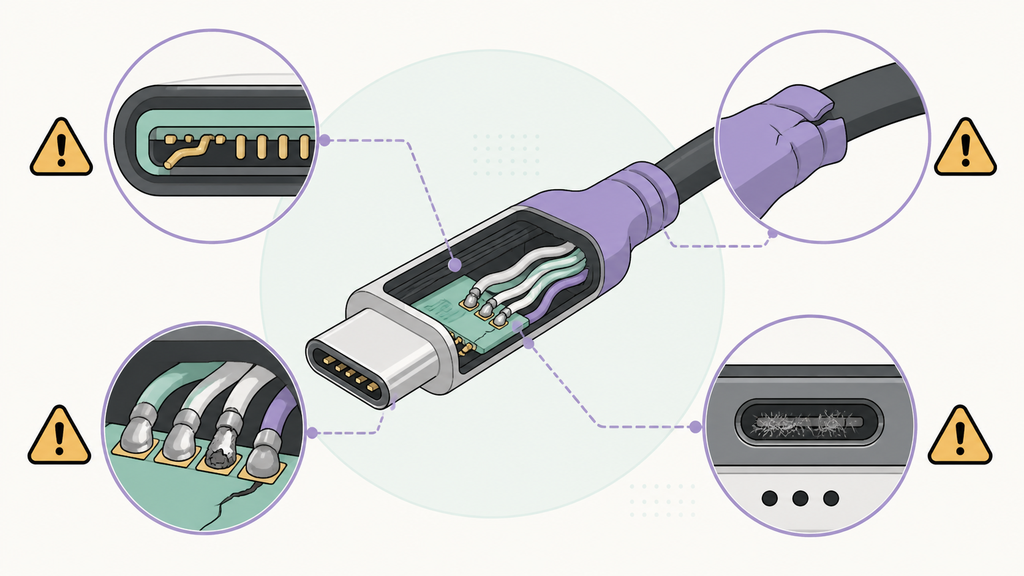
In manufacturing, I pay close attention to the plug end because that is where many failures begin. Users bend the cable near the connector. They pull it from the cable instead of the plug. They use it in cars, beds, offices, and travel bags. The plug area takes real abuse.
The internal structure decides how long the cable survives. Good strain relief spreads bending stress. Strong soldering keeps wires connected. Stable connector shells protect the pins. Poor design can fail even if the cable looks new.
| Defect | What users notice | Buyer prevention |
|---|---|---|
| Weak solder joint | Works at certain angles | Pull and bend testing |
| Bent contact | One-way charging | Connector inspection |
| Poor strain relief | Fails near plug | Flex cycle testing |
| Loose shell | Unstable connection | Mechanical fit control |
| Thin conductors | Slow or hot charging | Spec verification |
USB-C cable selection is more complicated than many buyers expect. Some cables are built only for basic charging. Some support higher current. Some include an e-marker for higher power levels. Some support fast data, and some do not. A user may judge all USB-C cables as the same because the connector shape looks the same.
For higher-power charging, cable design becomes more important. USB-IF explains certification and compliance resources for USB products.1 Brands should not rely only on printed wattage claims. They should ask for real test reports, material details, and sample validation.
Apple also warns that counterfeit or uncertified accessories may cause charging and connection problems.2 The warning is aimed at Apple accessories, but the principle applies broadly: a connector product can damage trust quickly when quality is poor.
I have seen buyers choose cheaper cable tooling because the outside appearance looked identical. The issue appeared later through higher return rates. The cost difference was small at purchase time, but the support cost was much larger.
The best prevention is not one test. It is a group of tests: insertion force, plug fit, bend cycles, continuity, charging load, temperature, and visual inspection. For private-label cables, packaging and cable appearance attract the sale. Connector reliability keeps the customer.
How Should Users And Brands Fix One-Way Charging Problems?
Users should isolate the faulty part, while brands should improve connector testing, cable sourcing, and support instructions.
To fix one-way USB-C charging, test another cable, charger, and device, inspect for lint or damage, and replace worn cables. Brands should add bend tests, plug-fit checks, continuity tests, and clear support steps before shipping private-label cables.
For users, I recommend a three-part test. First, use the same cable with another charger. Second, use the same cable with another phone or device. Third, use another cable with the original phone and charger. This quickly shows whether the cable, device port, or charger is most likely responsible.
Users should stop using a cable if it becomes hot, smells burnt, has exposed wires, or needs bending to work. Electrical safety groups advise users to avoid damaged cords and unsafe electrical conditions.3 A cable that only works when twisted is not a cable to trust.
For brands, the fix begins before launch. A cable should pass basic electrical tests and mechanical stress tests. It should also be tested with real chargers and phones, not only a lab fixture. USB-C behavior can vary when combined with different power adapters and devices.
| Action | User benefit | Brand benefit |
|---|---|---|
| Compare cable and device | Finds the faulty part | Reduces false returns |
| Clean port carefully | Restores contact | Low-cost support step |
| Replace damaged cable | Improves safety | Protects reputation |
| Test bend cycles | Prevents failures | Lowers return rate |
| Verify compliance | Supports claims | Reduces market risk |
Support language should be simple. Ask whether the cable works when flipped, whether it works with another device, whether the port has lint, whether the plug feels loose, and whether the cable has been bent near the connector. These questions help users without blaming them.
For B2B buyers, I would define cable expectations clearly. Is the cable for basic charging, fast charging, data transfer, or high-power laptop charging? A cable sold for a power bank bundle may not need the same data performance as a laptop cable, but it still needs reliable charging and safe construction.
EverGreat works with charging cables as part of broader charging solutions, so I see cable issues as part of the whole product experience. A good power bank can still get bad reviews if the included cable fails. A good wall charger can still look defective if the cable has poor contact.
The practical lesson is simple. USB-C solved plug direction for users, but it did not remove the need for good manufacturing. If a cable only charges one way, treat it as a warning. Test it, clean carefully, and replace it if the problem follows the cable.
Conclusion
USB-C should charge both ways. One-way charging usually points to dirt, wear, port damage, or poor cable construction.
-
USB-IF provides official information about USB standards and compliance through its compliance program resources. ↩ ↩
-
Apple explains risks from counterfeit or uncertified accessories in its accessory identification guidance. ↩
-
The Electrical Safety Foundation International provides home electrical safety guidance through its home safety resources. ↩