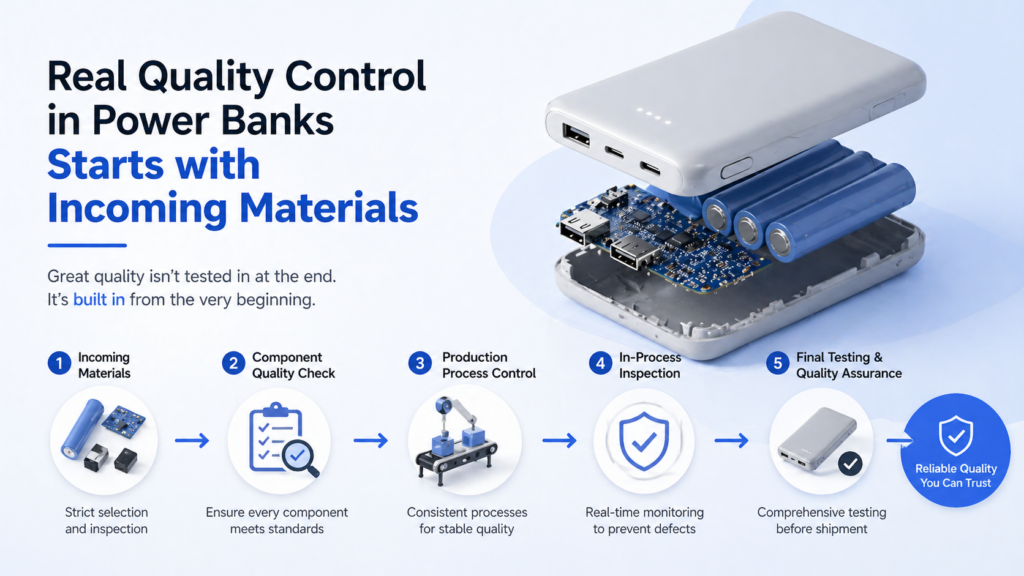
A successful prototype can still fail during scale-up when operators, fixtures, materials, test steps, and packaging have not been proven together.
A power bank pilot production run should include the approved design, production materials, trained operators, assembly instructions, test equipment, inspection limits, packaging, traceability, and a review of every defect and delay.

In my experience, the pilot run is where a product stops being a drawing and starts becoming a repeatable process. It should not be treated as a small commercial order or a ceremony before mass production. It is a controlled opportunity to discover what the factory and the product still need.
What Should Be Ready Before The Pilot Run Starts?
The pilot should begin with a controlled product definition so that the team is testing one agreed version instead of several moving targets.
Before the pilot, freeze the bill of materials, drawings, firmware, artwork, test requirements, packaging, approved suppliers, and change-control rules for the version being built.

Start with a pilot-readiness review. The product manager, engineering team, quality team, purchasing team, and factory should agree on what is being built and what remains open. An unresolved question is acceptable only when someone owns it and the pilot plan explains how it will be checked.
The bill of materials should identify the cell, protection board, controller, ports, display or indicators, enclosure parts, adhesive, cable, labels, and packaging. Include revision numbers and approved alternatives. A part described only as “equivalent” is difficult to control during a pilot.
Drawings should show critical dimensions, cosmetic surfaces, connector locations, screw positions, adhesive zones, and areas that must remain clear. For a power bank, the cell and circuit need special attention because small changes can affect fit, insulation, heat, and assembly sequence.
| Pilot input | What to confirm | Risk if it is missing |
|---|---|---|
| Bill of materials | Part numbers, revisions, and approved sources | Operators use unapproved components |
| Work instructions | Assembly order, torque, adhesive, and safety steps | Results depend on personal memory |
| Test specification | Equipment, conditions, limits, and records | Defects are judged inconsistently |
| Firmware | Version, settings, indicators, and recovery behavior | Software and hardware results diverge |
| Packaging | Inserts, labels, carton, and protection | Good products arrive damaged |
| Traceability | Batch, operator, material, and test records | Problems cannot be isolated |
| Open issues | Owner, due date, and decision rule | The same risk returns at mass production |
The team should prepare the line before materials arrive. Decide where cells are stored, how terminals are protected, how components are identified, and how defective units are isolated. Battery handling should be part of the work instruction, not an informal reminder.
Test equipment must be available and suitable for the product. Confirm calibration status, fixtures, cables, chargers, loads, meters, capacity testers, and data-recording methods. If a test depends on a specific device, name the device and keep it consistent across the pilot.
ISO 9001 describes a quality-management framework that includes planned and controlled operations, monitoring and measurement, documented information, and continual improvement.1 A pilot does not require every project to become bureaucratic, but it should produce enough evidence to show how the process performed.
Which Activities Should The Pilot Run Test?
The pilot should test the complete route from incoming materials to packed finished goods, including the points where defects are most likely to escape.
Run a representative quantity through receiving, kitting, assembly, firmware loading, charging tests, capacity checks, cosmetic inspection, labeling, packing, and final review using normal operators and equipment.

Use normal production conditions wherever possible. A senior engineer can assemble one perfect sample, but the pilot must show whether the documented method works for trained operators on the intended line. If the process needs a special expert every time, it is not ready.
Begin with incoming-material checks. Confirm cell identity, circuit revision, enclosure color, port fit, cable type, label content, and packaging parts. Record shortages and substitutions. A pilot is not useful when unapproved material is quietly mixed into the build.
During assembly, observe the sequence rather than only the finished unit. Check adhesive curing, screw tightening, cable routing, insulation, connector alignment, indicator placement, and enclosure closing force. Mark the operation where a defect is found. This helps the team fix the process instead of sorting everything at the end.
| Process stage | Pilot question | Evidence to collect |
|---|---|---|
| Kitting | Can the operator identify every part correctly? | Kit checklist and shortage record |
| Cell installation | Are terminals, insulation, and placement controlled? | Work record and sample photos |
| Board assembly | Are ports, wires, and fasteners repeatable? | First-piece approval and defect log |
| Firmware | Can the correct version be loaded and confirmed? | Version record and functional result |
| Electrical test | Do units meet input, output, and capacity limits? | Machine data and retest record |
| Cosmetic inspection | Are appearance limits clear? | Defect samples and acceptance guide |
| Packaging | Does the pack protect the product and accessories? | Pack-out audit and carton test |
Test more than the first and last unit. Sample across the run so that early setup, operator changes, material replenishment, and end-of-run fatigue are visible. Record the unit sequence, not just a final pass percentage.
The electrical test should match customer claims. Check charging, output, capacity basis, low-battery behavior, multiple outputs if applicable, and automatic shutoff or restart. Use the same cable, charger, load, temperature, and measurement method for comparable units.
Mechanical and cosmetic review should happen before packaging hides the evidence. Look for gaps, scratches, loose buttons, port misalignment, poor seams, trapped dust, and label errors. Keep representative defect samples so the team can agree on what is acceptable.
Packaging is part of the product. Confirm the unit, cable, manual, protective film, and labels fit the intended carton. Check whether the power bank can move inside the box, whether a stand or button can be pressed during transport, and whether the outer carton communicates the correct product claims.
How Should Brands Judge The Pilot Results?
The pilot result should lead to a clear decision: proceed, proceed with actions, repeat the pilot, or redesign before production.
Judge the pilot by yield, defect type, rework, test repeatability, cycle time, material shortages, operator feedback, packaging condition, and unresolved product risks—not by the number of units that eventually passed.
Separate product defects from process defects. A wrong capacity result may come from the circuit, the test setup, the cable, the load, or the operator’s method. A scratched enclosure may come from the material, the fixture, the work surface, or the packaging. The corrective action should target the cause, not only the symptom.
Create a defect Pareto for the run. Count missing parts, cosmetic failures, charging failures, assembly damage, software errors, label issues, and packaging problems separately. A small number of repeated causes often explains more risk than a long list of unrelated observations.
Review rework carefully. A unit that passes after a connector is reseated is not equivalent to a unit that passed first time. Record the rework step, time, responsible station, and whether the product needs additional inspection afterward.
| Result | Meaning | Recommended decision |
|---|---|---|
| Stable yield and repeatable tests | Process is understood | Proceed with routine controls |
| Good yield but repeated rework | Hidden process cost | Correct station before mass production |
| Test results vary by operator | Method or fixture is weak | Standardize and repeat testing |
| Material substitutions were needed | Supply plan is incomplete | Approve sources before launch |
| Cosmetic limits cause disputes | Standard is unclear | Create visual samples and training |
| Packaging damage appears | Protection is inadequate | Revise pack-out and re-test |
| Safety or thermal concern appears | Product risk remains open | Stop and redesign or investigate |
Traceability should connect a finished unit to its cell batch, circuit revision, operator or station, firmware, test result, and package. This does not need to be complicated, but it must be useful when a customer reports a problem months later.
Use the pilot to update the control plan. Add the checks that caught real issues, remove steps that created no useful evidence, and define who reviews abnormal results. If a change can affect safety, capacity, charging, compatibility, or transport, define when a new sample or test is required.
The final pilot review should include photographs, test data, defect samples, open actions, owners, deadlines, and a decision. “Looks good” is not a release record. The team should be able to explain why the process is ready and what controls will remain during mass production.
EverGreat uses pilot builds to connect product engineering with factory reality. The purpose is not to make the first batch look perfect. It is to expose repeatable problems while the buyer and manufacturer can still change the process at reasonable cost.
Conclusion
Use a power bank pilot to prove the full process, collect traceable evidence, fix root causes, and release mass production only when risks have owners and acceptance limits.
-
International Organization for Standardization, ISO 9001 quality management systems. ↩