EU charger rules are no longer a future headline. Brands that wait may face rushed redesigns, wrong labels, and avoidable channel delays.
Charger brands should prepare by aligning products with USB-C, USB Power Delivery, clear wattage labeling, charger-in-box decisions, and supplier documentation before 2026 laptop and high-power accessory demand increases. The rule is not just about a connector; it changes product planning, packaging, and compliance control.

Many buyers think this is only a phone regulation. In my experience, the real work starts when the rule touches product families, bundles, cables, packaging, and retail claims.
What Does The EU USB-C Common Charger Rule Actually Require?
The biggest mistake is treating USB-C as only a port shape. The EU rule also cares about charging communication, power information, and customer clarity.
The EU common charger rule requires covered wired-charging devices to use USB-C. If they fast charge above 5V, 3A, or 15W, they must support USB Power Delivery. Packaging must also help buyers understand charger inclusion and power requirements.
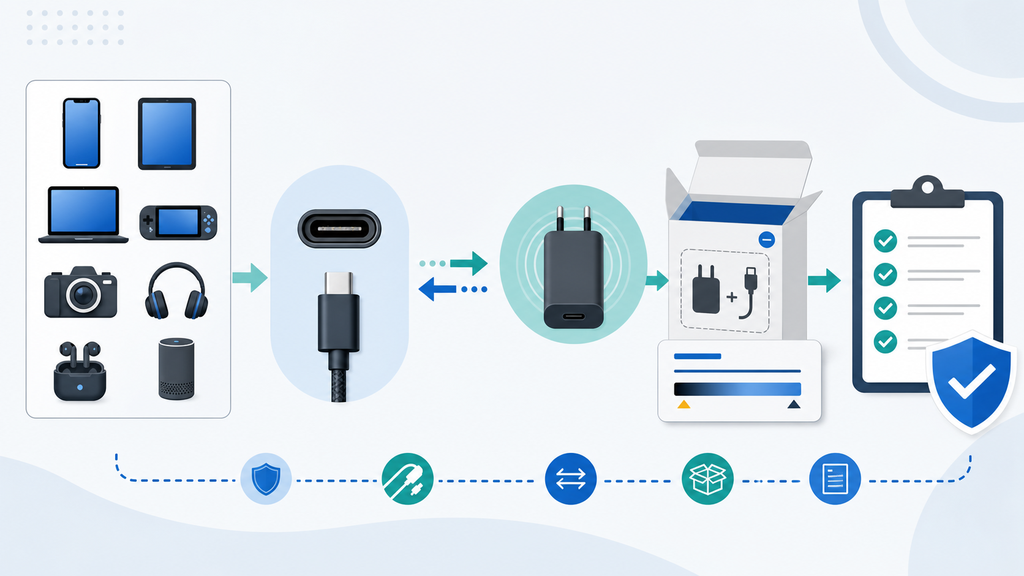
The legal base is Directive (EU) 2022/23801. It amends the Radio Equipment Directive and lists product categories such as mobile phones, tablets, digital cameras, headphones, handheld game consoles, speakers, e-readers, keyboards, mice, earbuds, and laptops. For charger and cable brands, the important point is not only the covered device list. The rule changes what downstream customers expect from the charging ecosystem.
I often find that buyers focus on one question: "Does it have USB-C?" That question is too small. A product can have a USB-C port and still create a poor buyer experience if the power negotiation, cable rating, label, and packaging message are unclear. The directive says covered fast-charging products must support USB Power Delivery when wired charging goes beyond 5V, 3A, or 15W. It also requires information about minimum and maximum charging power.
For a private-label charger project, that means the buyer should review the product as a system:
| Area | What Buyers Should Check | Why It Matters |
|---|---|---|
| Port design | USB-C output, not only USB-A legacy output | Retailers expect modern compatibility |
| Protocol | USB PD support where fast charging is claimed | Avoids misleading fast-charge claims |
| Cable | Correct wattage rating and e-marker when needed | Prevents slow charging and complaints |
| Label | Clear min/max watt information | Helps users choose the right charger |
| Bundle | Charger included or not included | Affects packaging and channel messaging |
I have seen projects where the charger itself was fine, but the bundled cable limited the real performance. A 65W charger with a weak cable can become a customer complaint. A 100W or 140W roadmap without cable planning can become a safety and support problem. This is why the regulation should be used as a checklist, not only as a legal topic.
For EverGreat customers, the practical first step is mapping each SKU by port type, wattage, protocol, cable rating, plug version, target market, and package claim. That map quickly shows which products are ready, which need label updates, and which should be redesigned before the next production run.
Why Does 2026 Matter For Chargers, Cables, And Laptop Accessories?
2026 matters because laptop charging pulls the common charger discussion into higher wattage, stronger cables, and more serious thermal and compliance decisions.
For charger brands, 2026 is a planning year for higher-power USB-C products. Laptop charging creates demand for 65W, 100W, 140W, and even 240W-ready product families, but every higher wattage adds cost, heat, cable, and documentation risks.
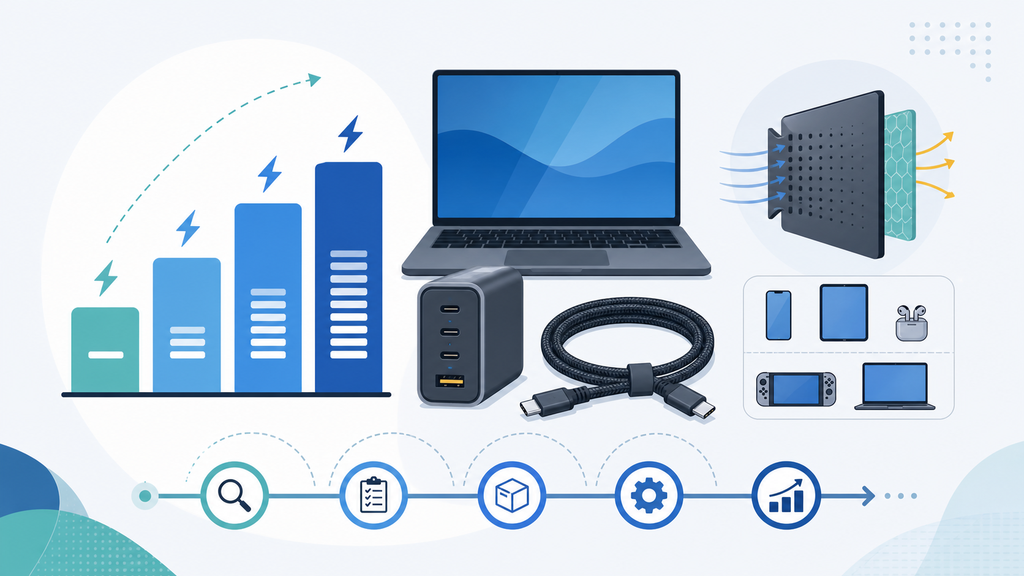
The EU rule already affected many small and medium devices before the laptop deadline. But laptops change the commercial picture. They make USB-C common charging more relevant to office kits, travel chargers, desktop GaN chargers, multi-port chargers, power banks, and high-watt USB-C cables. The market moves from "one phone cable" to "one charging setup for phone, tablet, laptop, and accessories."
The USB standards side also matters. USB-IF explains that USB Power Delivery Revision 3.1 enabled up to 240W over a full-featured USB Type-C cable and connector, with new fixed voltage levels such as 28V, 36V, and 48V for higher power levels.2 USB-IF’s USB Power Delivery document library also lists the USB Power Delivery Specification Revision 3.2 Version 1.2 dated 05/20/2026, which shows the standard continues to evolve.3 Buyers do not need to memorize every revision, but they do need to know that "USB-C" is not one simple product grade.
In manufacturing, higher power changes the design conversation:
| Wattage Position | Typical Buyer Use | Main Tradeoff |
|---|---|---|
| 20W-35W | Phones, earbuds, small travel kits | Low cost, but limited differentiation |
| 45W-65W | Tablets, ultrabooks, compact GaN chargers | Good balance of size and usefulness |
| 100W | Laptop and multi-device charging | Needs stronger thermal design and cable clarity |
| 140W-240W | High-power laptops and premium workstations | Higher cost, stricter component and cable planning |
Many customers ask me whether they should jump directly to the highest wattage. My answer is usually no. A 240W-ready story sounds attractive, but it is not always the best SKU for a brand’s customer base. Higher wattage can mean larger housings, better heat dissipation, stronger components, more complex testing, and more expensive cables. It may be right for a premium laptop accessory line. It may be wasteful for a phone-focused retail program.
The better strategy is a clear ladder. A brand might keep a compact 30W phone charger, build a strong 65W travel charger, add a 100W multi-port model, and reserve 140W or 240W positioning for laptop-heavy channels. This creates choice without turning every product into an overbuilt item.
I would also review cable SKUs now. Many consumers assume any USB-C cable can charge any USB-C device at full speed. That is not true in practice. For brands, the support risk is obvious: the customer blames the charger, even when the cable is the bottleneck. Good packaging should state the real cable capability and avoid vague phrases like "fast cable" without wattage support.
What Should Private-Label Buyers Ask Suppliers Before Ordering?
A supplier can say "EU ready" very quickly. A serious buyer should ask for documents, test evidence, labeling support, and a clear product roadmap.
Private-label buyers should ask suppliers about USB-C design, USB PD profiles, cable rating, thermal testing, safety certification, packaging labels, charger-in-box options, and batch control. The supplier should explain what is compliant now and what still needs market-specific review.
In my experience, the best supplier conversations are boring in a good way. They do not begin with big promises. They begin with a table of SKUs, power levels, target countries, packaging versions, certification needs, and customer use cases. That table prevents expensive misunderstandings later.
Here are the questions I would ask before placing an order:
| Buyer Question | Good Supplier Answer | Red Flag |
|---|---|---|
| Which USB PD profiles does this model support? | Specific PDO/PPS or EPR details by SKU | "It is all fast charging" |
| What cable is bundled or recommended? | Wattage, length, e-marker need, and data rating | "Any USB-C cable works" |
| How is max power shown on packaging? | Clear watt text and label plan | No package-level answer |
| Is the charger included with the device kit? | Clear bundled and unbundled options | One package for every market |
| What tests support the claim? | Safety, thermal, aging, and production checks | Only a sample photo |
| Can the BOM change? | Locked critical parts and change notice process | Supplier can switch parts freely |
The EU rule also pushes brands to think about unbundling. The directive aims to avoid forcing consumers to buy a new charger with every device. Industry coverage of the EU USB-C mandate has also highlighted charger unbundling, labels, and fast-charging interoperability as practical market changes, not just legal language.4 For private-label kits, this means buyers should decide whether a charger is part of the offer, optional, or sold separately.
That decision affects more than packaging. It affects margin, channel positioning, customer service, and after-sales support. A travel charging kit with a proven charger and cable can reduce customer confusion. A device sold without a charger may reduce cost and packaging size, but it must tell customers what power adapter they need. Both choices can be correct. The problem is making the choice late.
I would also ask suppliers to prepare a claim review. Words such as "EU compliant," "USB-C universal," "240W ready," and "laptop fast charging" should be supported by the exact product configuration. If the charger is 100W but the cable is 60W, the package should not imply a full 100W cable bundle. If a product supports USB PD but not every brand’s proprietary fast-charge behavior, the sales page should avoid promising identical performance across all devices.
EverGreat can help buyers turn these questions into a practical product brief. The brief should include target market, plug type, port mix, wattage, USB PD requirements, cable bundle, packaging language, certification path, MOQ, and launch deadline. A clear brief helps the factory choose the right platform and prevents the buyer from paying for features that do not match the sales channel.
Conclusion
The EU USB-C rule rewards brands that plan products, labels, cables, and claims together before the next buying cycle.
-
This primary EU legal text supports the article’s explanation of USB-C, USB PD, packaging pictograms, and power-label requirements. ↩
-
This USB-IF page supports the explanation of USB PD 3.1, 240W power delivery, and high-power USB-C cable requirements. ↩
-
This USB-IF document page supports the point that USB Power Delivery specifications continue to evolve in 2026. ↩
-
This industry explainer supports the market context around charger unbundling, labeling, and fast-charging interoperability. ↩