A short quoted lead time can become a long delay when sampling, materials, approvals, production slots, testing, and shipping are counted separately.
Importers should compare power bank lead times by mapping every stage from specification to delivery, identifying dependencies, confirming evidence, and separating a factory promise from a realistic launch schedule.

I have seen buyers compare “30 days” with “35 days” and choose the lower number, only to discover that one supplier started counting after every part was ready while the other included development and testing. Lead time is a process, not a single number.
What Should Importers Include In A Lead-Time Comparison?
A useful comparison begins by defining the exact product, order condition, and delivery point behind each supplier’s estimate.
Before comparing suppliers, define the product revision, quantity, customization, packaging, certifications, destination, shipping method, payment condition, and required delivery date.
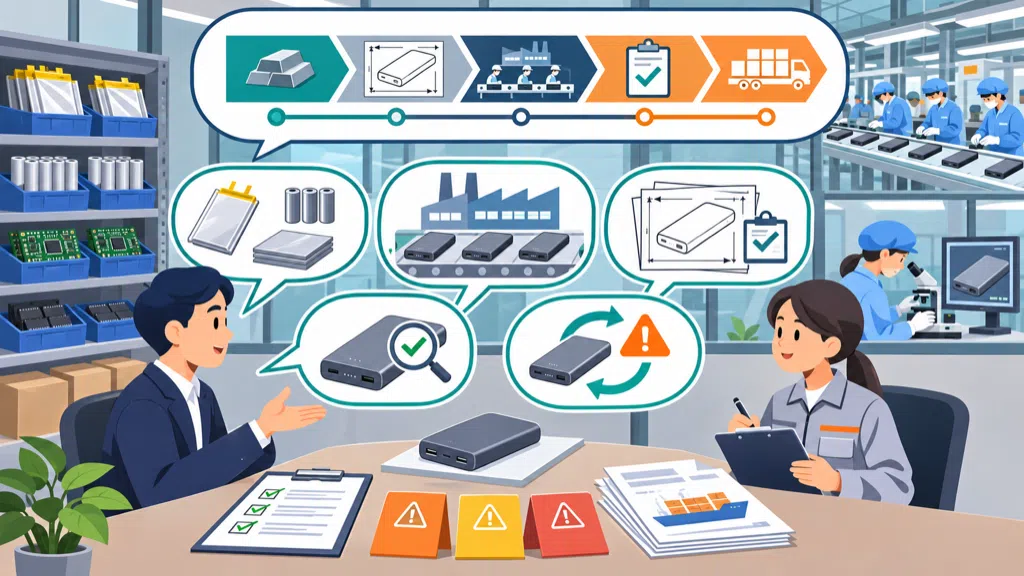
Start with the product state. A standard catalog power bank, a private-label product, and a custom enclosure do not carry the same schedule. Ask whether the quote is for an existing platform, a modified design, or a new development project.
Separate sample lead time from mass-production lead time. A sample may use available parts and manual assembly, while a production order may require new artwork, tooling, material reservations, firmware loading, inspection, and packaging. Combining these stages hides the real critical path.
Define what “delivery” means. Is it the date goods leave the factory, arrive at the forwarder, clear export, reach the importer’s warehouse, or become available for sale? A supplier and buyer can both be accurate while using different endpoints.
| Schedule item | What to ask | Why it matters |
|---|---|---|
| Product state | Standard, modified, or custom? | Determines engineering and tooling work |
| Starting point | Deposit, approved artwork, or final specification? | Prevents different counting methods |
| Materials | Which parts are in stock and which are ordered? | Exposes procurement risk |
| Tooling | Is a mold, fixture, or test setup required? | Adds fixed schedule dependencies |
| Certification | Which reports or tests are needed? | May affect release and shipment |
| Production slot | When is capacity reserved? | A quote is not always a booking |
| Quality release | When does inspection and rework finish? | Prevents premature shipping assumptions |
| Delivery point | Factory, port, or warehouse? | Makes logistics comparable |
Ask for a milestone plan rather than a total number. A simple plan can show brief confirmation, design review, sample build, sample approval, tooling, material ordering, pilot production, mass production, inspection, packing, and shipment. The buyer can then see which stages overlap and which cannot start until an approval is complete.
The critical path changes by project. A custom logo may be quick, while a new enclosure or certification test may control the date. A supplier that gives one total number without naming dependencies is difficult to manage.
Quality should be included in the schedule. ISO 9001:2026 describes controlled operations, monitoring and measurement, documented information, supplier-related processes, and continual improvement as parts of a quality-management system.1 It does not provide a universal power bank lead time. It supports the need for controlled planning and evidence rather than informal promises.
Also define the buyer’s response time. A supplier cannot start artwork approval, sample confirmation, or a change decision until the importer responds. Put buyer review windows into the schedule so that delays are not automatically blamed on production.
Which Supplier Questions Reveal A Realistic Schedule?
The most useful questions ask for evidence of readiness, capacity, dependencies, and recovery options instead of asking whether the supplier can “do it faster.”
Ask suppliers what has already been completed, which materials are confirmed, what approvals are still open, when production capacity is reserved, and what evidence supports each milestone.
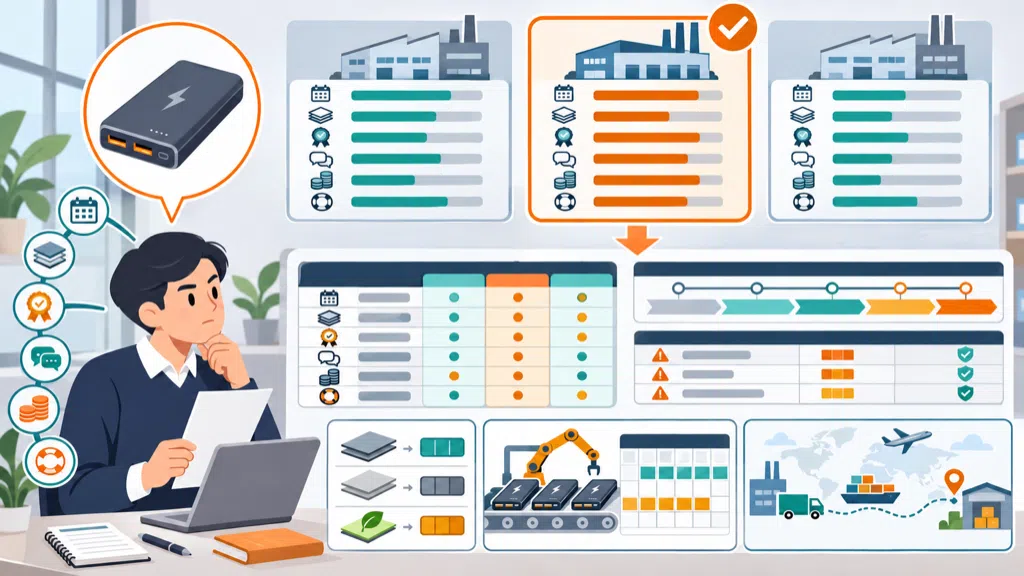
Ask whether the quoted lead time assumes existing cells, controllers, ports, cables, packaging materials, and firmware. If a part is subject to allocation or a long purchase cycle, the schedule should show it rather than hide it inside a general estimate.
Ask for the latest date by which the buyer must approve each item. Artwork, sample comments, label text, packaging, and technical claims can all become schedule gates. A supplier who identifies these gates early is often more reliable than one who promises a short total without explaining them.
Capacity questions should be specific. Ask how many production lines can build the product, whether the line is shared with seasonal orders, which stations are constrained, and how additional capacity would be approved. The goal is not to demand confidential factory data. The goal is to understand whether the planned slot is real.
| Supplier question | Evidence to request | Warning sign |
|---|---|---|
| Are key materials available? | Part list, status, and expected arrival | “All materials are easy” without detail |
| Is the design frozen? | Approved drawing and revision | New changes after the quote |
| Is production capacity reserved? | Planned slot or internal milestone | Capacity described only as “available” |
| What can delay the order? | Risk list and owners | No risks are acknowledged |
| How is quality released? | Inspection and test plan | Shipping date ignores rework |
| What happens after a delay? | Recovery plan and alternatives | Only a new promise is offered |
| What is the logistics endpoint? | Incoterm and handover date | “Delivery” is undefined |
Ask to see the difference between sample availability and mass-production readiness. A sample built from spare parts does not prove that the full production bill of materials can be secured. A sample approval does not prove that the packaging line or test fixture is ready.
Check the change process. If the supplier substitutes a cell, controller, cable, enclosure material, or packaging part, the change may require a new sample or test. A fast substitution can create a longer delay later if it is not reviewed properly.
Use a schedule risk register. For each risk, record probability, impact, trigger, owner, mitigation, and decision date. Examples include a delayed mold, a rejected artwork file, an unavailable cell, a failed pilot test, a missing report, a port shortage, or a shipping booking problem.
Do not reward an unrealistic schedule. If one supplier is much faster, ask which stage was excluded. A more transparent supplier may appear slower because the estimate includes inspection and approval work that another supplier has ignored.
How Should Buyers Turn Lead-Time Data Into A Supplier Decision?
Lead time should be evaluated together with quality, communication, flexibility, cost, and the supplier’s ability to recover without hiding changes.
Choose the supplier whose schedule is traceable, achievable, owned by named people, updated with evidence, and supported by recovery options—not simply the supplier with the shortest initial promise.
Build a weighted comparison instead of ranking lead time alone. A supplier with a slightly longer schedule may reduce total launch time if its samples are accurate, communication is clear, and production changes are controlled. A fast first sample can become slow if every later stage needs rework.
| Decision factor | What good evidence looks like | Tradeoff to discuss |
|---|---|---|
| Schedule clarity | Milestones, gates, owners, and dates | More detail takes time but reduces ambiguity |
| Material readiness | Confirmed parts and alternatives | Early reservation may require a deposit |
| Sample quality | Sample matches the planned product | A careful sample can take longer |
| Production capacity | Named slot and line plan | Peak-season flexibility may cost more |
| Quality release | Defined tests and inspection | Shipping after proper checks may add days |
| Communication | Prompt updates with evidence | More reporting creates better control |
| Recovery ability | Options for parts, lines, and logistics | Alternatives may change cost or design |
Ask the supplier to mark the schedule as committed, estimated, or dependent. A committed date should have an owner and a condition. An estimated date should have a range or risk note. A dependent date should name what the buyer must provide.
Use a weekly project review after approval. Compare planned and actual milestones, update risks, confirm the next decision, and record changes. A schedule that is not updated becomes a historical document instead of a management tool.
Set escalation triggers before the project starts. Examples include a material arrival that slips beyond a buffer, a sample that fails a critical test, an approval that misses its review window, or a production slot that is moved. Decide who can approve an alternate, change the date, split a shipment, or stop the order.
Logistics needs its own buffer. Factory completion is not warehouse availability. Export documents, booking, port handling, customs, transport, and destination delivery can all affect the launch. The importer should plan the commercial date from the final required location, not only from the factory handover.
For new products, consider a staged release. Approve the design and critical materials first, run a controlled pilot, then release the larger order after the product and process evidence are acceptable. This can reduce the risk of waiting for a large batch that later needs correction.
At EverGreat, we prefer a schedule that shows the work behind every date. That makes a conversation more useful when something changes. The buyer can choose whether to adjust the product, approve an alternate, change the shipment plan, or preserve the original requirement.
Conclusion
Compare lead times by milestones, dependencies, evidence, ownership, quality release, and logistics endpoint. The most credible schedule is transparent and recoverable.
-
International Organization for Standardization, ISO 9001:2026 quality management systems. ↩