A power bank can pass factory inspection and still create returns when customers cannot diagnose charging, capacity, heat, or cable problems.
Brands should build an after-sales plan around clear product claims, troubleshooting steps, warranty rules, spare parts, RMA data, and a feedback loop that sends recurring failures back to product and manufacturing teams.
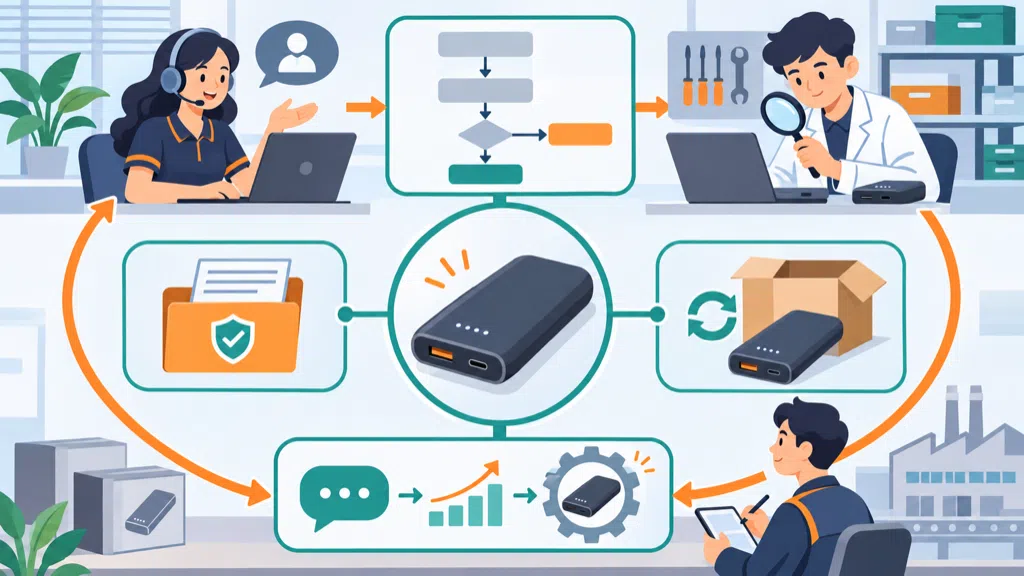
I have seen a support team receive the same complaint in five different words because the product team never defined the expected behavior. A useful plan starts before launch, when the brand can still improve the product, package, instructions, and supplier agreement.
What Should An After-Sales Plan Cover Before Launch?
The best support plan begins with a shared definition of the product, the customer promise, and the evidence needed to decide whether a problem is normal behavior or a defect.
Before launch, define the warranty scope, expected charging behavior, capacity basis, safety escalation, troubleshooting flow, replacement rules, spare parts, response targets, and ownership between brand and manufacturer.
Start with the customer promise. If the package says “fast charging,” explain which device, cable, charger, and output profile were tested. If it says “high capacity,” define whether the number refers to cell capacity or usable output. If the product supports several devices, identify the tested combinations.
Ambiguous claims create avoidable returns. A customer may report that the power bank is defective because a tablet charges slowly, while the product was only tested for a phone. Another customer may expect a display to show an exact percentage when it is designed only as a rough battery indicator.
Write a behavior sheet for support teams. Include charging start conditions, indicator behavior, automatic shutoff, pass-through charging if supported, simultaneous output limits, cable requirements, temperature guidance, and what happens when the battery is nearly empty.
| Plan element | What to define | Why it matters |
|---|---|---|
| Product promise | Devices, cables, outputs, and conditions | Makes customer expectations testable |
| Warranty scope | Covered defects, exclusions, and time period | Gives support a consistent decision rule |
| Troubleshooting | Questions, tests, and safe reset steps | Resolves simple problems quickly |
| Safety escalation | Swelling, smoke, leaks, heat, or damage | Prevents unsafe handling |
| Replacement policy | Repair, replacement, refund, and approval owner | Reduces customer friction |
| Spare parts | Cables, packaging, samples, and service units | Supports practical resolution |
| Data capture | Model, batch, failure type, and evidence | Connects support to quality improvement |
The warranty wording should match the market and the brand’s legal advice. Avoid making a promise that the factory cannot verify. If a supplier offers a replacement only for a narrow manufacturing defect but the brand advertises broad performance coverage, the commercial risk remains with the brand.
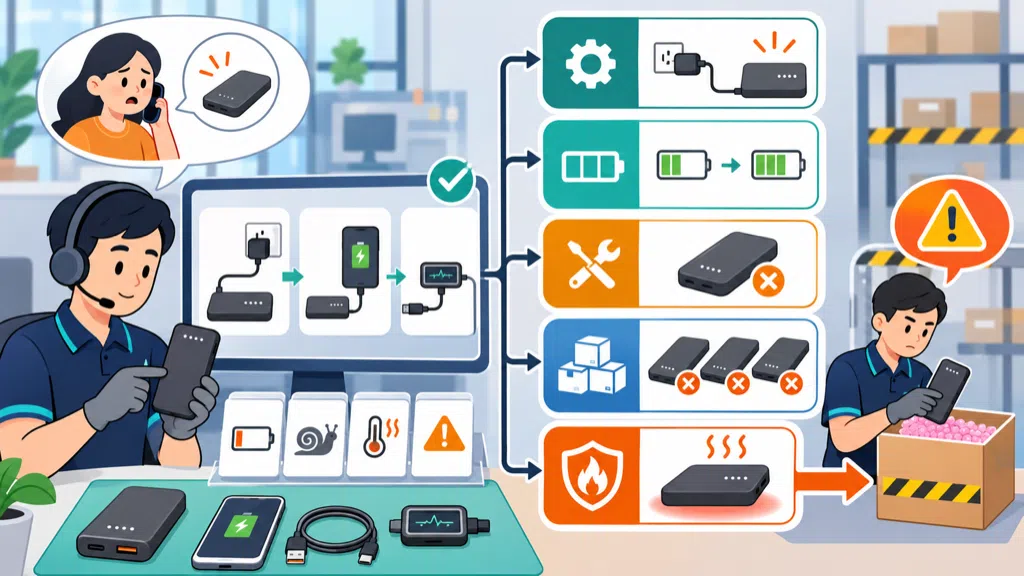
Safety needs a separate path from ordinary troubleshooting. A customer reporting swelling, a burning smell, smoke, liquid damage, a cracked enclosure, or abnormal heat should not be asked to keep charging the product for diagnosis. The support agent should isolate the case, provide safe handling instructions approved by the brand, and escalate it to the responsible technical team.
The technical file should be easy to find. Keep the approved specification, cell and circuit revision, firmware version, test method, user manual, packaging artwork, inspection limits, and supplier contact together. IEC 62133-2 specifies requirements and tests for the safe operation of portable sealed secondary lithium cells and batteries under intended use and reasonably foreseeable misuse.1 The support process should know which final product configuration those documents describe.
Agree on response ownership. The brand may own the customer relationship, while the manufacturer investigates batch patterns or technical failures. Put response times, evidence requirements, escalation levels, and reporting format in the project plan before the first shipment.
How Should Brands Triage Power Bank Complaints?
A good triage process separates user setup issues, expected product behavior, isolated defects, batch problems, and potential safety incidents.
Triage each complaint by product identity, symptom, usage conditions, basic checks, safety signs, and repeatability before deciding whether to educate, replace, investigate, or stop a batch.
Ask for the model, purchase date, serial or batch information if available, device being charged, cable, charger, output port, indicator behavior, and when the problem began. A short video or photo can help with port damage, swelling, display errors, or a loose button.
Do not ask for more evidence than the customer can reasonably provide. The first support message should be short and safe. A simple decision tree is better than a long technical questionnaire that makes the customer abandon the request.
Begin with safety screening. Ask whether the unit is swollen, unusually hot at rest, leaking, cracked, smoking, or producing a burning smell. If yes, stop normal troubleshooting. Never ask a customer to open a power bank, press a swollen cell, or continue charging a suspicious unit.
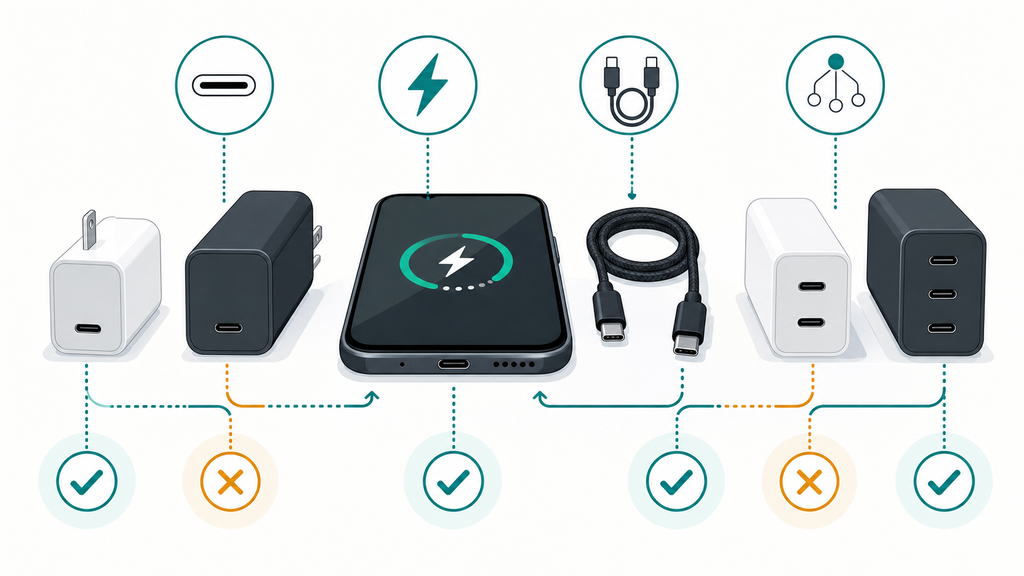
For ordinary charging complaints, check the complete path. Confirm the output port, cable, device, device battery state, power bank charge level, and whether another output is active. USB Power Delivery is a negotiated system, so the source and device must agree on a supported power profile; a USB-C connector alone does not prove fast charging.2
| Complaint pattern | First checks | Likely next action |
|---|---|---|
| Device does not charge | Port, cable, button, battery level, device compatibility | Guide a controlled test or replace if repeatable |
| Charging is slow | Device model, cable, output profile, active workload | Explain limits or investigate performance |
| Indicator seems wrong | Charge state, firmware, indicator behavior, reset method | Provide behavior guide or test sample |
| Power bank turns off | Load, low-current device, cable, protection behavior | Confirm expected cutoff or inspect unit |
| Unit gets hot | Location, load, charger, duration, surface, damage | Stop use if abnormal and escalate |
| Capacity feels low | Test basis, device battery, conversion losses, usage | Explain usable output or run verification |
| Physical damage | Photos, impact, swelling, exposed parts | Follow safety and warranty path |
Use a known-good device and cable for controlled comparison when it is safe. Record the starting conditions and result. “It did not work” is not enough to identify whether the issue belongs to the power bank, cable, device, charger, or customer expectation.
The support team should know when to stop troubleshooting. Repeated failures across different cables and devices, a rising complaint rate, or a safety symptom should move the case to technical review. A replacement can solve one customer’s problem while hiding a batch issue, so every replacement must still create a usable record.
Complaint categories should be specific enough to analyze. “Charging issue” is too broad. Use categories such as no output, intermittent output, slow output, input not charging, indicator mismatch, capacity concern, port damage, overheating, cosmetic defect, accessory missing, or packaging damage.
How Can Warranty Data Improve The Next Production Run?
After-sales data becomes valuable when brands connect complaints to product revisions, suppliers, batches, usage conditions, and corrective actions.
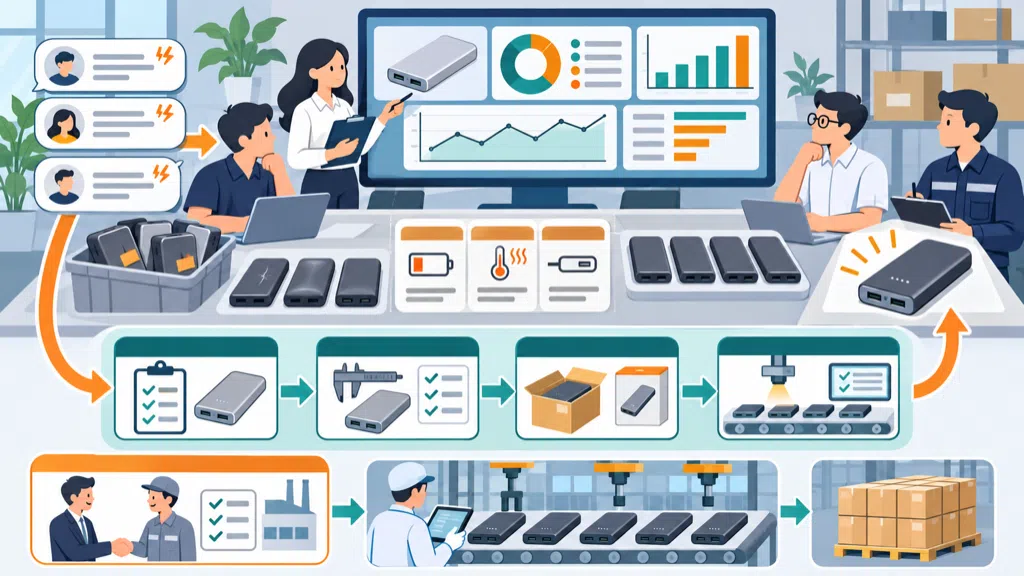
Review warranty and RMA data by rate, failure mode, batch, channel, device, supplier, and time in service, then use the findings to update product requirements, inspection plans, manuals, and future samples.
Create a weekly or monthly review that includes support, quality, engineering, purchasing, and the manufacturer. Look for patterns rather than isolated stories. A single damaged unit may be normal handling. Ten similar port failures from one batch may indicate a fixture, material, or packaging problem.
Track both confirmed defects and “no fault found” cases. A high no-fault rate may mean the troubleshooting guide is weak, the product claims are unclear, or the support team lacks a known-good test setup. It can also reveal that returns are being approved before evidence is collected.
| Metric | What it can reveal | Follow-up question |
|---|---|---|
| Return rate by model | Product or claim risk | Is one version creating most complaints? |
| Failure mode share | Repeated technical issue | Which part or process is involved? |
| No-fault-found rate | Weak triage or unclear claims | Can the support test be improved? |
| Time to first failure | Early defect or normal wear | Does the problem cluster after launch? |
| Repeat replacement rate | Incomplete resolution | Is the replacement from the same risky batch? |
| Complaint rate by channel | Packaging or user education issue | Is one channel creating different expectations? |
| Response and closure time | Service capacity | Where does a case wait? |
Use the data to improve the next production control plan. If port damage appears after transport, review the insert and carton. If cable complaints cluster around one accessory, test the supplied cable and update the specification. If customers misunderstand capacity, revise the label and manual rather than asking agents to explain the same point forever.
ISO 9001:2026 describes a quality-management system that supports customer satisfaction, controlled operations, monitoring and measurement, documented information, and continual improvement.3 It is a framework, not a product warranty or a substitute for product-specific testing. The practical lesson is that complaint data should become an input to decisions, not remain in a separate customer-service spreadsheet.
Corrective actions should have an owner, due date, evidence, and verification. “Retrain the operator” may be useful, but it is not enough if the fixture still allows the wrong assembly. Prefer changes that make the correct result easier and the incorrect result harder.
Keep a golden sample and a controlled complaint sample set. The golden sample represents the approved product. Complaint samples help the technical team reproduce real failures. When a supplier changes a cell, controller, port, firmware, adhesive, enclosure, or package, review whether the after-sales risk has changed and whether a new approval test is needed.
At EverGreat, we treat after-sales feedback as part of product development. The goal is not only to close tickets quickly. It is to reduce repeated customer effort, protect safe use, and send reliable evidence back into the next product decision.
Conclusion
Build after-sales support before launch, triage safely, record evidence consistently, and use warranty data to improve the product, process, packaging, and customer promise.
-
International Electrotechnical Commission, IEC 62133-2 safety requirements. ↩
-
USB Implementers Forum, USB Charger and USB Power Delivery information. ↩
-
International Organization for Standardization, ISO 9001:2026 quality management systems. ↩