Too many ports can raise cost and confusion, while too few can limit real use. A good port plan starts with customer devices, not a crowded product rendering.
Brands should choose power bank ports by mapping target devices, charging power, cable habits, size, cost, and simultaneous-use requirements. Add only ports that serve a clear customer need.
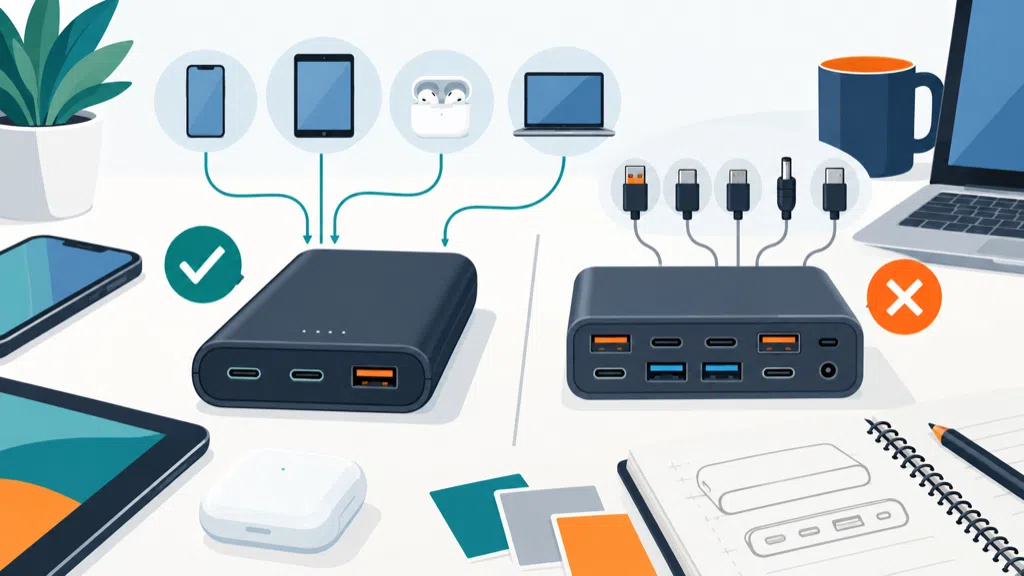
I have seen product briefs request every familiar connector at once. The result is often a larger enclosure, more complex testing, and a package that promises more than the circuit can deliver. The right combination is a product decision, not just a hardware count.
Which Devices Must The Power Bank Support?
A port combination should begin with the devices customers actually carry, because every connector and output path affects the product architecture.
List the target devices first, then define their charging inputs, expected power, cable type, and simultaneous-use pattern. This prevents brands from paying for ports that their customers rarely use.
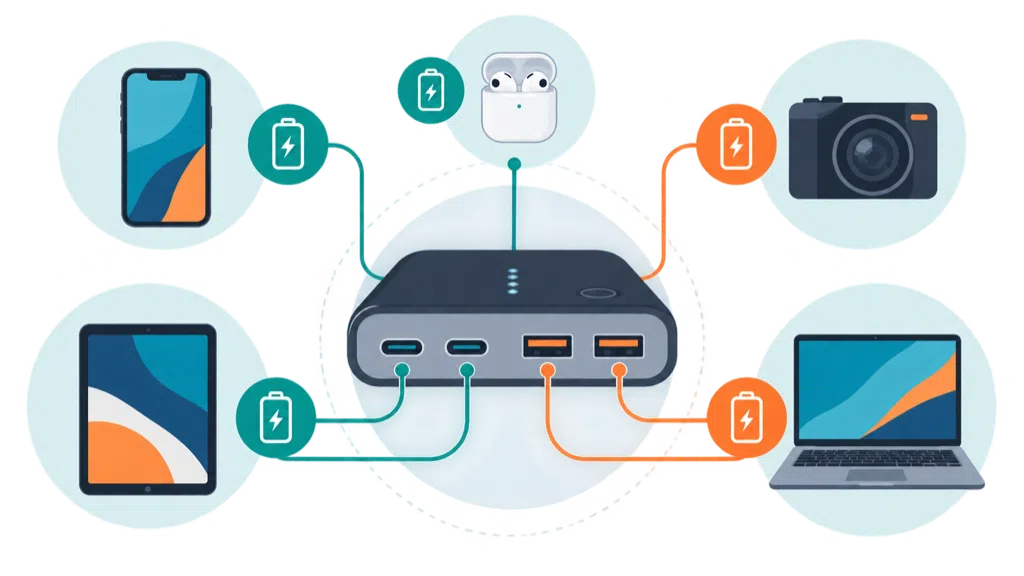
Start with the sales channel. A retailer selling phone accessories may need USB-C output for current smartphones and earbuds, while a travel product may need one USB-C input/output port plus a USB-A port for older cables. A promotional product may prioritize broad compatibility and low cost over laptop charging.
The device list should include more than phones. Consider tablets, handheld game consoles, cameras, earbuds, smartwatches, and small personal electronics. Each product can have a different cable, current profile, or charging handshake. A port that physically accepts a plug does not guarantee the best charging experience.
I usually ask buyers to divide devices into primary, secondary, and occasional loads. Primary devices drive the power path. Secondary devices influence the second port. Occasional loads may be better served by a replaceable cable or an adapter rather than a permanent connector.
| Customer need | Port decision | Buyer question |
|---|---|---|
| Modern phone charging | USB-C output | What power level is expected? |
| Older accessories | USB-A output | Is legacy compatibility worth the space? |
| Recharging the power bank | USB-C input | Should input and output share one port? |
| Several devices | Multiple outputs | What happens when used together? |
| Laptop or tablet use | Higher-power USB-C | Is the cell and controller architecture ready? |
| Travel convenience | Built-in cable or compact port mix | Will the cable survive daily handling? |
The customer’s cable behavior matters too. Some users carry USB-C cables already. Others expect the power bank to include a cable or support older USB-A accessories. If a brand targets several regions or age groups, packaging must explain the intended combination clearly.
USB Power Delivery is negotiated between compatible equipment. USB-IF describes USB Power Delivery as a system that allows a device to request power within the source’s available capabilities.1 A USB-C port therefore needs the correct controller, power profile, thermal design, and test plan. The connector alone is not a fast-charging promise.
Do not use the phrase “universal” as a substitute for a compatibility test. A port may charge one device quickly and another slowly because the device, cable, charger protocol, battery state, or temperature differs. Product pages should state the supported use cases in plain language.
For a private-label product, the final port plan should appear in the product brief, electrical specification, artwork, manual, and test checklist. A mismatch between these documents creates customer-service tickets after launch.
How Do Port Choices Affect Cost, Size, And Reliability?
Every additional port needs mechanical space, electrical components, protection, assembly work, and a clear rule for how power is shared.
More ports can improve convenience, but they also increase enclosure space, controller complexity, testing requirements, standby behavior, and the number of failure points. The best design balances usefulness with reliability.
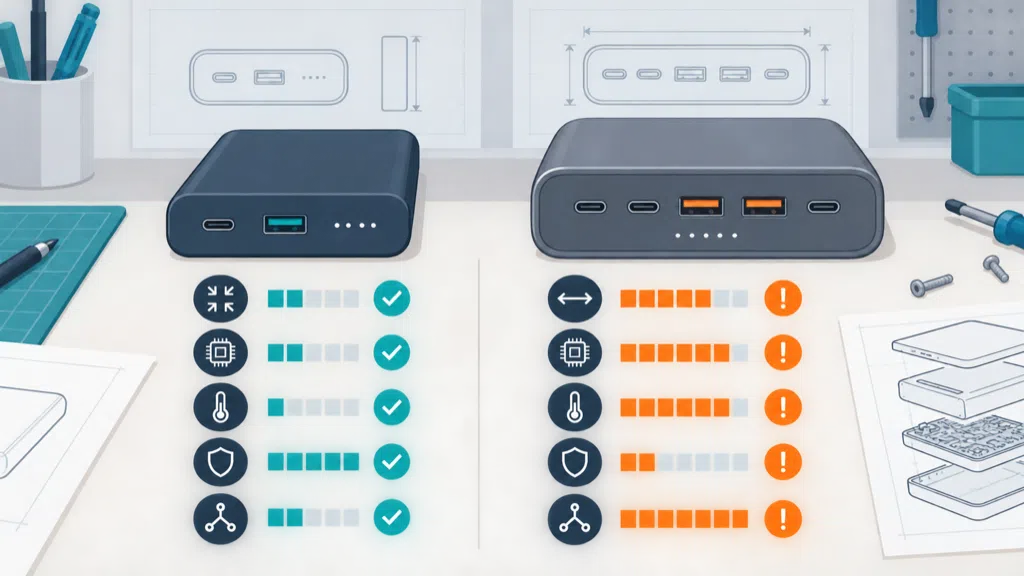
A second output is not free space on a drawing. It may require another connector, current path, protection component, indicator rule, and assembly inspection. The enclosure may need a longer edge, thicker wall, or revised internal layout. Those changes can affect the battery size and final capacity.
Simultaneous charging is a major design question. A power bank may advertise several outputs but limit total power when two or more devices are connected. That can be acceptable if the rule is stable and visible. It becomes a problem when customers assume each port can deliver its maximum rating at the same time.
The controller must manage input, output, protection, and thermal conditions together. If one port is removed or replaced late in development, the supplier should review the firmware, cable detection, current limits, and test matrix. A cosmetic port change can become an electrical change.
| Port strategy | Strength | Tradeoff |
|---|---|---|
| One USB-C input/output | Compact and easy to explain | Less legacy compatibility |
| USB-C plus USB-A | Broad cable compatibility | Larger edge and more testing |
| Two USB-C outputs | Suits modern devices | Higher architecture and power-sharing demands |
| Built-in cable plus ports | Convenient for travel | Cable fatigue and repair risk |
| Port-rich design | Flexible use cases | More cost, confusion, and failure points |
Connector durability deserves practical testing. Check insertion and removal, sideways force, cable fit, port looseness, debris exposure, drop performance, and the way users hold the product while charging. A port that works on a lab bench may feel weak in a bag or during travel.
The enclosure must also protect the ports. Openings can collect dust and moisture, and a port placed too close to a rounded edge may be hard to use. If the product includes a built-in cable, the storage channel must avoid sharp bends and pinch points.
Safety testing should follow the final configuration. IEC 62133-2 specifies requirements and tests for the safe operation of portable sealed secondary lithium cells and batteries under intended use and reasonably foreseeable misuse.2 The port layout does not replace battery safety work, but it changes the complete product that must be evaluated.
Port count can affect inventory. A single platform with several output variants may require separate circuit boards, shells, packaging files, and spare parts. A brand should ask whether the expected sales volume justifies those variants or whether one well-defined platform is stronger.
I often recommend a simple comparison sheet: retail price target, enclosure size, target devices, peak and shared output, cable support, test scope, and expected warranty exposure. If one port does not improve the score for the intended customer, it probably does not belong in the product.
How Should Brands Validate The Final Port Configuration?
Brands should validate ports with real devices, approved cables, combined loads, thermal checks, mechanical tests, packaging review, and clear customer instructions.
Before production, test every port alone and in combination, record power-sharing behavior, verify supported cables and devices, inspect mechanical durability, and match all claims to measured results.
Begin with a port truth table. For each input and output, record connector type, supported direction, voltage and current profiles, maximum power, shared limits, indicator behavior, and recovery behavior after a disconnect. This table becomes the basis for engineering, artwork, and quality inspection.
Test common device categories rather than one convenient phone. Use several phones, a tablet, earbuds, a camera, and any laptop or console named in the sales brief. Repeat with different cable lengths and approved cable types. The goal is not to promise every device; it is to understand the promised use cases.
Test combinations in a controlled sequence. Connect one device, add a second, remove the first, reconnect the input, and repeat after the power bank becomes warm. Record whether the output pauses, renegotiates, or reduces power. A stable reduction can be acceptable. An unexplained reset is a product risk.
| Validation area | Practical test | Evidence to keep |
|---|---|---|
| Port function | Connect and disconnect approved devices | Test record and device list |
| Power sharing | Use each output alone and together | Measured output matrix |
| Cable support | Test included and target cables | Approved cable list |
| Thermal behavior | Run the highest expected load | Temperature and time record |
| Mechanical durability | Insertion, pull, drop, and fit checks | Inspection photos and limits |
| Recovery | Remove and reconnect loads | Reset and wake results |
| Communication | Compare package, manual, and listing | Approved artwork set |
Check the charging experience from the user’s side. Does the correct indicator appear? Does the product wake when expected? Does the button behave differently when two ports are active? Can the user tell whether the power bank or cable is the problem?
Packaging needs special attention when ports have different roles. Use diagrams or short labels to distinguish input, output, shared output, and built-in cable. Avoid a large watt number that hides a lower combined limit. Retail staff and support teams need the same explanation.
For higher-power USB-C products, confirm the source, sink, cable, and device negotiation behavior. USB-IF’s public guidance makes clear that Power Delivery depends on negotiated capabilities, so the port claim should be tied to the tested system rather than only the connector shape.1
Keep a golden sample with the approved port arrangement, firmware, cable, artwork, and test matrix. If a controller or connector changes, reopen the relevant tests. Supplier substitutions should never be treated as cosmetic when they affect current, heat, fit, or charging behavior.
EverGreat helps brands compare a compact one-port platform with a broader multi-port platform before tooling and packaging are frozen. The goal is to give customers the connections they will use while keeping the product easy to understand, inspect, and support.
Conclusion
Choose power bank ports from real device needs, then validate power sharing, cables, heat, durability, and customer communication before approving production.
-
USB Implementers Forum, USB Charger and USB Power Delivery information. ↩ ↩
-
International Electrotechnical Commission, IEC 62133-2 safety requirements. ↩