You are excited for your trip, but there is a problem. Your big power bank might not fly with you. I know this can be confusing, but I will help you understand.
Many airlines do not allow power banks over 100 watt-hours (Wh) in the cabin. A standard 30,000mAh power bank usually exceeds this limit. This means you cannot bring it on the plane with you, as it poses a safety risk.
I want to make sure your travel plans go smoothly. Understanding power bank rules is simple once you know the basics. Let us look at what truly matters.
Does mAh really tell the whole story for flights?
You bought a high-capacity power bank. Now, you worry if you can take it on your next trip. This can cause some stress.
No, mAh does not tell the whole story. Airlines follow rules based on watt-hours (Wh), not milliamp-hours (mAh). You need to convert mAh to Wh to know if your power bank is allowed on a flight.
How I calculate power bank limits
When I check my power bank, I always look for the Wh rating. This is the key number. If your power bank does not show Wh, I convert it myself. This helps me avoid problems at security. The most common rule is a 100Wh limit. Some airlines allow up to 160Wh with special approval, but you’re often limited to two such power banks. Going over 100Wh means I usually cannot bring it on board. My typical 30,000mAh power bank often uses a 3.7V lithium-ion battery. This voltage is important for the calculation. To find the Wh, I multiply the capacity in Ah by the voltage. First, 30,000mAh becomes 30Ah (30,000 divided by 1000). Then, I multiply 30Ah by 3.7V. This gives me 111Wh. This is more than the 100Wh limit. This is why I cannot bring most 30,000mAh power banks on a plane. The rules are in place for safety. Lithium batteries can catch fire if damaged. Airlines are very strict about this. It’s also crucial to remember that damaged, defective, or recalled lithium batteries are strictly prohibited in both carry-on and checked baggage.
Here is a quick look at how the numbers add up:
| Capacity (mAh) | Voltage (V) | Calculation | Watt-Hours (Wh) | Allowed on Flight? |
|---|---|---|---|---|
| 30,000 | 3.7 | 30Ah * 3.7V | 111 | No |
| 26,800 | 3.7 | 26.8Ah * 3.7V | 99.16 | Yes |
As you can see, a small difference in mAh can make a big difference in Wh. I always do the math before I pack.
What is the safe alternative, like 26800mAh?
Are you wondering if there is a safe option for flying with a power bank? Many people get confused by the numbers. This can make travel planning harder.
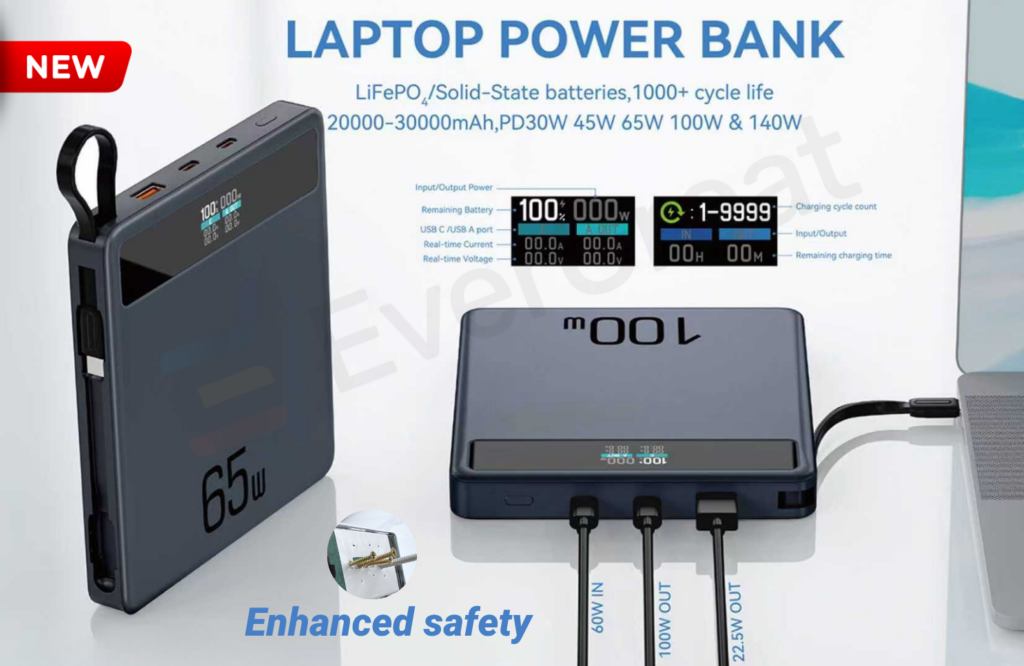
Yes, a 26800mAh power bank is a common safe alternative. When using a standard 3.7V battery, it falls just under the 100Wh limit. This means most airlines will allow it in your carry-on luggage without needing special approval.
My choices for a safe power bank
I always look for power banks that are safely under the 100Wh limit. A 26,800mAh power bank with a 3.7V battery is a good choice. My calculation shows it is 26.8Ah multiplied by 3.7V, which equals 99.16Wh. This number is below 100Wh. It means I can usually take it on any flight without issues. However, technology changes. Some new power banks use a different battery type called LiFePO₄, or LFP. These batteries have a lower nominal voltage, typically 3.2V. This changes the Wh calculation. For example, if I have a 30,000mAh (30Ah) power bank with an LFP battery, the calculation is 30Ah multiplied by 3.2V. This gives me 96Wh. This is also under the 100Wh limit. So, even a 30,000mAh power bank can be allowed if it uses LFP batteries. It is not just the mAh rating that determines if I can fly with it. The voltage, which tells me the battery chemistry, is also very important. I always double-check both the mAh and the voltage. Remember, power banks are only allowed in carry-on luggage; they are strictly prohibited in checked baggage due to the fire risk associated with lithium-ion batteries.
Here is how different battery types affect the Wh:
| Capacity (mAh) | Battery Type | Voltage (V) | Calculation | Watt-Hours (Wh) | Allowed on Flight? |
|---|---|---|---|---|---|
| 26,800 | Li-ion | 3.7 | 26.8Ah * 3.7V | 99.16 | Yes |
| 30,000 | LiFePO₄ (LFP) | 3.2 | 30Ah * 3.2V | 96 | Yes |
| 30,000 | Li-ion | 3.7 | 30Ah * 3.7V | 111 | No |
I make sure the label clearly shows the Wh or both mAh and voltage. This helps me and airport staff.
What happens if your power bank has no label?
Imagine you are at airport security. They ask to see your power bank. You grab it, but then you see it. There is no label. This can cause a real problem.
If your power bank has no clear label showing its capacity in Wh or both mAh and voltage, airport security might not let it fly. Without this information, they cannot confirm it meets safety rules. This means you might have to leave your power bank behind.
Why a missing label is a big problem for me
I learned this the hard way once. My friend had a great power bank, but the label wore off. At security, they asked him about its capacity. He knew it was big, but he could not say the exact Wh. He also did not know the voltage for sure. The security officer could not let him take it. They said they needed clear proof it was safe. This is because airline rules are strict for everyone’s safety. Power banks are portable batteries. If they are too powerful, or if they are faulty, they can be a fire risk. Airlines need to know exactly what is on their planes. A label tells them this quickly. Without it, they must assume the worst. My friend had to throw his power bank away. I always tell people to keep their power bank’s label intact. If it starts to fade, I take a photo of it. I also save the product details online. This way, I have proof if anyone asks. This way I have backup information in case the physical label is unreadable. Always check your power bank’s label before you leave home. To be extra safe, protect the battery terminals from short circuits by covering them with tape or placing the power bank in a separate plastic bag. Remember some airlines are banning the use of power banks inflight, or requiring them to be kept visible at all times, so it’s best to check beforehand. Also, be aware of stricter guidelines imposed by certain regions such as South Korea as of March 1, 2025, concerning power banks and e-cigarettes.
Here is what I always confirm before my flights:
- Clear Wh Rating: I look for the Wh number printed directly on the power bank. This is the best.
- mAh and Voltage: If no Wh, I look for both mAh and the voltage (e.g., 3.7V or 3.2V). I can calculate Wh from these.
- Intact Label: The label must be readable and not worn off.
- Backup Information: I keep a photo of the label or product specifications on my phone.
This small check prevents a big headache at the airport. I want my travels to be smooth, and this helps a lot.
Conclusion
Understanding power bank rules for flights is simple. It is about Watt-hours (Wh), not just mAh. Always check your device’s Wh rating or calculate it using mAh and voltage. Always carry power banks in your carry-on and ensure they are properly labeled. Checking with your specific airline for their rules can save you from potential issues at the airport.