Two samples can look identical and perform differently. Importers need a repeatable comparison method before choosing a supplier or approving a private-label product.
Importers should compare power bank samples against the same requirements, devices, cables, measurements, cosmetic limits, documents, and follow-up responses instead of choosing by appearance or price alone.
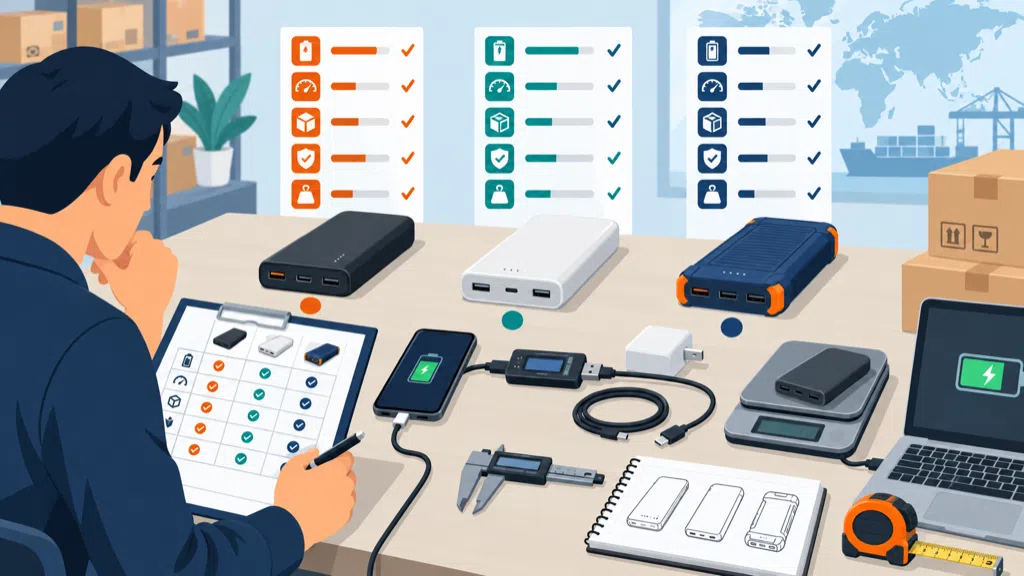
I have seen buyers approve the sample with the nicest finish, then discover that another supplier had better charging stability or documentation. A sample is evidence of a process, not proof that every future unit will be identical.
What Should Importers Define Before Comparing Samples?
A fair comparison starts with a written brief that gives every supplier the same target, test conditions, and commercial assumptions.
Before comparing samples, define capacity, ports, power claims, dimensions, weight, materials, accessories, target devices, market, packaging, quantity, price, and required documents.
The brief should separate fixed requirements from preferences. Capacity, output, safety documents, destination market, and required ports may be fixed. Color, texture, indicator style, or packaging finish may remain flexible. This prevents a supplier from winning by optimizing an unimportant detail.
Define the customer use case in plain language. Is the product for travel, retail, promotional distribution, laptop charging, emergency backup, or daily phone use? The same sample can be suitable for one channel and wrong for another.
Ask for the same information from each supplier. Record cell type or configuration, rated capacity, input and output profiles, charging time, product dimensions, weight, included cable, warranty assumptions, lead time, MOQ, sample fee, and any tooling requirement. If one supplier answers with a different basis, mark the comparison as incomplete.
| Comparison item | Why it matters | Common mistake |
|---|---|---|
| Rated capacity | Sets the product promise | Comparing labels without test method |
| Output profiles | Shows device compatibility | Assuming connector shape proves power |
| Dimensions and weight | Affects user experience and freight | Ignoring packaging and accessories |
| Cell and circuit version | Affects performance and documents | Treating substitutions as cosmetic |
| Included cable | Influences actual charging result | Testing with a cable not supplied |
| Compliance file | Supports the target market | Accepting a report for another model |
| MOQ and lead time | Affects cash and launch plan | Choosing a sample without supply proof |
The buyer should also define the sample state. Charge level, firmware, cable, device, ambient condition, and test instrument can change results. A short test is useful for screening, but the final decision should use a consistent method.
USB Power Delivery is designed to provide flexible power over a USB-C connection, and USB-IF explains that devices can request power within the source’s available capabilities.1 When samples claim PD, compare the advertised profiles, cable requirements, and actual device behavior. “USB-C” alone is not a complete performance specification.
Build a comparison sheet before the samples arrive. It should include objective scores and a notes area for unknowns. Unknown information should not be silently treated as a pass.
Which Tests Reveal The Difference Between Samples?
The most useful sample tests combine measured performance with real devices, repeated use, physical inspection, and a review of what the supplier can document.
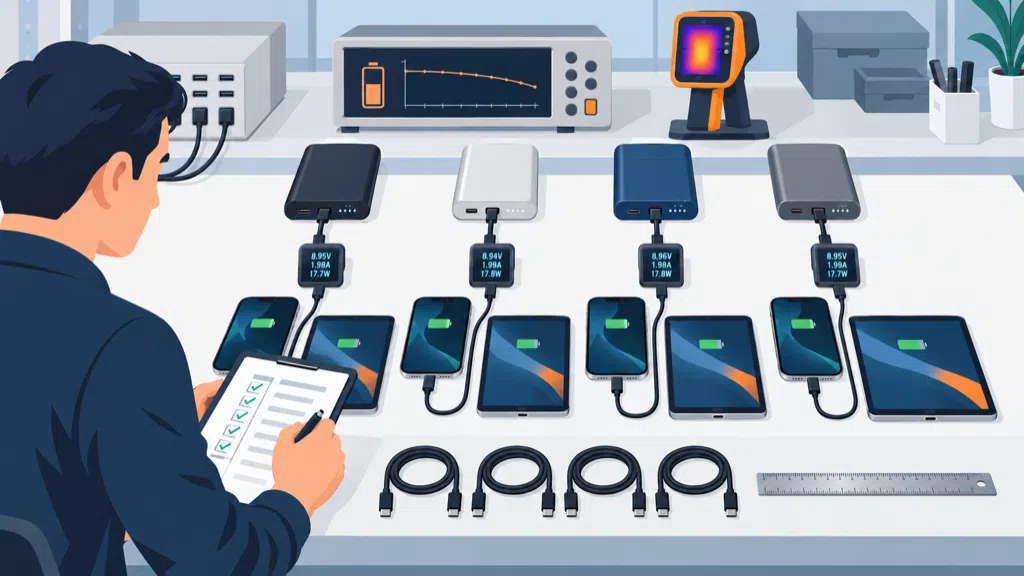
Compare samples by testing charging input, output, capacity method, thermal behavior, simultaneous loads, cable fit, mechanical condition, and recovery after disconnects under identical conditions.
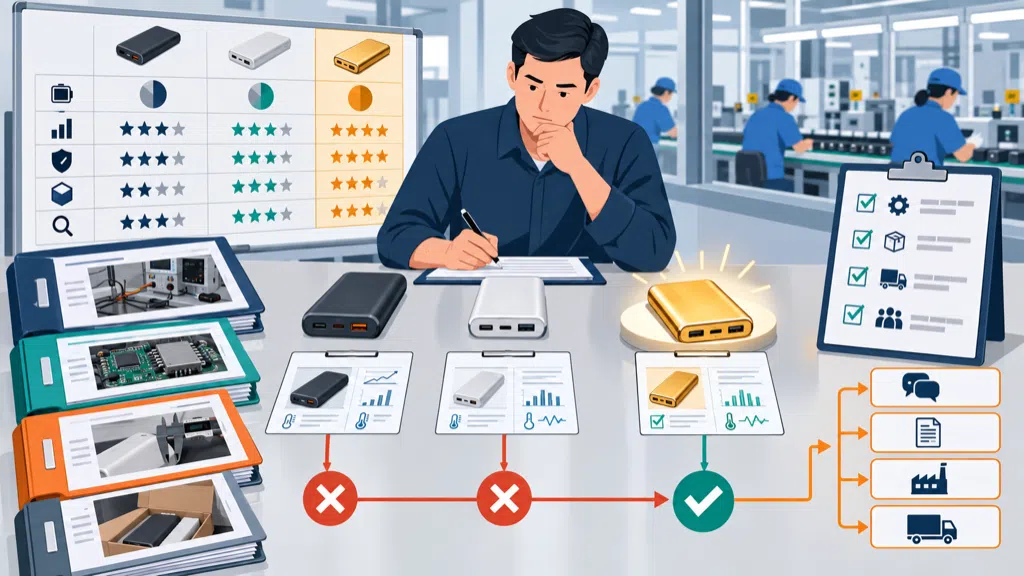
Start with basic inspection. Measure dimensions and weight, check port alignment, press buttons, inspect gaps, examine the surface, and confirm that the sample matches drawings or product photos. A sample that is already different from the approved brief needs explanation before more testing.
Then test the charging path. Use the same charger, same cable class, and same target devices for each supplier. Record whether charging starts automatically, whether the power bank stops early, whether the indicator behaves consistently, and whether a second device changes the output.
Capacity comparisons need discipline. State the starting condition, load, cutoff, temperature, and calculation. A supplier may quote cell capacity while another quotes usable output. Those numbers are not directly comparable. Ask for the method and record the basis beside the result.
| Test area | What to record | Decision question |
|---|---|---|
| Input charging | Charger, cable, time, current | Does the sample recharge predictably? |
| Single-device output | Device, profile, start and stop | Does it meet the promised use? |
| Multi-device output | Connected devices and shared result | Is power sharing clear and stable? |
| Capacity | Load, cutoff, temperature, result | Are the figures based on the same method? |
| Thermal behavior | Surface and port temperature | Does sustained use feel acceptable? |
| Mechanical fit | Ports, buttons, seams, cable strain | Does the sample feel production-ready? |
| Recovery | Disconnect and reconnect sequence | Does it recover without a reset problem? |
| Documentation | Reports, model, cell, version | Do the documents match the sample? |
Test at least one low-load device and one higher-load device. Earbuds or small accessories may expose sleep-mode behavior. A tablet or laptop-capable device may expose power negotiation and heat limits. The right pair depends on the product brief.
Look for repeated behavior, not one impressive result. Run the same charge and discharge sequence more than once. If the sample changes noticeably, ask what controls the variation. A supplier that explains the variation is more useful than one that only repeats a sales claim.
Mechanical testing should match the expected product life. Check insertion and removal, cable bending, button actuation, surface marks, enclosure flex, and drop performance. The goal is not to destroy a sample without purpose. The goal is to identify a risk that could become a return or warranty problem.
Safety evidence must match the actual battery product. IEC 62133-2 specifies requirements and tests for the safe operation of portable sealed secondary lithium cells and batteries under intended use and reasonably foreseeable misuse.2 A report for a different cell arrangement or model should be marked as incomplete until the supplier explains the relationship.
When comparing samples, compare the supplier response too. Does the team answer technical questions with measurements? Do they provide a change record? Do they propose a controlled correction? The quality of communication is part of the supply risk.
How Should Buyers Turn Sample Results Into A Supplier Decision?
Buyers should use weighted criteria, written exceptions, and a follow-up sample so the final decision reflects both product performance and supplier execution.
Choose a supplier by scoring product fit, repeatability, documents, communication, cost, lead time, and risk; then close every exception with a revised sample or written control before ordering.
Start with a weighted scorecard. Product performance and safety evidence may deserve more weight than cosmetic preference. A low price should not erase a missing test record or unstable output.
| Decision factor | Example evidence | Suggested treatment |
|---|---|---|
| Product fit | Test matrix and user notes | High weight |
| Repeatability | Repeated sample results | High weight |
| Documentation | Matched reports and specifications | High weight |
| Quality process | Inspection plan and records | High weight |
| Cost | Sample, tooling, unit, freight assumptions | Medium weight |
| Lead time | Component and production plan | Medium weight |
| Communication | Response quality and change control | Medium weight |
| Cosmetic preference | Finish, color, logo treatment | Lower unless brand-critical |
Keep a list of open questions. For each one, state the owner, evidence required, due date, and effect on approval. “Supplier will improve” is not a closed action. “Supplier will provide revised housing sample and drop result before pilot” is a controllable action.
Save the sample record with photos, test dates, device names, cable descriptions, firmware version, and supplier contact. If several samples arrive over time, give each one an internal reference. This prevents a later conversation from confusing the original sample with a revised unit. It also gives the purchasing team a clear reference when production goods are inspected.
Ask for a golden sample after changes. The golden sample should represent the cell, circuit, enclosure, firmware, cable, artwork, and accessories that will enter production. Keep it with the approved specification and inspection plan.
ISO 9001 provides a framework for quality management and includes purchasing information and verification considerations for supplied products.3 Certification can support supplier confidence, but it does not replace the importer’s product comparison, sample approval, or change control.
Commercial terms should match the technical decision. If the supplier changes a cell, cable, controller, or enclosure, the purchase agreement should require notice and define when a new sample or test is needed. Otherwise, the approved sample can become disconnected from the shipped product.
Do not compare a standard sample with a customized sample as if they carry the same development risk. A standard platform may be faster and cheaper. A custom enclosure or circuit may offer stronger differentiation but need more tooling, testing, and approval time.
EverGreat helps buyers compare samples by connecting product requirements, charging tests, compliance documents, packaging, and production controls. The practical goal is a decision that still makes sense after the first shipment, not a sample that only wins a meeting.
Conclusion
Compare power bank samples with the same brief, tests, devices, documents, and scorecard. Approve the supplier only after open risks have evidence and ownership.
-
USB Implementers Forum, USB Charger and USB Power Delivery information. ↩
-
International Electrotechnical Commission, IEC 62133-2 safety requirements. ↩
-
International Organization for Standardization, ISO 9001 quality management systems. ↩