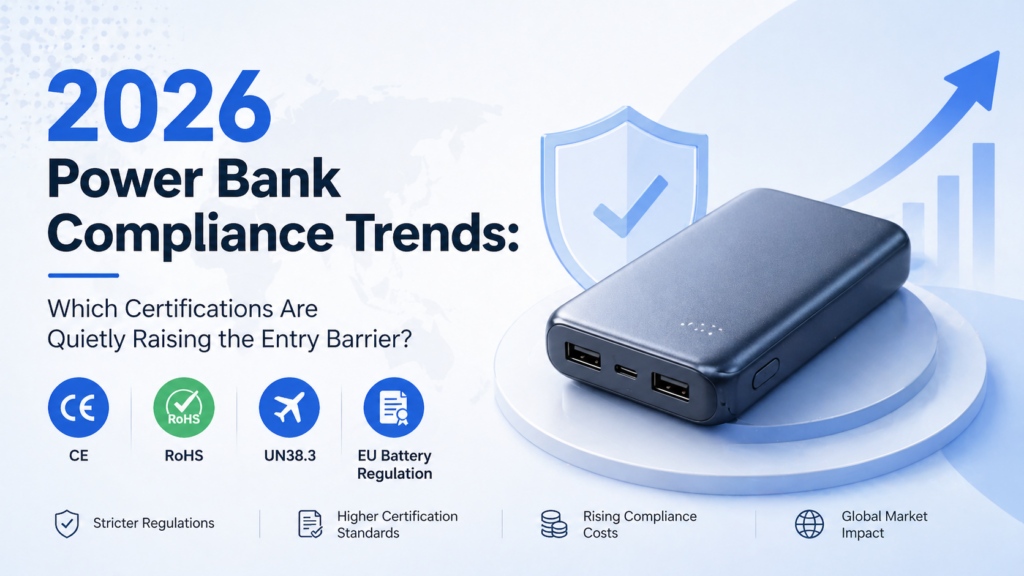
A power bank can fail at the worst moment. Confusing charge duration with product lifespan makes it harder to choose the right capacity.
A power bank can run a phone for one to several extra charges and may remain useful for several years. Actual results depend on capacity, conversion efficiency, device size, charging cycles, heat, storage, and cell quality. Runtime and total lifespan are different questions.
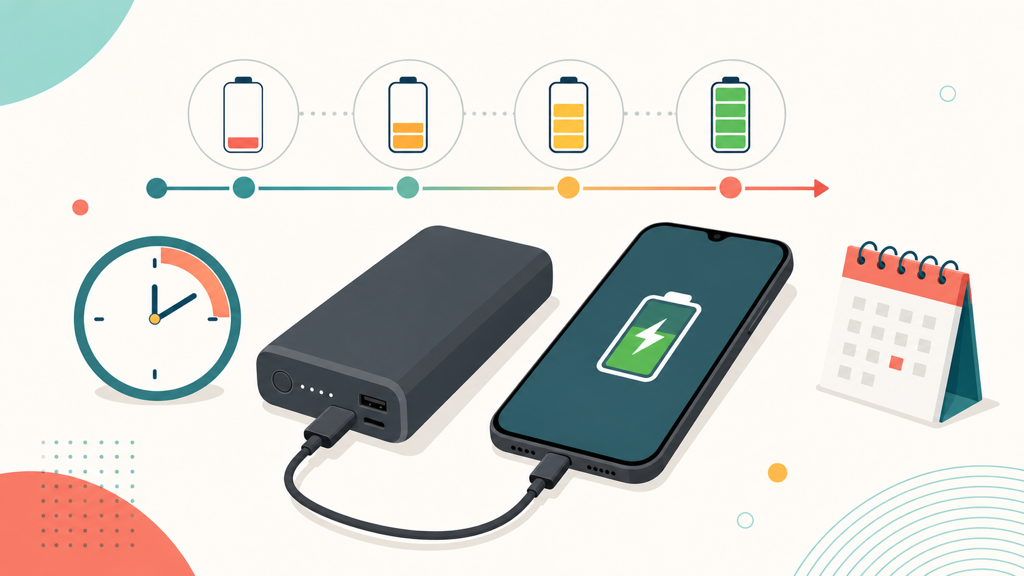
I often hear this question after a buyer has already compared mAh numbers. The better answer starts by separating daily runtime from long-term battery health.
How Many Hours Does A Power Bank Last Per Charge?
A power bank does not have one fixed runtime. Its useful time depends on stored watt-hours, output efficiency, the connected device, and how the device is used.
Estimate runtime by comparing usable power bank energy with device consumption. A 10,000mAh model can often provide about one to two smartphone charges, while larger models can provide more. Screen use, mobile signal, fast charging, cable quality, and conversion loss change the result.
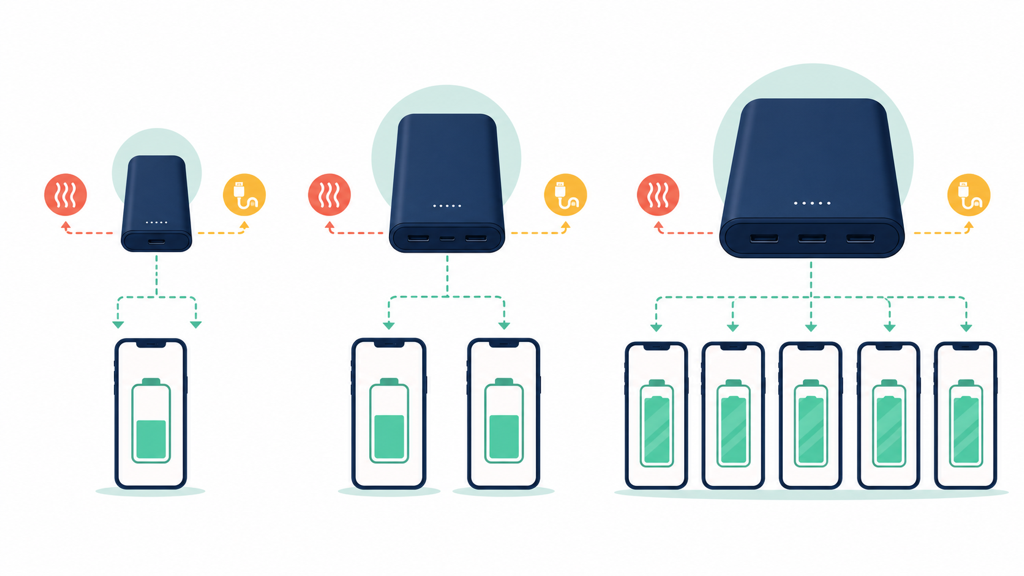
A power bank label usually shows the capacity of its internal cells. It does not promise that every labeled milliamp-hour will enter your phone. The internal battery may operate near 3.7V, while the USB output may supply 5V, 9V, or another negotiated voltage. The control circuit must convert that energy, and some energy becomes heat.
Watt-hours make the comparison clearer:
Wh = mAh x battery voltage / 1000
A 10,000mAh power bank rated at 3.7V stores about 37Wh. A 20,000mAh model stores about 74Wh. The final usable energy will be lower because the power bank circuit, cable, and phone charging circuit all have losses.
| Power Bank Size | Approximate Stored Energy At 3.7V | Practical Use |
|---|---|---|
| 5,000mAh | 18.5Wh | Emergency top-up or compact daily carry |
| 10,000mAh | 37Wh | About one to two modern phone charges |
| 20,000mAh | 74Wh | Multiple phone charges or some tablet use |
| 27,000mAh | 99.9Wh | Longer travel or higher-power devices |
These are planning ranges, not guarantees. A phone with a large battery will receive fewer full charges than a smaller phone. A user who runs navigation, video, games, or a mobile hotspot while charging will also see less battery percentage gained. Part of the output is powering the phone at that moment.
Charging power affects time, but it does not create more stored energy. The USB Implementers Forum explains that USB Power Delivery lets compatible devices negotiate flexible power levels over USB.1 A 30W or 65W power bank may charge a compatible device faster than a basic 10W model, but capacity still determines how much total energy is available.
In my experience, the most common buyer mistake is treating capacity and wattage as the same specification. Capacity tells you roughly how much energy the product stores. Wattage tells you how quickly it can deliver energy under supported conditions. A high-wattage, low-capacity model can be fast but short-lived. A high-capacity, low-wattage model can last longer but feel slow.
Brands should test the finished power bank with several popular phones, not only with an electronic load. Real-device testing reveals protocol compatibility, cable behavior, heat, and charge tapering near 100 percent. Consumer product pages should use estimated charge ranges and name the test device. That is more useful than promising an exact number for every phone.
How Many Years Does A Power Bank Last?
A well-made power bank may remain useful for several years, but every rechargeable lithium-ion battery gradually loses capacity. Usage and storage conditions matter as much as calendar age.
Power bank lifespan depends on charge cycles, cell quality, temperature, depth of discharge, charging voltage, protection design, and storage. Replace a unit that is swollen, damaged, unusually hot, leaking, or unreliable. A shorter runtime alone can be normal aging, but physical changes need immediate attention.
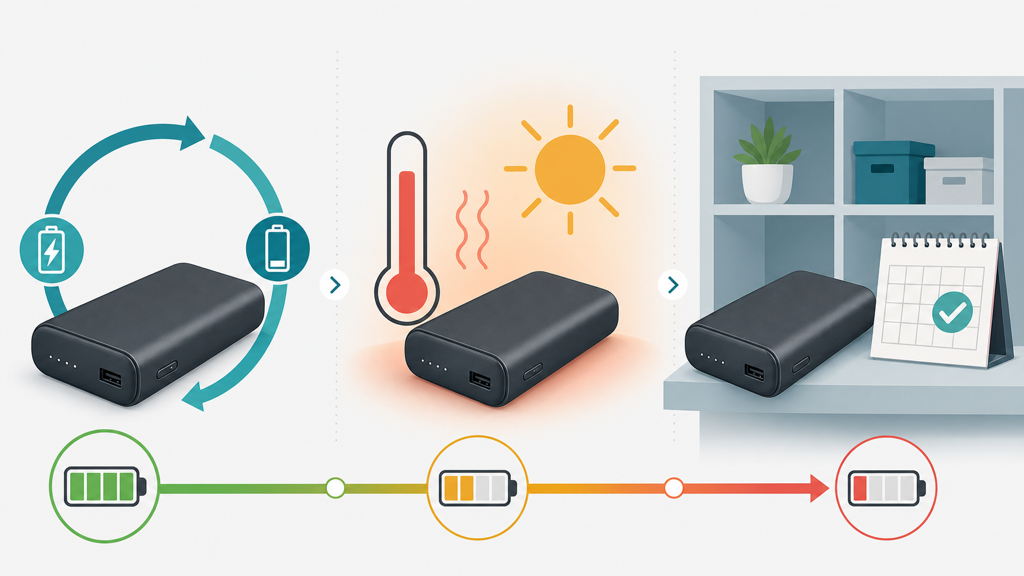
Apple makes a useful distinction in its battery guidance: battery life is the time a device runs before recharging, while battery lifespan is the time until replacement is needed. Its explanation of lithium-ion battery aging also notes that chemical age reflects factors such as charging cycles and care, not time alone.2 The same basic distinction helps power bank users.
A charge cycle is not necessarily one cable connection. Several partial discharges can add up to one full cycle. A user who consumes 50 percent today and 50 percent tomorrow has used roughly one equivalent cycle. Frequent small top-ups are therefore not automatically worse than waiting for a complete discharge.
| Lifespan Factor | Why It Matters | Better Practice |
|---|---|---|
| High temperature | Accelerates chemical aging and may damage capacity | Keep the unit away from hot cars and direct sun |
| Long storage at empty | Protection circuitry may eventually shut down the pack | Recharge it periodically |
| Long storage at full | High state of charge can increase aging stress | Store partly charged when practical |
| Heavy daily cycling | Uses available cycle life faster | Choose enough capacity to reduce deep daily discharge |
| Poor cells or assembly | Creates inconsistent capacity and safety risk | Buy from a traceable supplier with test records |
Heat deserves special attention. Apple’s guidance on maximizing battery performance warns that exposure above 35°C can permanently damage battery capacity and that charging in high ambient temperatures can cause further damage.3 A power bank is not an iPhone, but the underlying lesson for lithium-ion products is relevant: avoid unnecessary heat during use, charging, and storage.
I often find that users store a power bank in a glove compartment because they want emergency power nearby. That is convenient, but a closed vehicle can become a severe heat environment. A better place is a cool indoor location where the user can check and recharge the unit.
For private-label buyers, lifespan starts before assembly. Cell grade, incoming inspection, matching, welding quality, battery management settings, thermal layout, and standby current all affect the finished result. A low-cost quotation may hide weaker cells or a protection circuit with higher self-discharge. The product can pass a short function test and still disappoint customers months later.
Ask a supplier for the cell specification, cycle-test method, sample test data, protection functions, aging process, and traceability plan. The exact test target must match the cell and product design, so a single universal cycle claim is not enough. Buyers should also define the capacity level that counts as end of life in the test report. Without that condition, two cycle-life claims may not be comparable.
How Can You Make A Power Bank Last Longer?
Keep a power bank cool, use suitable chargers and cables, avoid physical damage, and recharge it during long storage. Stop using it if the case swells, cracks, smells unusual, or becomes abnormally hot.
Good care cannot stop battery aging, but it can reduce avoidable stress. Do not leave the power bank in extreme heat, crush it in luggage, expose ports to metal objects, or keep using damaged cables. Follow the manufacturer’s storage and charging instructions.
Start with temperature. Charge the power bank on a hard, open surface where heat can escape. Do not cover it with bedding or place it in direct sunlight. Mild warmth during fast charging can be normal, but rapid temperature rise, odor, deformation, or repeated shutdown is not.
Use a charger and cable that support the required voltage, current, and protocol. USB-C does not automatically mean every charger, cable, and device supports the same power. The power bank and connected device negotiate what they can use. An unsuitable or damaged cable can create slow charging, unstable connections, or extra heat.
Storage also matters. If the power bank will sit unused for months, follow its manual. A partly charged state is often more suitable than leaving it completely empty. Check it periodically because the circuit consumes a small amount of standby power even when no device is connected.
For travel, care includes legal packing. The FAA says power banks are spare lithium batteries and must be carried in the cabin rather than checked baggage. It allows rechargeable batteries from 0-100Wh, while 101-160Wh units require airline approval and batteries above 160Wh are forbidden on passenger aircraft; airlines may apply stricter rules.4 Travelers should check their airline before departure.
The watt-hour rating should be visible on the product. The FAA gives the calculation as volts multiplied by amp-hours. If capacity is shown in mAh, divide by 1,000 before multiplying by voltage. A clear, durable label helps airport staff and users identify the product quickly.
Use this practical checklist:
- Inspect the case and ports before charging.
- Keep the unit away from water, impact, and high heat.
- Use a suitable, undamaged charger and cable.
- Disconnect it if heat or behavior becomes abnormal.
- Recharge it periodically during long storage.
- Carry it in cabin baggage and protect it from short circuit.
- Recycle it through an approved battery collection channel.
For brands, long service life also depends on communication. The manual should explain normal indicator behavior, supported input and output modes, temperature warnings, storage guidance, and disposal. Clear instructions reduce misuse and help customer service distinguish a compatibility issue from a defective battery.
EverGreat approaches power bank development as a complete system. Cell selection is important, but enclosure design, battery management, ports, firmware, thermal behavior, packaging, and customer support all affect how long users can rely on the product. A strong design balances capacity, charging speed, size, cost, and realistic lifespan instead of maximizing one number.
Conclusion
A power bank lasts longer when capacity fits the device, the design limits losses and heat, and the user stores, charges, and handles it carefully.
-
This USB-IF page supports the explanation of negotiated USB Power Delivery and compatible power levels. ↩
-
This Apple Support page supports the distinction between battery life and lifespan and explains chemical aging factors. ↩
-
This Apple battery guidance supports the warning that high ambient temperature can permanently damage lithium-ion battery capacity. ↩
-
This FAA page supports the watt-hour calculation and passenger rules for power banks and spare lithium-ion batteries. ↩