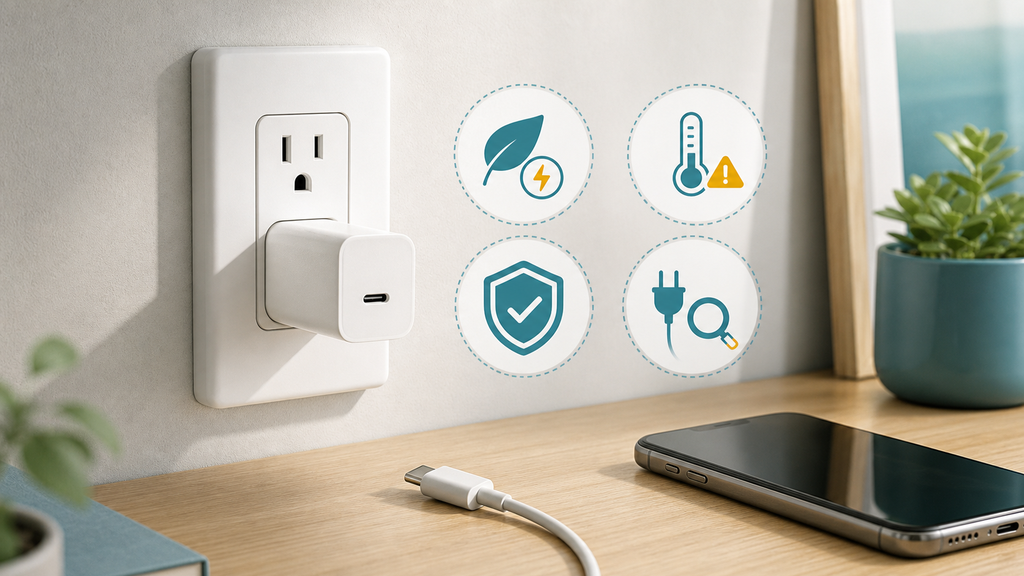
Your wireless charger works today, then fails after you change the case. The charger may not be broken. The gap changed.
A wireless charger can work through many phone cases, but thick cases, metal plates, wallets, magnets in the wrong position, pop grips, and poor coil alignment can block or weaken charging. Thin non-metal cases usually work best.

I often see this issue when brands sell wireless chargers without explaining case limits. The charger looks simple, but the space between two coils decides a lot.
Why Do Some Phone Cases Stop Wireless Charging?
Some cases stop wireless charging because they add distance, block the magnetic field, or move the phone away from the charging coil.
Phone cases can stop wireless charging when they are too thick, contain metal, include wallet cards, use misaligned magnets, or lift the phone away from the coil. Wireless charging needs close coil alignment and a material path that does not interfere.

Wireless charging is based on power transfer between a transmitter coil in the charger and a receiver coil in the phone. The system works best when the coils are close and aligned. A case changes both conditions.
The Wireless Power Consortium manages the Qi standard, including newer magnetic alignment features in Qi2.1 Magnetic alignment helps reduce one common problem: users placing the phone slightly off center. But magnets do not solve every case problem. If the case is too thick or contains the wrong material, charging can still be weak or unstable.
| Case type | Wireless charging result | Main risk |
|---|---|---|
| Thin plastic case | Usually works | Minor efficiency loss |
| Thick rugged case | May work poorly | Larger coil gap |
| Metal case | Often fails | Field interference |
| Wallet case | Risky | Cards and metal parts |
| Ring grip case | Unstable | Poor contact and alignment |
Many users think wattage is the only reason charging feels slow. In reality, the case can reduce efficiency before wattage matters. A 15W wireless charger may not deliver a stable experience if the phone sits too far from the coil. The user may see heat, cycling, slow charging, or no charging at all.
I also see problems with decorative parts. A metal plate for a car mount can block charging. A thick camera lip can prevent the phone from lying flat. A ring stand can create a physical gap. Even if the phone shows the charging icon, the actual current may be low.
For brands, this is a product communication issue. The listing should not simply say “case friendly.” That phrase is too vague. A better description explains that thin non-metal cases are usually supported, while metal, magnetic accessories in the wrong location, and thick wallet cases may interfere.
For manufacturers, fixture testing helps. Test common case categories, not only a bare phone. A charger that works perfectly with no case may still disappoint real users because most users do not remove the case every night.
Can Thick Cases Make Wireless Charging Hot Or Slow?
Yes, thick cases can make wireless charging slower and warmer because they increase distance and reduce transfer efficiency.
A thick phone case can make wireless charging slower or warmer because the charger must transfer power across a larger gap. Poor alignment and blocked heat dissipation can increase temperature and cause the phone or charger to reduce charging speed.
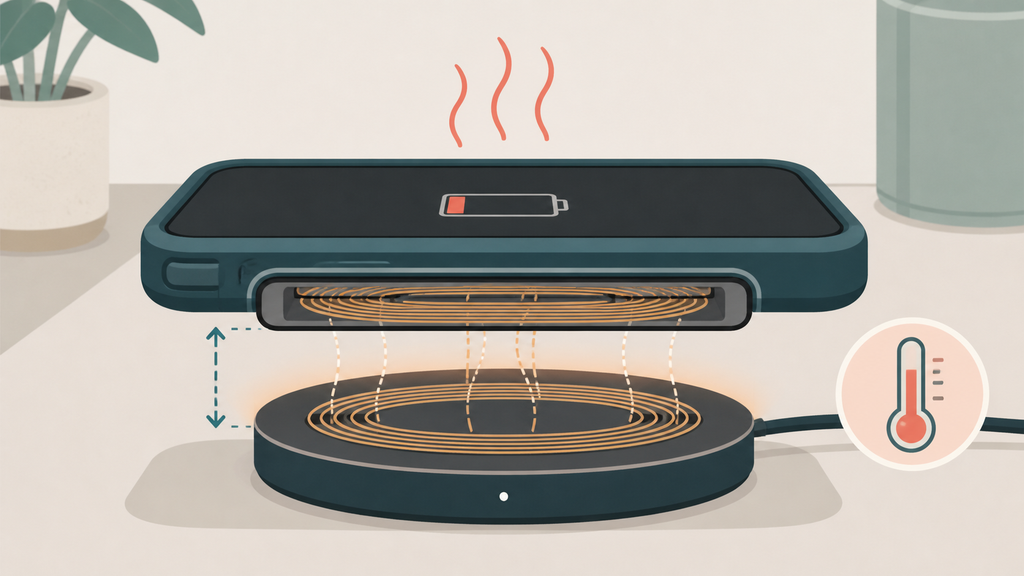
Heat is one of the most common wireless charging complaints. It does not always mean danger, but it often means inefficiency. When the coil alignment is poor or the gap is too large, more energy can be lost as heat instead of reaching the battery efficiently.
Phone makers often manage charging speed based on temperature. If the phone gets warm, the system may slow charging to protect the battery. Apple explains that iPhone charging can slow or pause when the device gets too warm.2 This is not only a wired charging issue. Wireless charging can also trigger thermal control when heat builds up.
| Symptom | Possible case-related cause | What to test |
|---|---|---|
| Slow wireless charging | Case too thick | Try without case |
| Phone gets warm | Poor efficiency | Check alignment |
| Charging starts and stops | Coil position mismatch | Reposition phone |
| Charger LED blinks | Foreign object detection | Remove metal parts |
| Works on one charger only | Coil size difference | Compare charger designs |
The case can also trap heat. A thick rugged case protects the phone from impact, but it may reduce heat dissipation. A user may think the charger is overheating when the phone case is part of the thermal path. This is why I test both bare-phone and case-on scenarios when evaluating wireless chargers.
Foreign object detection is another factor. Qi chargers are designed to detect certain metal objects between the charger and phone. This matters because metal objects can heat up. Wallet cases with cards, coins, keys, or metal plates can create risk. Even when the charger refuses to start, that failure may be the system protecting the user.
From a B2B point of view, the case problem affects return rates. A retailer may receive many “charger not working” complaints, but the root cause is mixed case behavior. If the product page, manual, and support team do not explain this, the charger gets blamed for every accessory conflict.
EverGreat usually advises customers to define a realistic case test before production. Do not promise compatibility with every case. Test thin TPU, silicone, leather-style, magnetic, and thick protective cases. Record which ones pass and which ones should be excluded from the user instructions.
The best product is not the charger that claims everything. It is the charger that performs consistently under realistic conditions and explains its limits clearly.
What Should Buyers Check Before Selling Case-Friendly Wireless Chargers?
Buyers should test coil alignment, case thickness, magnet layout, temperature, charging stability, and user instructions before launch.
Before selling a case-friendly wireless charger, buyers should test common phone models with real cases, confirm coil alignment, check temperature rise, verify foreign object detection, and write clear limits for metal cases, wallet cases, and thick rugged cases.
The easiest mistake is testing only with one phone and no case. That test proves the charger works in a clean lab condition. It does not prove the charger will work for customers.
I prefer a practical test matrix. Choose the target phone models, then test each one with several common case types. Track start time, charging stability, temperature, and whether the phone needs exact placement. A charger that requires perfect placement may pass technically but fail commercially.
| Buyer checklist | Why it matters |
|---|---|
| Phone model coverage | Coil position varies by device |
| Case thickness test | Finds real-world failures |
| Magnet alignment check | Important for magnetic chargers |
| Temperature test | Reduces heat complaints |
| Manual wording | Prevents false expectations |
Certification and compliance also matter. Wireless chargers are electronic devices that may need market-specific safety and radio-frequency compliance. In the U.S., the FCC explains equipment authorization requirements for RF devices.3 Buyers should confirm the applicable path before import rather than treating wireless chargers as simple plastic accessories.
For Qi or Qi2 products, buyers should also understand what certification claims mean. A product should not casually use Qi branding unless it follows the required program. The WPC maintains the official Qi ecosystem and product certification structure.1 For private-label brands, this affects packaging, listing language, and long-term trust.
The manual should include direct case guidance. Good wording can say that charging works with many thin non-metal cases, but users should remove metal plates, wallet cards, magnetic accessories not designed for the charger, and unusually thick cases. This reduces confusion without sounding defensive.
Support teams need the same clarity. When a customer says the charger stopped working, ask whether they changed the case, added a metal plate, used a wallet case, or placed the phone off center. These questions solve many complaints quickly.
From a manufacturing perspective, coil design and housing shape also matter. A large stable contact area helps users place the phone correctly. Rubber pads can prevent sliding. Magnetic alignment can improve consistency when the phone and case support it correctly. Small design choices can make the charger feel more reliable.
For brands, I would treat “case-friendly” as a tested claim, not a marketing phrase. If you can name the limits, support can defend the product. If you cannot name the limits, the market will discover them through returns.
Conclusion
Wireless chargers work through many cases, but thickness, metal, accessories, alignment, and heat decide the real user experience.
-
The Wireless Power Consortium explains Qi and Qi2 through its official Qi wireless charging standard resources. ↩ ↩
-
Apple describes temperature-related charging limits in its iPhone temperature guidance. ↩
-
The FCC explains RF device authorization through its equipment authorization resources. ↩