A bad power bank can make users nervous fast. One warm cable, slow charge, or swollen battery story can damage trust in the whole category.
A quality power bank should not damage your phone because modern phones control how much power they accept. The real risks come from poor-quality power banks, damaged cables, unstable output, excess heat, fake ratings, and products without proper protection design.
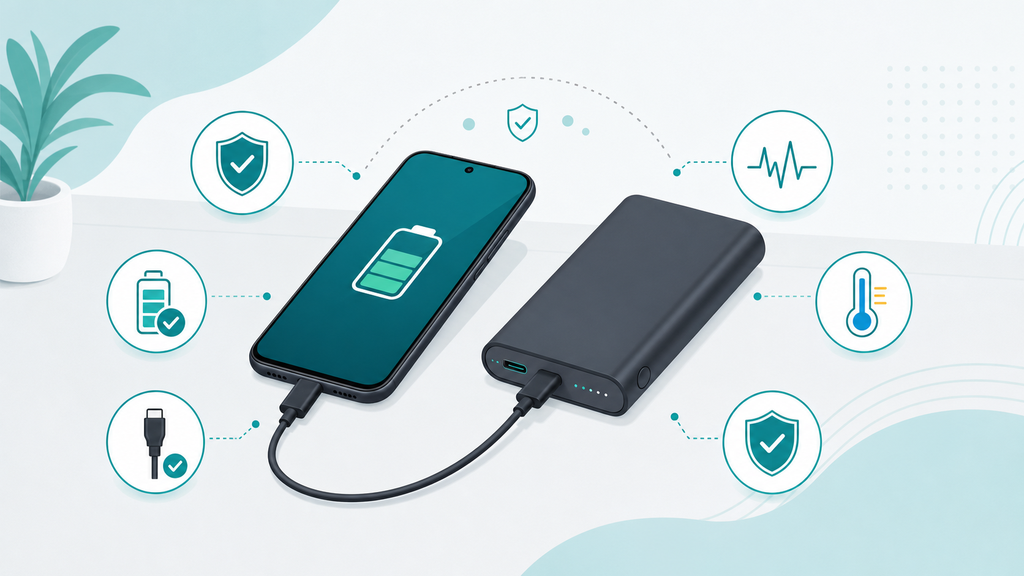
Many customers ask me this before buying a power bank or launching a private-label model. The answer is reassuring, but it is not casual. The phone, power bank, cable, and user environment all matter.
Can A Power Bank Overcharge Or Overpower A Phone?
Users often think a large power bank can push too much power into a phone. That fear is understandable, but charging does not work like pouring water into a cup.
A proper power bank should not overcharge or overpower a phone. The phone manages charging and accepts only supported power levels. With USB-C Power Delivery, the charger and device negotiate power instead of simply sending maximum output.
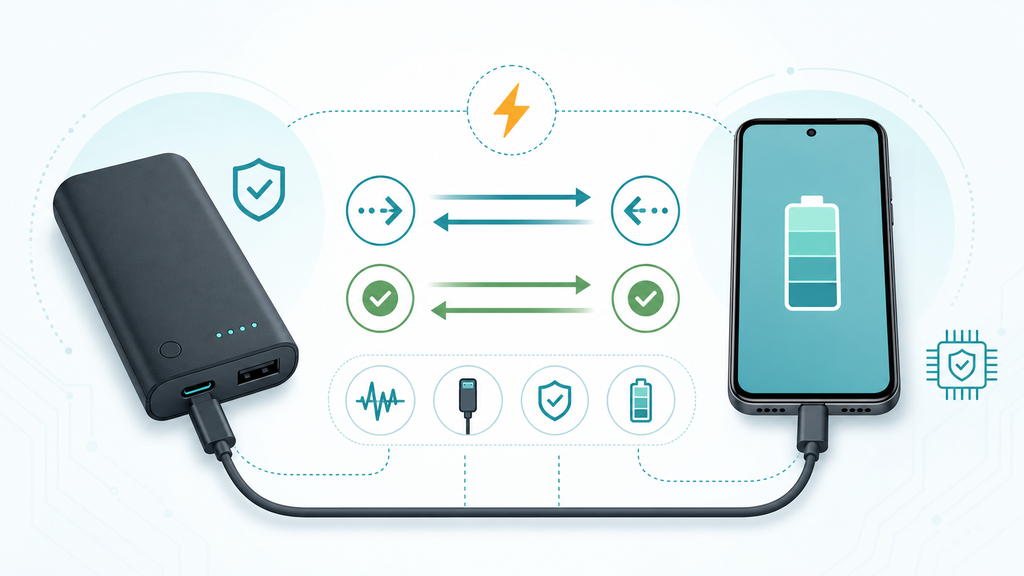
USB-IF describes USB Power Delivery as a flexible system that lets devices receive the power they require.1 That is the key idea behind safe fast charging. A 65W power bank does not automatically force 65W into every phone. The phone requests a supported voltage and current profile. The power bank responds. The cable must also be suitable for the current.
Apple explains that lithium-ion batteries charge quickly until they reach about 80 percent, then switch to slower charging.2 This also shows that the phone’s charging behavior is controlled. Charging speed changes with battery level, temperature, settings, and device conditions. If a phone slows down near full charge, that is usually battery management, not a bad power bank.
In manufacturing, I explain power bank safety as a chain:
| Part | What It Controls | Why It Matters |
|---|---|---|
| Phone | Charging request and battery management | Prevents unsupported charging behavior |
| Power bank circuit | Output stability and protection | Prevents voltage drops, spikes, and overheating |
| Cable | Current carrying and connector fit | Prevents heat and unstable contact |
| Battery cells | Energy storage quality | Affects safety, cycle life, and heat |
| Firmware | Protocol negotiation and cutoffs | Controls PD, PPS, and protection behavior |
The danger is not that a large-capacity power bank has more mAh. Capacity mainly means how much energy the power bank stores. It does not tell you whether the product has good output control. A 20,000mAh power bank can be safe if the cells, PCB, firmware, ports, and housing are designed well. A small cheap power bank can be risky if those parts are weak.
Many users also confuse wattage with damage. Higher wattage can help charge laptops, tablets, and phones faster when the device supports it. But phone charging is still limited by the phone. The bigger issue is whether the power bank output is stable under load and whether the cable is built correctly.
For brands, this is why claims must be precise. Do not say "safe for all phones" without testing and documentation. Say which output protocols are supported. Say what cable is recommended. Test common iPhone and Android models. Test low battery, mid battery, and near-full battery behavior. Test one port and multiple ports if the product supports multi-device charging.
At EverGreat, I prefer sample approval to include real phone testing, not only a power meter reading. A power meter tells part of the story. Real phones reveal negotiation behavior, heat, user comfort, and unexpected compatibility differences.
When Can A Power Bank Actually Be Risky?
Most damage stories start with a weak accessory, a hot environment, or a product that looked acceptable only because it charged at first.
A power bank can be risky when it has poor cells, weak protection circuits, unstable output, damaged ports, fake certification claims, a swollen battery, overheating, water damage, or a cable that gets hot at the connector.
The U.S. Consumer Product Safety Commission has warned consumers not to buy or use chargers marketed as universal when they are not compatible with a device, because incompatibility can create fire hazards in lithium battery products.3 The warning focuses on micromobility products, but the broader lesson is useful for consumer electronics: fitting the port is not the same as being electrically suitable.
A power bank contains a lithium-ion or lithium-polymer battery. It also contains a charging input circuit, output circuit, protection system, and often fast-charging firmware. If the product is poorly designed, problems can appear as heat, unstable charging, sudden shutdown, port failure, or battery swelling.
| Warning Sign | Possible Meaning | User Action |
|---|---|---|
| Power bank swells | Battery cell failure risk | Stop using it immediately |
| Port or cable gets hot | Poor contact or high resistance | Stop charging and replace the cable or product |
| Charging starts and stops | Unstable output, loose port, or compatibility issue | Test another cable and device |
| Strong smell or noise | Internal fault risk | Stop using it |
| Shell becomes very hot | Thermal design or load problem | Disconnect and let it cool |
| Rating looks unrealistic | Possible fake capacity or poor design | Avoid the product |
UL Solutions notes that lithium-ion batteries can fail when damaged, misused, or poorly manufactured, and that failures can involve heat, fire, or explosion risk.4 That is why product quality matters so much. The user usually cannot see cell matching, insulation, PCB layout, protection ICs, thermal design, or firmware quality. They only see the shell and the price.
I often see risk rise when buyers choose based only on capacity and low cost. A very cheap "high-capacity" model may cut corners in cells, housing material, port structure, or testing. It may work during a short sample test, but fail after heat, vibration, repeated cable plugging, or multi-device use.
Cable quality is another common blind spot. A good power bank can still produce a bad experience with a damaged or weak cable. Heat at the connector is not normal. A loose plug can create intermittent contact. A thin cable can limit charging or warm under load. For private-label projects, the cable should be treated as part of the product system, not a throwaway accessory.
For EverGreat projects, I prefer conservative product design over exciting but fragile specifications. Good products need overcharge protection, over-discharge protection, over-current protection, short-circuit protection, temperature control, cell quality checks, aging tests, and realistic port testing. These details are not always visible in marketing photos, but they decide after-sales risk.
How Should You Choose A Phone-Safe Power Bank?
The safest power bank is not always the biggest one. It is the one that matches your device, uses quality cells, controls heat, and gives honest specifications.
Choose a phone-safe power bank by checking reliable branding, real capacity, USB-C PD support, quality cables, protection features, certification documents, thermal performance, and clear instructions for charging phones, tablets, and other devices.
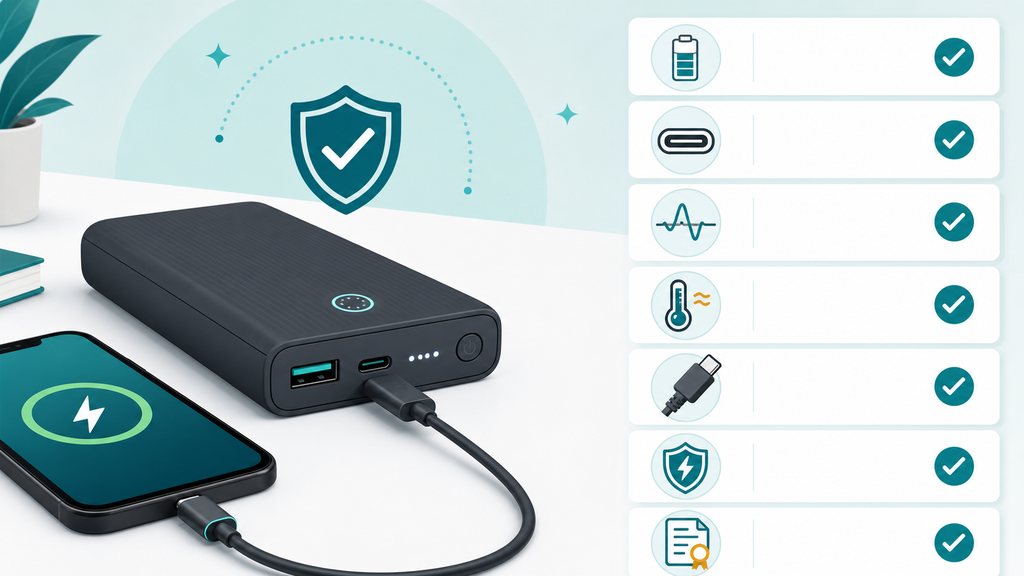
For everyday phone users, start with fit. If your phone supports USB-C fast charging, a USB-C PD power bank is usually a better choice than an old USB-A-only model. If you use an iPhone with USB-C or Lightning, use the correct cable and avoid loose connectors. If you use wireless charging, check alignment, case thickness, and heat.
For buyers and brands, the checklist should go deeper:
| Buying Check | What To Ask | Why It Matters |
|---|---|---|
| Cell quality | What cell brand, grade, and test process are used? | Reduces swelling and capacity issues |
| Output protocol | Does it support USB-C PD or PPS as needed? | Improves compatibility and charging speed |
| Protection design | What protections are built into PCB and firmware? | Reduces electrical and thermal risk |
| Thermal testing | What happens under long load and warm conditions? | Reveals real user comfort |
| Cable pairing | Which cable was used for testing? | Prevents connector heat and slow charging |
| Certification | Which market documents are available? | Supports import and retail compliance |
Do not choose only by mAh. Capacity matters, but it is only one dimension. A 10,000mAh power bank with stable PD output and good thermal control may be better for daily phone charging than a cheaper 30,000mAh model with unknown cells. For travel, size, weight, airline rules, and certification also matter. For retail, packaging claims and user instructions matter because they reduce confusion.
I also suggest checking how the power bank behaves near empty battery and under multi-port use. Some products perform well at full charge but become unstable at low remaining capacity. Some multi-port models split power in a way users do not expect. If the packaging promises a maximum wattage, the user may assume every port always gets that wattage. That is rarely true.
For brands, product manuals should explain compatible cables, input/output limits, pass-through charging rules, storage conditions, and warning signs. Good instructions are not just legal text. They prevent users from charging under blankets, ignoring swelling, using damaged cables, or expecting laptop-level output from a phone-focused model.
EverGreat customers often ask me what specification sells best. My answer depends on the market, but I always push for balanced quality: honest capacity, stable output, good cells, tested ports, and clear charging behavior. A power bank should protect the user’s phone, but it should also protect the brand’s reputation after thousands of daily charging cycles.
Conclusion
A good power bank should not damage your phone. Choose stable output, quality cells, proper cables, protection design, and tested thermal behavior.
-
USB Implementers Forum, USB Charger (USB Power Delivery). ↩
-
Apple, Batteries – Why Lithium-ion?. ↩
-
U.S. Consumer Product Safety Commission, CPSC Urges Consumers to Not Buy or Use "Universal" Chargers with Micromobility Products Due to Fire Hazard. ↩
-
UL Solutions, Lithium-Ion Battery Safety. ↩