A travel charging kit can look useful, but one weak cable, unsafe power bank, or unclear claim can damage customer trust.
Brands should build a private label travel charging kit by matching the wall charger, cable, power bank, storage pouch, compliance documents, and packaging claims to one clear travel use case. The best kit is not the biggest bundle. It is the bundle customers can understand and use safely.
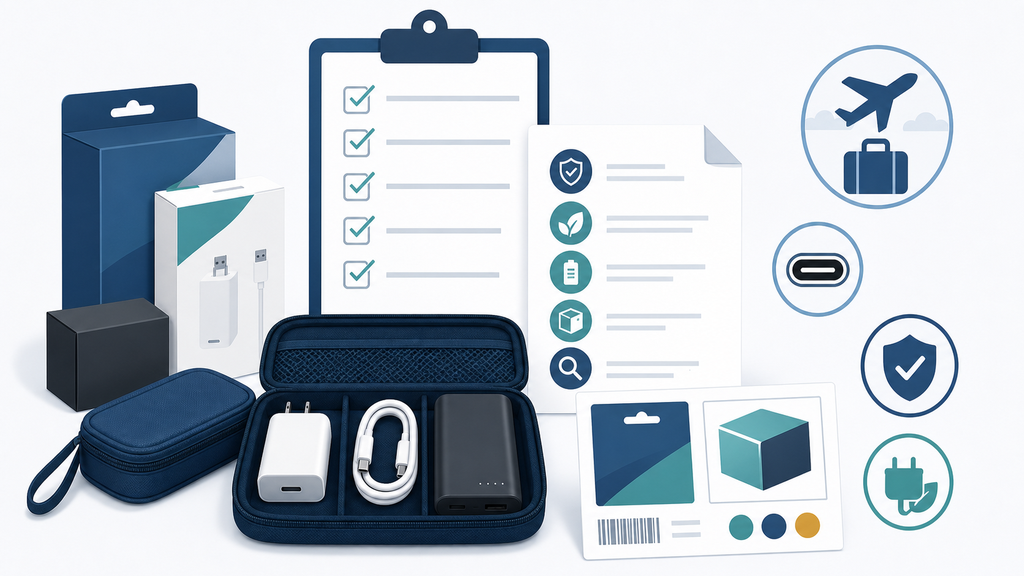
I often see buyers start with a product list. I prefer to start with the travel moment, because that decides what the kit should include and what risk the brand must control.
What Should Go Inside The Kit?
Too many items raise cost and confusion, while too few items make the kit feel incomplete.
A travel charging kit should include only the items that solve one clear charging problem: a wall charger, suitable cable, optional power bank, travel pouch, and simple instructions. The exact mix depends on the target customer, device type, market, and price point.
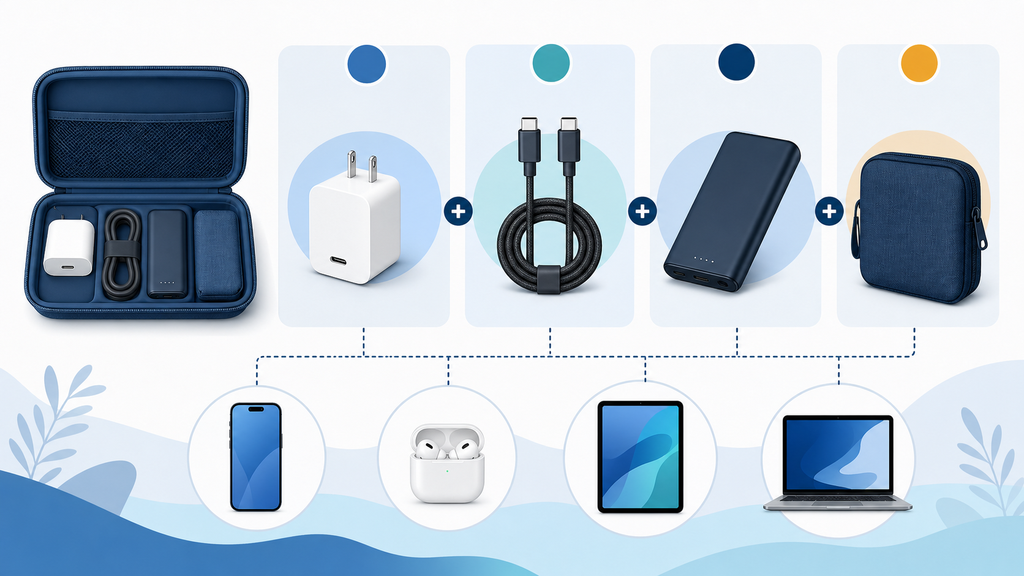
In my experience, the most common mistake is building a kit around quantity. A buyer may ask for a charger, two cables, adapters, a power bank, and a pouch because the bundle looks rich. The problem appears later. The retail price becomes high, the packaging becomes crowded, and the customer does not know which item is the main value. A better kit has a clear promise. It may be a "phone travel kit," a "business trip laptop kit," or a "conference giveaway charging kit." Each promise leads to a different product structure.
For a basic phone travel kit, a 20W to 30W USB-C charger, one USB-C cable, and a compact pouch may be enough. For a business traveler, a 45W to 65W charger and a stronger cable can make more sense. If the kit includes a power bank, the buyer must think about battery capacity, airline rules, labeling, and after-sales support. The FAA says spare lithium ion batteries, including power banks and portable rechargers, must be carried in carry-on baggage only, with common lithium ion batteries limited to 100Wh unless airline approval applies for larger spare batteries under its PackSafe lithium battery guidance1. This matters because a travel kit should not create confusion at the airport.
USB-C is now the natural center of most travel kits. The USB-IF explains certified USB chargers under USB Power Delivery through its USB charger and Power Delivery program2. For buyers, this means the charger and cable should be planned together. A cable that cannot support the advertised power can make the charger look weak. A charger with unclear port sharing can create complaints when users charge more than one device.
| Kit Type | Typical Contents | Buyer Risk |
|---|---|---|
| Phone travel kit | 20W-30W charger, USB-C cable, pouch | Low cost, limited differentiation |
| Laptop travel kit | 45W-65W charger, stronger cable, pouch | More heat and power-claim risk |
| Power bank travel kit | Power bank, cable, pouch, warning insert | Airline and battery documentation risk |
| Promotional kit | Simple charger or cable, branding, gift box | Deadline and quality consistency risk |
I suggest buyers choose one hero item. If the hero item is the charger, the cable and pouch should support it. If the hero item is the power bank, the kit should focus on safe storage, clear capacity, and travel instructions. This keeps sourcing, packaging, and customer service easier to manage.
EverGreat often helps customers narrow the kit before quoting. That step saves time. A smaller, clearer kit can sell better than a crowded bundle because customers understand what they are buying.
Which Compliance Details Should Buyers Check First?
A kit combines several products, so one missing document can delay the whole launch.
Buyers should check charger safety, energy efficiency, cable rating, battery transport documents, label artwork, and market-specific packaging rules before mass production. The compliance plan should match the actual kit contents, not a generic product list.
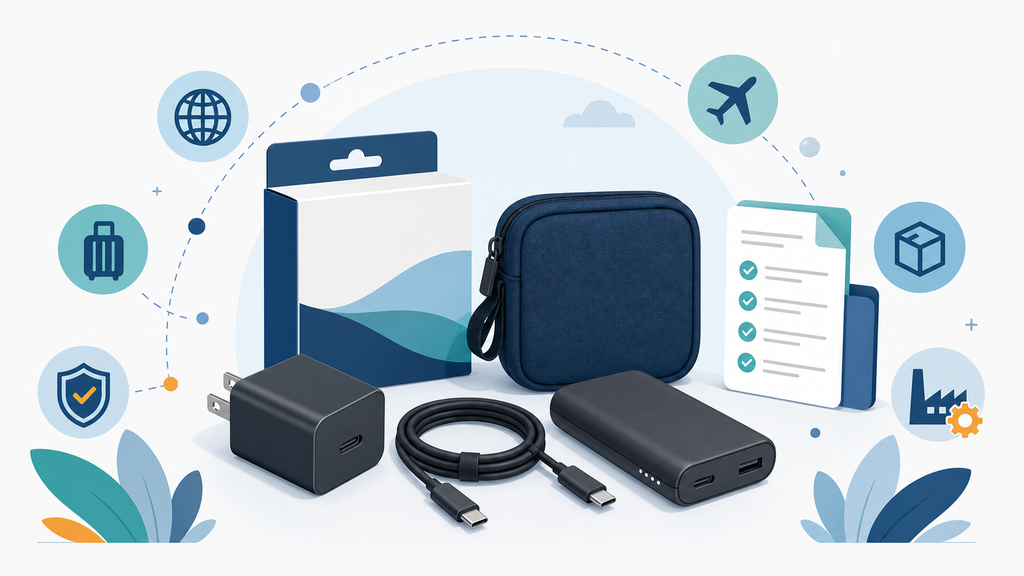
Private label kits create a documentation problem that many new brands miss. Each item may have its own requirement. A wall charger connects to mains power. A cable may need rating and material checks. A power bank contains lithium-ion cells. Packaging may carry recycling marks, warning labels, and power claims. When these items are sold together, the buyer needs a document package that explains the full kit clearly.
For wall chargers sold in the United States, energy efficiency can matter. The U.S. Department of Energy defines an external power supply as a circuit that converts household electric current into DC current or lower-voltage AC current to operate a consumer product, and its page on external power supplies3 explains that manufacturers have had to comply with DOE energy conservation standards for external power supplies since 2007. Buyers should not treat this as a final paperwork step. If the tested charger, label, and mass production design do not match, the brand may face channel questions later.
For Europe, USB-C expectations affect product planning and packaging. The European Parliament said the common charger law would make USB-C the common charging port for many portable electronic devices from late 2024, with laptops following later, in its common charger announcement4. A travel kit does not become compliant only because it uses USB-C. Buyers still need to check the charger, cable, device compatibility claims, labels, and local market rules. But USB-C does influence what customers expect to see in a modern kit.
| Item | Document To Check | Common Mistake |
|---|---|---|
| Wall charger | Safety report, efficiency evidence, rating label | Using documents from a similar model |
| USB-C cable | Current rating, material, connector quality | Advertising higher power than cable supports |
| Power bank | Cell documents, UN38.3, MSDS, transport file | Capacity label does not match shipment file |
| Packaging | Warning text, recycling marks, import label | Printing artwork before document review |
I have seen projects lose time because packaging was approved before compliance review. The box looked beautiful, but the output rating, battery capacity, and warning text needed changes. That creates waste and stress. It is better to review the technical documents before final artwork. The buyer should ask the supplier to confirm model numbers, ratings, certification owner, factory information, and whether private label changes affect existing reports.
The strongest suppliers do not only send certificates. They explain how the documents connect to the exact product. That explanation is important. It shows whether the supplier understands the market or only copies files from past orders.
How Can Packaging And Claims Reduce Returns?
Returns often start when the package promises more than the kit can reliably deliver.
Packaging should explain the kit’s real charging use case, compatible devices, power limits, travel notes, and safe storage instructions in simple language. Honest claims reduce customer confusion, retailer pressure, and after-sales cost.
Packaging is not only a sales surface. It is also a risk control tool. I often find that buyers want the largest power number on the front of the box. That may help attention for a moment, but it can create complaints if customers misunderstand it. For example, a kit may include a 65W charger and a cable, but the charger may only provide 65W on one port when used alone. If the customer plugs in a phone and laptop together, the power may split. That is normal, but the packaging must make the real behavior clear.
The same issue appears with power banks. A 10,000mAh power bank sounds simple, but real charging output depends on voltage conversion, device behavior, cable quality, temperature, and battery level. If the kit is marketed for travel, buyers should include clear instructions for carry-on storage and short-circuit protection. A small insert card can prevent customer confusion and reduce service messages. It can also show that the brand takes safety seriously.
I also recommend writing claims from the customer’s point of view. Instead of saying "universal fast charging for all devices," say what the kit is designed to support. For example, "designed for phones, earbuds, and small travel devices" is safer than a broad universal claim. For a laptop kit, list the power range and explain that charging speed depends on the device and cable. Simple language often builds more trust than aggressive marketing.
| Claim Area | Safer Approach | Risky Approach |
|---|---|---|
| Power | State the charger output and port-sharing behavior | Promise maximum power in every situation |
| Compatibility | Name device categories and limits | Say it works with all devices |
| Travel | Explain carry-on storage for power banks | Ignore airline battery rules |
| Cable | Match cable rating to charger claim | Bundle a low-rated cable with a high-power charger |
| Safety | Give storage and heat guidance | Use vague "100% safe" language |
Manufacturing consistency also affects returns. A kit has more touchpoints than a single product. The charger, cable, pouch, insert, box, and barcode all need quality control. One wrong cable color or missing insert can delay a retailer shipment. One weak pouch zipper can make the whole kit feel cheap. Buyers should inspect the complete assembled kit, not only each item separately.
For EverGreat projects, I like to build a golden sample that includes every final detail: product, cable, pouch, instruction card, label, barcode, and carton mark. The buyer can approve that sample before mass production. The factory can use it as the reference during inspection. This simple step reduces arguments because everyone can see what "correct" means.
Conclusion
Build travel charging kits around one clear use case, matched components, verified documents, honest claims, and complete kit-level quality control.
-
This FAA source supports the travel guidance around lithium-ion power banks and carry-on baggage rules. ↩
-
This USB-IF source supports the discussion of USB Power Delivery and certified charger planning. ↩
-
This U.S. Department of Energy source supports the point that external power supplies may have energy conservation requirements. ↩
-
This European Parliament source supports the EU market context around USB-C common charger expectations. ↩