You need backup power for a long trip. But one wrong packing choice can delay boarding or get your power bank rejected.
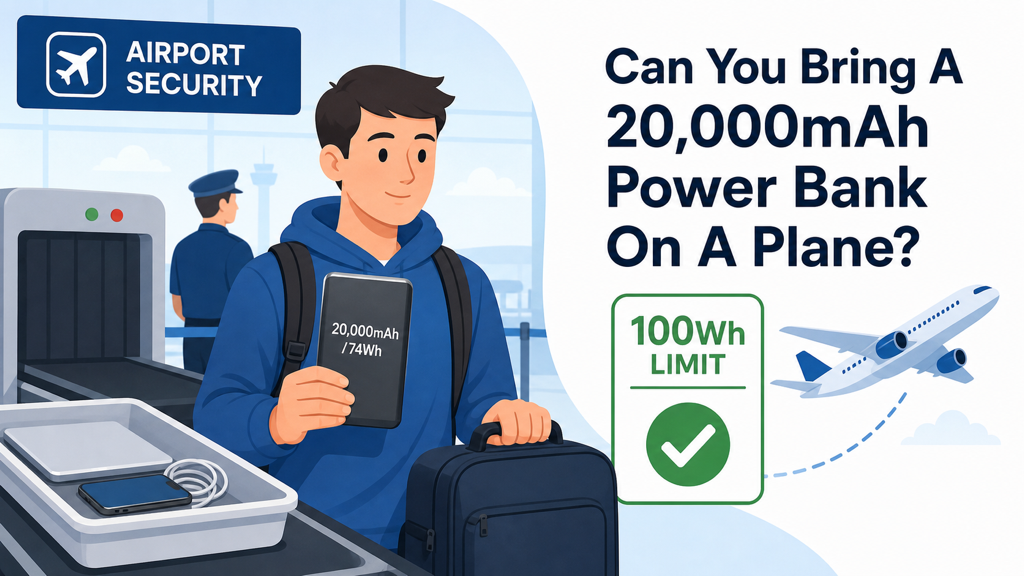
Yes, you can usually bring a 20,000mAh power bank on a plane if it is under 100Wh, packed in carry-on baggage, and protected from damage. Most 20,000mAh models are around 74Wh, but always check the label before flying.
Airline battery rules are not only a traveler issue. In my experience, they also shape how brands should label, design, and position travel power banks.
Is A 20,000mAh Power Bank Usually Under Airline Limits?
Many people check only the mAh number. That creates confusion because airlines usually judge lithium batteries by watt-hours, not only capacity.
A 20,000mAh power bank is usually allowed because many models use 3.7V lithium cells, which equals about 74Wh. The common airline limit is 100Wh for lithium-ion batteries.
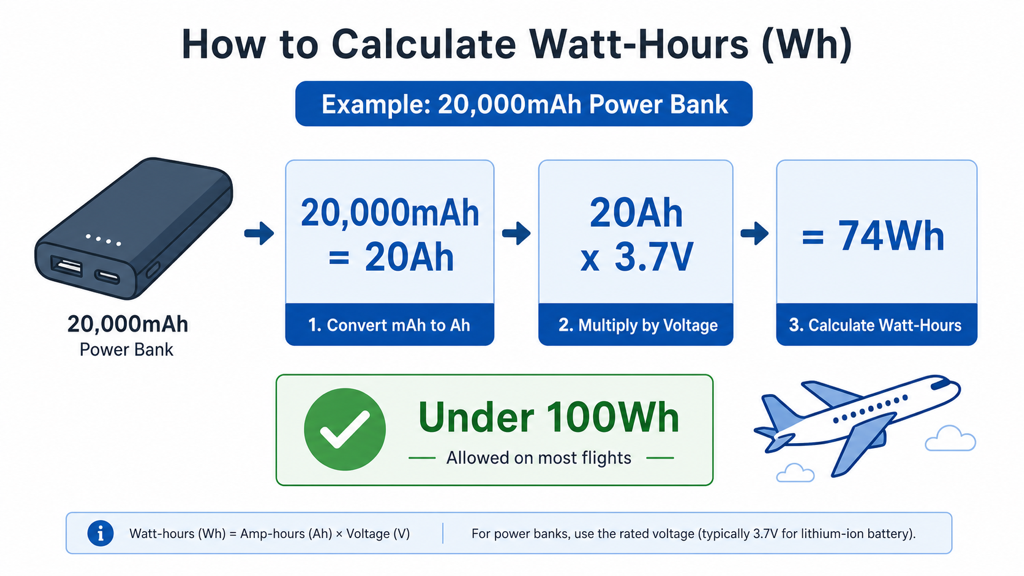
The important number is Wh. The Federal Aviation Administration says rechargeable lithium-ion batteries are limited to 100 watt-hours per battery for normal passenger carriage, with airline approval required for some larger spare batteries between 101Wh and 160Wh.FAA PackSafe lithium battery rules1 This is why a 20,000mAh power bank is often fine, while some very large 30,000mAh or 50,000mAh models can become harder to carry.
The simple conversion is:
| Label Value | What It Means | Example |
|---|---|---|
| mAh | Battery capacity | 20,000mAh |
| V | Nominal cell voltage | Often 3.7V |
| Wh | Energy rating airlines use | 20Ah x 3.7V = 74Wh |
I often find that buyer confusion starts when brands print a big mAh value but hide the Wh value in tiny text. That may look acceptable on a retail shelf, but it creates friction at airports. A traveler wants quick confidence. A security officer wants visible information. A distributor wants fewer complaints after purchase.
For brands and importers, this means the label should not treat Wh as a technical afterthought. It should be clear, durable, and easy to find. If the model is designed for travel, the package can also explain that the power bank must be carried in cabin baggage, not checked luggage. This does not replace airline rules, but it helps the customer use the product correctly.
I would also avoid pushing borderline capacity as a travel feature. A 27,000mAh design may still sit near the 100Wh line if cell voltage and rated energy are managed correctly, but it gives less room for misunderstanding. A 20,000mAh model is often a better balance for travel: useful capacity, easier airline fit, and less buyer anxiety.
Manufacturing teams should also keep certification and test documentation organized. For lithium battery transport and international shipping, the broader supply chain still cares about declarations, packaging, and battery classification. IATA notes that lithium batteries can be carried by air depending on configuration and watt-hour rating, and that spare batteries are not allowed in checked baggage.IATA battery guidance2 That matters before the product ever reaches the traveler.
How Should You Pack And Use A Power Bank During A Flight?
The biggest mistake is putting a spare power bank into checked luggage. Cabin access matters because crew can respond faster if a battery overheats.
Pack power banks in carry-on baggage only. Keep terminals protected, prevent crushing, and do not use a damaged, swollen, overheated, or recalled power bank on board.
The FAA is direct on this point: spare lithium-ion batteries, including power banks and charging cases, must be carried in carry-on baggage only. If your carry-on is gate-checked, the power bank should be removed and kept with you in the cabin.49 CFR passenger battery rule3
This rule is practical, not cosmetic. Lithium-ion batteries can enter thermal runaway if they are damaged, overheated, exposed to water, overcharged, improperly packed, or affected by manufacturing defects. The passenger cabin is not risk-free, but a visible problem is easier to manage than a hidden problem in the cargo hold.
Here is the travel checklist I would give customers:
| Before Flying | Why It Matters |
|---|---|
| Check the Wh label | Confirms the airline energy limit |
| Put it in carry-on baggage | Required for spare lithium batteries |
| Protect ports and terminals | Reduces short-circuit risk |
| Keep it away from sharp pressure | Reduces damage risk |
| Stop using it if it gets hot or swells | Early action can prevent escalation |
| Check airline-specific rules | Some carriers are stricter than the baseline |
Many airlines now pay closer attention to power banks because incidents attract public concern. The FAA maintains a lithium battery incident page and notes that listed events involve smoke, fire, or extreme heat that the agency is aware of.FAA lithium battery incident records4 The page also warns that the list should not be treated as a complete record of all incidents. That cautious wording is important. It tells us not to exaggerate the risk, but also not to dismiss it.
In real product use, small design choices matter. A recessed power button can reduce accidental activation. A strong shell can reduce impact damage. Clear LED behavior can help users notice abnormal charging. Good cell matching and protection circuitry reduce risk during normal operation. None of these details make a battery impossible to misuse, but they reduce avoidable problems.
For users, the safest habit is simple: keep the power bank where you can reach it, stop charging if anything feels wrong, and tell cabin crew if the device gets hot, expands, smokes, or smells unusual. For brands, the lesson is also simple: travel products should be designed for real travel behavior, not only lab specifications.
What Should Buyers And Brands Check Before Selling Travel Power Banks?
A travel-friendly power bank is not just a high-capacity battery. It needs clear labeling, reliable protection design, and customer instructions that match airline expectations.
Brands should check Wh labeling, battery protection design, test records, recall risk, packaging claims, and airline-facing user instructions before marketing a power bank for travel.
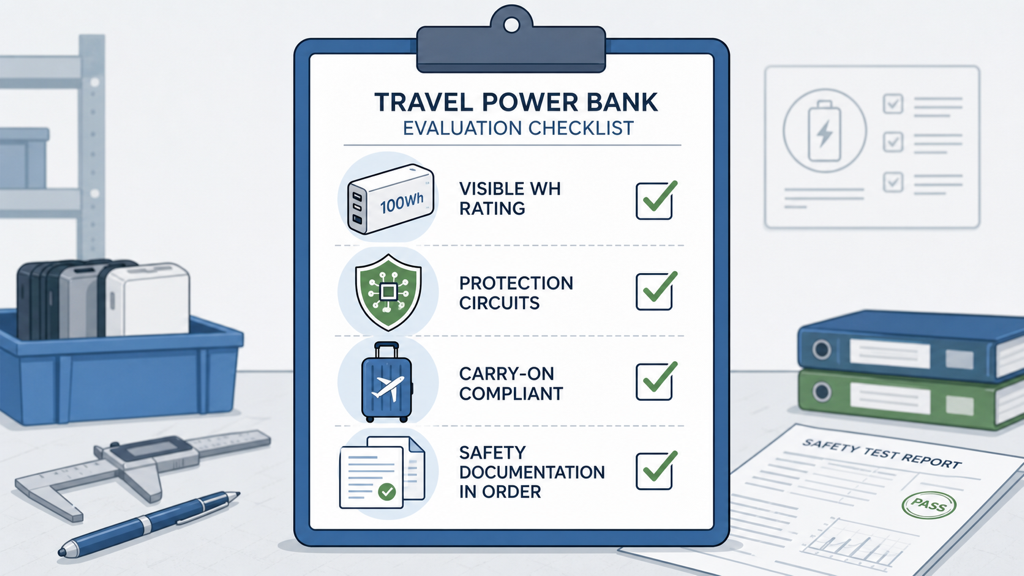
From a manufacturing view, I see two common mistakes. The first is treating airline rules as a customer-service issue after shipment. The second is treating safety labels as a graphic design detail. Both create avoidable risk.
If a product is likely to be used by travelers, the product team should discuss travel requirements during development. The rated energy should be easy to locate. The user manual should explain carry-on packing. The retail listing should avoid vague claims like "airline approved" unless the brand has checked the relevant markets and carriers. A safer phrase is often more precise: "Designed within common under-100Wh passenger battery limits; always check airline rules before travel."
I also recommend checking recall and safety history when selecting battery products or suppliers. The U.S. Consumer Product Safety Commission maintains public recall information, which is useful when buyers want to understand how battery-related product problems are communicated to consumers.CPSC recall database5 For a distributor, this is not only a legal concern. It affects brand trust, returns, customer reviews, and retailer confidence.
Here is a practical buyer-side review:
| Review Area | Good Signal | Risk Signal |
|---|---|---|
| Energy label | Wh is visible and permanent | Only mAh is obvious |
| Shell design | Strong case and clean seams | Weak enclosure or rattling parts |
| Protection system | Overcharge, overcurrent, short-circuit, and thermal protection | No clear protection explanation |
| Documentation | Test reports and battery transport documents are organized | Supplier sends files only after pressure |
| User guidance | Carry-on and abnormal-use instructions are clear | Manual says little about travel safety |
| Supplier response | Fast answers from engineering and quality teams | Sales-only answers with vague promises |
In my experience, serious buyers should ask suppliers to explain the product, not just quote a price. Ask where the Wh rating comes from. Ask how the battery management system handles abnormal current or heat. Ask how the factory controls cell sourcing. Ask whether the packaging copy could confuse travelers. A good supplier should answer these questions calmly and specifically.
EverGreat works with customers who sell through retail, promotional, and private-label channels, so I often see the commercial side of this issue. A clear travel power bank can reduce after-sales friction. It gives the end user confidence. It gives the importer better product copy. It gives the distributor fewer airport-related complaints. It also helps the brand avoid overclaiming, which is a quiet but important part of long-term trust.
The best travel power bank is not always the largest one. For many users, a well-labeled 10,000mAh or 20,000mAh model is easier to understand and easier to carry. For brands, that can be a stronger product decision than chasing maximum capacity.
Conclusion
A 20,000mAh power bank is usually flight-friendly, but clear Wh labeling, carry-on packing, and safe design decide the real travel experience.
-
FAA PackSafe explains passenger lithium battery limits, carry-on requirements, thermal runaway risks, and the common 100Wh threshold. ↩
-
IATA summarizes battery air-transport guidance and confirms spare batteries are not allowed in checked baggage. ↩
-
The eCFR rule supports the legal basis for passenger carriage of spare lithium batteries and larger battery limits with approval. ↩
-
FAA incident records give context for why regulators and airlines treat lithium battery visibility and access seriously. ↩
-
CPSC recall information helps buyers and brands understand public safety actions involving consumer products. ↩