Are you tired of your magnetic power bank constantly slipping? I understand how frustrating it feels when your portable charger can’t stay put, leaving your phone uncharged.
Magnetic power banks often fall off due to low-quality magnets, uneven contact surfaces, or incompatible phone cases. For a secure hold, I’ve learned that you need high-grade magnets, a flat attachment area, and MagSafe-compatible accessories.
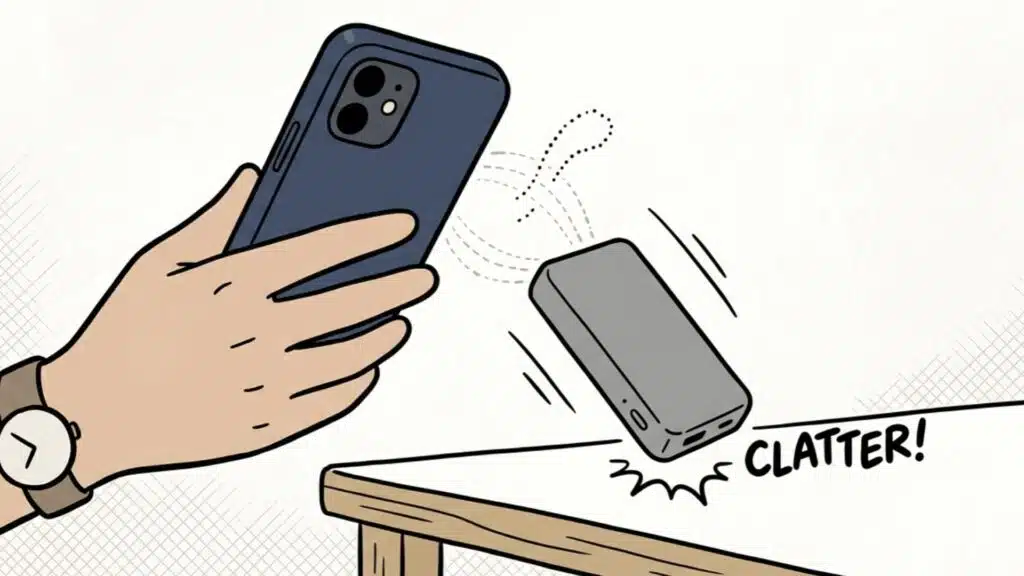
From my experience, a magnetic power bank should offer convenience, not create new problems. I’ve seen many users, myself included, struggle with chargers that just won’t stay attached. This isn’t just an annoyance; it means your phone might not charge when you need it most. I want to help you understand why this happens and what you can do to fix it, so your power bank always works as it should.
Why is my magnetic power bank not sticking properly?
Is your magnetic power bank constantly losing its grip? I know the frustration of expecting a solid connection only for it to slide right off.
A magnetic power bank usually doesn’t stick well because of weak magnets or a poor contact design. I’ve found that high-grade magnets and a flat, precise attachment area are essential for a strong and reliable connection.
I’ve learned that the core strength of any magnetic power bank comes down to two main things: the quality of the magnets and the physical design of the contact area. First, let’s talk about magnet quality. Not all magnets are made equal. I’ve seen that premium magnets, like N54-grade neodymium magnets, offer a much stronger pull. These are among the strongest types you can find. If your power bank uses lower-grade magnets, it simply won’t have the gripping power needed to stay attached, especially when you’re moving around or just holding your phone. I often think of it like this: a weak magnet is like trying to hold two slick surfaces together; it just won’t work. The strength of neodymium magnets directly correlates to their grade, with higher numbers indicating a more powerful magnetic field.
Second, the design of the magnetic surface itself is critical. I’ve noticed that a flat, precise contact area makes a huge difference. Even with strong magnets, if the surfaces that are supposed to connect aren’t perfectly aligned or if one is uneven, the magnetic force won’t be fully utilized. This means the connection will feel weaker. I’ve found that a smooth, unobstructed surface allows for maximum magnetic efficiency. When I look at poorly designed power banks, I often see slight curves or raised edges that prevent a full, flush connection. This reduces the effective magnetic contact, making the power bank prone to slipping.
Let me show you a quick comparison of magnet grades and their impact:
| Magnet Grade | Relative Strength | Common Use Case | Impact on Power Bank Adhesion |
|---|---|---|---|
| N35 | Low | Basic closures | Very weak, likely to slip easily |
| N42 | Medium | General purpose | Moderate, might struggle with movement |
| N52 | High | Strong hold | Good, generally reliable |
| N54 | Very High | Industrial, premium, MagSafe | Excellent, very secure |
I believe understanding these details helps explain why some power banks feel so much more secure than others. It’s not magic; it’s about the materials and engineering that go into making a reliable product. I’ve personally seen how a power bank with N54 magnets can hold onto a phone through various activities, from walking around to slight bumps, compared to a cheaper one that barely stays on. This is why I always prioritize products with high-grade magnets in my own choices.
Do phone cases affect magnetic power bank strength?
Wondering if your phone case is the culprit behind your magnetic power bank’s weak hold? I’ve seen this happen countless times, and it’s a common issue.
Yes, phone cases significantly impact magnetic power bank strength. I’ve learned that only MagSafe-compatible cases, which have a built-in magnetic ring, allow for a secure connection, while regular cases often block the magnetic field.
In my experience, phone cases are one of the biggest factors determining how well a magnetic power bank performs. The key here is "MagSafe compatibility." If you’re using a phone case that isn’t MagSafe-compatible, you’re essentially putting a barrier between your power bank and your phone’s internal magnets. This barrier, even if thin, can dramatically weaken the magnetic connection. I often compare it to trying to pick up a paperclip with a magnet through a thick piece of wood; it just won’t work as well, or at all.
A proper MagSafe-compatible case has a special magnetic ring built right into it. This ring aligns perfectly with the magnets in your phone and in the power bank. When all three components—phone, case, and power bank—have this aligned magnetic structure, you get a strong, secure connection. Without it, the power bank might barely stick or fall off with the slightest bump. I’ve personally experimented with various cases, and the difference between a standard silicone case and a MagSafe one is night and day when it comes to magnetic adhesion. It’s not just about protection; it’s about maintaining functionality.
Here’s a breakdown of how different cases interact with magnetic power banks:
| Case Type | Magnetic Ring | Impact on Adhesion | Recommendation for Magnetic Power Banks |
|---|---|---|---|
| No Case | N/A | Strongest | Excellent (if you don’t mind no protection) |
| MagSafe Case | Yes | Very Strong | Ideal, provides protection and strong hold |
| Thin Non-MagSafe | No | Weak | May work but prone to slipping |
| Thick Non-MagSafe | No | Very Weak/None | Will likely not hold at all |
I’ve advised many users to check their case’s specifications. If it doesn’t explicitly state "MagSafe compatible" or feature the distinct magnetic ring, then it’s almost certainly weakening the connection. Investing in the right case is just as important as having a good power bank. I once tried to use a magnetic power bank with a very stylish, but non-MagSafe, leather case. It would constantly slide off, even when I was just sitting still. The moment I switched to a MagSafe-enabled case, the problem vanished, and the power bank snapped into place with a satisfying click, holding firm through my day.
How to make a magnetic power bank stay attached securely?
Frustrated with your magnetic power bank constantly falling off? I’ve found simple steps you can take to ensure it stays put and charges your phone reliably.
To ensure your magnetic power bank stays attached securely, I recommend using a high-grade power bank with strong N54 magnets, making sure your phone’s contact surface is clean and flat, and always using a certified MagSafe-compatible phone case.
From my own experience, achieving a secure attachment for your magnetic power bank isn’t complicated once you know the core principles. It’s about optimizing all the elements we’ve discussed. First, always prioritize the quality of your power bank. I look for models that specifically mention using strong magnets, like N54-grade neodymium. This is the foundation of a solid connection. If the power bank itself has weak magnets, no amount of tweaking will make it truly secure. I often advise people to check product specifications carefully before buying, as this detail is frequently overlooked. A small investment in a quality power bank upfront saves a lot of frustration later on.
Second, I pay close attention to the contact surfaces. I always make sure both my phone (or its case) and the power bank have clean, flat surfaces where they meet. Any dust, debris, or unevenness can create a gap, reducing the magnetic force. I sometimes even gently wipe the surfaces before attaching my power bank. It’s a small step, but it makes a difference. If you have a phone with a camera bump, ensure the power bank design accounts for this and doesn’t create an awkward, non-flush contact point. Some power banks are specifically designed with a cutout for camera modules, which I find very helpful. This ensures the entire magnetic surface can make full contact. I learned this the hard way when I had a power bank that would slightly wobble because of my phone’s camera, causing it to detach unexpectedly.
Finally, and this is crucial, I always use a MagSafe-compatible phone case. I’ve seen firsthand how a non-MagSafe case can completely undermine even the strongest power bank. The embedded magnetic ring in a MagSafe case creates an uninterrupted magnetic circuit, allowing the power bank to snap on firmly and stay put. If you’re using a regular case, I strongly suggest upgrading to a MagSafe-compatible one. It’s an investment that pays off in reliability and peace of mind. I’ve often felt a distinct ‘snap’ when attaching my power bank to a MagSafe case, a feeling I never get with a standard case. By focusing on these three areas—magnet quality, contact surface, and case compatibility—I’m confident you can achieve a much more reliable and secure magnetic connection for your power bank.
Here’s a checklist I use to ensure a secure connection:
| Factor | Check | My Action for Security |
|---|---|---|
| Power Bank Magnets | Are they high-grade (e.g., N54)? | I ensure my power bank uses strong, specified magnets. |
| Contact Surfaces | Are they clean, flat, and unobstructed? | I clean both surfaces and check for debris or unevenness. |
| Phone Case | Is it MagSafe-compatible? | I only use cases with a built-in magnetic ring. |
| Phone Model | Is it inherently MagSafe-enabled? | I verify my phone supports MagSafe (iPhone 12 and newer). |
I’ve found that addressing each of these points dramatically improves the adhesion and keeps my power bank securely attached, even when I’m on the go. While MagSafe was introduced with the iPhone 12, it’s important to note that later models may have slight variations or improvements in the MagSafe system.
Conclusion
In my experience, a secure magnetic power bank needs strong magnets, flat contact, and MagSafe-compatible cases. Addressing these points ensures a reliable, frustration-free charging experience for you.