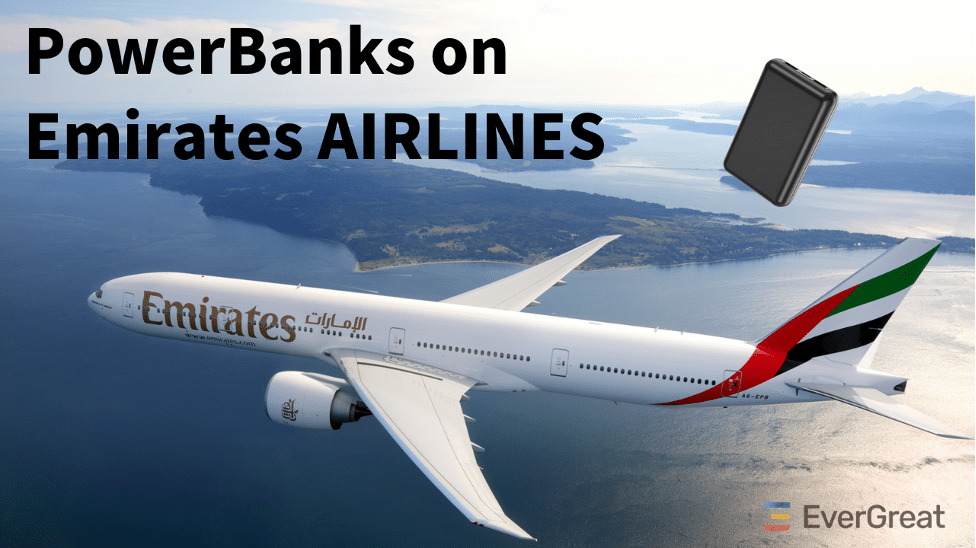
Are you confused about bringing your power bank on a flight? Many travelers worry about battery rules, and for good reason. Understanding these limits is key for smooth travels.
Airlines limit power banks to 100 Watt-hours (Wh) to prevent fire risks from lithium-ion batteries in flight. You must carry them in your hand luggage, never checked, for quick access if any issues happen. This rule keeps everyone safe.
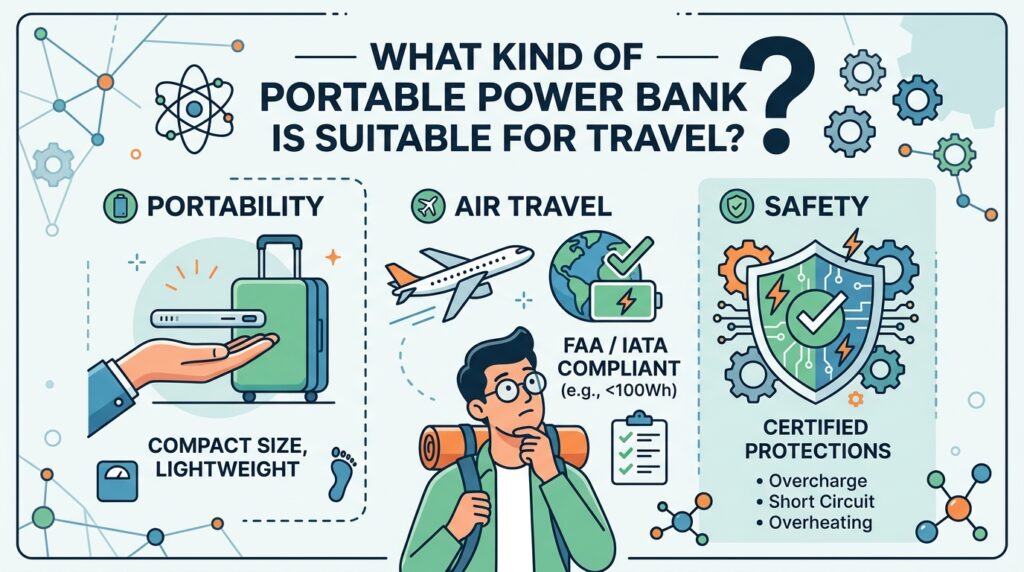
I always hear travelers asking about power banks. It is a common source of confusion. Knowing these rules can save you stress and keep your devices charged during your journey. Let’s look closer at why these rules exist and what they mean for your next trip.
Why are power banks limited to 100Wh on airplanes?
Running out of phone battery on a long flight is frustrating, but bringing a large power bank seems risky. Do you understand why airlines set strict limits on these devices? This rule is in place for a very important reason.
Airlines limit power banks to 100Wh because of the fire risk posed by lithium-ion batteries. These batteries can overheat or short circuit. This poses a danger in the confined space of an aircraft cabin. Safety rules prevent potential fires.
I often see people surprised by this limit. Many think it is just a random rule. It is actually about keeping everyone safe during flight. The problem with lithium-ion batteries is their potential for "thermal runaway." This means the battery can get very hot, even leading to intense fires, explosions, and the release of toxic fumes. The FAA tracks these incidents, and they are a growing concern. This risk is much higher in an airplane. An airplane cabin is sealed and air-pressurized. A fire here is extremely dangerous and hard to control. This is why groups like IATA, FAA, and ICAO set these strict rules. These organizations focus on global aviation safety. They require all spare power banks to be in your carry-on bag. They are never allowed to be stowed in overhead bins, ensuring that if a battery begins to overheat or ignite, it is visible and accessible to the crew. Power banks are never allowed in checked luggage. This way, if a power bank shows any problem, the flight crew can see it. They can then act fast.
A 100Wh limit helps balance passenger needs with flight safety. Most smaller power banks, like 10,000mAh ones, are well below this limit. They are typically around 37Wh. This makes them easy to bring. Batteries from 100Wh up to 160Wh often need airline approval. You must ask the airline before your flight. Note that airline approval is not guaranteed; policies vary, and some airlines might not allow them at all. Passengers must contact the airline well in advance to get approval and understand any specific restrictions. Power banks larger than 160Wh are usually banned completely. My experience working with battery manufacturers shows this is a standard safety measure. We build our products with these rules in mind. We want travelers to feel safe and confident. It is all about stopping small issues from becoming big dangers at 35,000 feet.
Can you bring a power bank on a plane and what are the rules?
Packing for a trip can be stressful. You might wonder about every item in your bag. Can you really bring a power bank on your next flight? Knowing the exact rules helps you pack correctly.
Yes, you can bring a power bank on a plane. You must pack it in your carry-on luggage only. You cannot put it in your checked bag. The power bank should also have a capacity of 100Wh or less. This rule ensures safety for all passengers.
I always tell travelers that checking power banks is a big mistake. The main rule is simple: carry-on, not checked. This is not just a suggestion. It is a strict safety regulation. Imagine a power bank catching fire in the cargo hold. The crew would not know right away. They could not get to it quickly. In the cabin, they can see and address any issue fast. This is why the rules exist. The power bank must also be off. You should not charge devices with it during takeoff or landing. Some airlines even ask you to keep it off during the whole flight. This is extra protection. Also, according to the new rules issued by the International Civil Aviation Organisation (ICAO), passengers on international flights are now limited to two power banks in the cabin, and charging them is banned. These new restrictions came into effect on March 27, 2026 and were approved by all 36 ICAO Council member states and apply to all 193 member countries.
When you bring a power bank, make sure it is clearly marked. Look for the Watt-hour (Wh) rating printed on the device. Sometimes, only the mAh (milliampere-hour) is shown. You can convert mAh to Wh using a simple formula: (mAh V) / 1000 = Wh. While most power banks use a voltage (V) of 3.7V, it’s important to check the specific voltage of your power bank, as some may use different voltages. The Wh number is what airlines care about. This is because a power bank’s voltage also plays a role in determining its overall energy capacity. So, a 27,000mAh power bank is roughly (27,000 3.7) / 1000 = 99.9Wh. This is right at the 100Wh limit. Anything above 27,000mAh will likely exceed 100Wh. For devices between 100Wh and 160Wh, you need to get airline approval. I have seen travelers turned away at security because their power bank was too large. Or it was in the wrong bag. To prevent short circuits, it’s also wise to protect the battery terminals by leaving the batteries in their original retail packaging, covering battery terminals with tape, using a battery case or sleeve, or putting them snugly in a plastic bag or protective pouch. Always check with your airline before you fly. Also, inquire about any potential quantity limits for power banks. This saves you hassle at the airport. It also ensures a smooth trip.
What size power bank is best for travel?
You want to stay charged on your trip, but you also need to follow airline rules. With so many power bank sizes, how do you pick the right one? Finding the perfect balance between power and portability matters.
For travel, a 10,000mAh power bank is often best. It gives you 1–2 full phone charges. It is compact, lightweight, and always well under the 100Wh airline limit. This size offers the right mix of power and convenience for most journeys.
I often hear travelers ask about the ideal power bank size. For most trips, a 5,000mAh to 10,000mAh power bank is perfect. It is small enough to fit in your pocket or a small bag. It is light, so it does not add much weight. This size gives you enough power for your phone. It can recharge it at least once, maybe twice. This covers many travel needs. It is always below the 100Wh limit. This means no extra checks or approvals are needed. My company, EverGreat Technology, works to create these ideal travel companions. We make sure they meet all safety standards.
When choosing, look at the Wh rating. Do not just look at the mAh. The Wh number is what airlines care about. A 10,000mAh power bank is usually around 37Wh. This gives you plenty of room below the limit. Some people want more power. They might look at 20,000mAh or larger options. A 20,000mAh power bank is about 74Wh. This is still under 100Wh. But it is much heavier and bigger. It might not fit as easily in your pocket. These larger ones can also take longer to charge themselves.
In the future, I believe 5,000mAh to 10,000mAh models will still be the best choice for travelers. This is because of new technology. Fast charging capabilities mean even a smaller power bank can quickly top up your device. Also, semi-solid-state batteries are becoming more common. These batteries are safer than traditional lithium-ion ones. They are less likely to swell, leak, or overheat. This gives travelers more peace of mind. So, you get great performance and high safety in a small package. For serious travelers, always choose models with this kind of technology. It offers superior reliability. It means you can stay connected without worry.
Conclusion
Airlines limit power bank capacity for everyone’s safety. Always carry your power bank in your hand luggage. For most travelers, a 10,000mAh model is the best choice.