A big mAh number looks simple, but it can mislead buyers. Many users expect more charges than the power bank can really deliver.
mAh means milliampere-hour, a measure of battery charge capacity. On a power bank, it usually describes the internal battery cells, not the exact energy your phone receives. To compare power banks more accurately, also check Wh, output wattage, conversion loss, and device battery size.
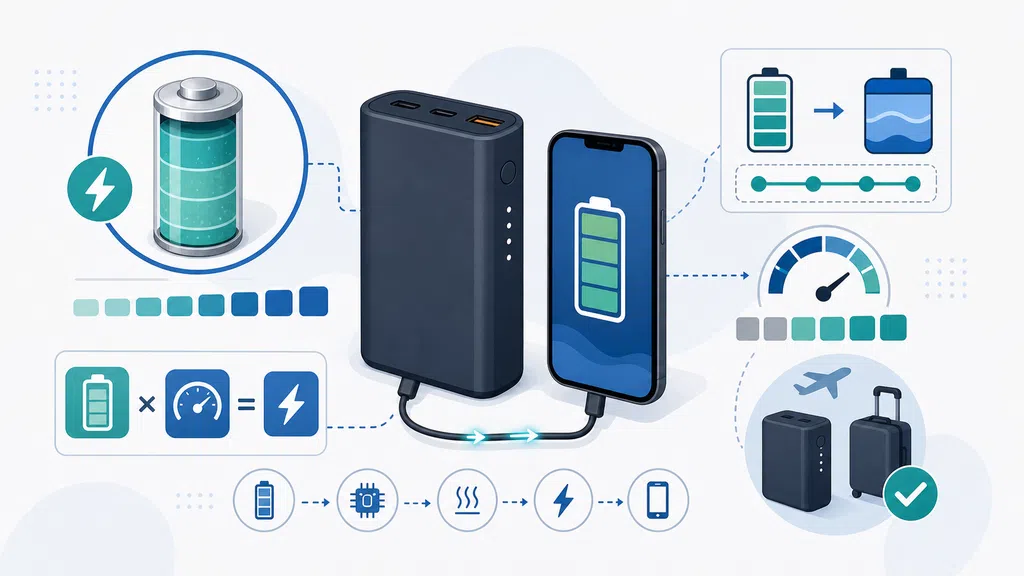
I often see customers compare two power banks by mAh alone. That is a useful start, but it is not the full story behind real charging time.
Is mAh The Same As Real Charging Capacity?
The short answer is no. mAh is a capacity clue, but it does not directly tell you how many times a power bank will charge your phone.
mAh measures electric charge, usually based on the internal battery cell voltage. Real charging capacity depends on watt-hours, voltage conversion, heat loss, cable loss, and the device being charged. A 10,000mAh power bank will not deliver all 10,000mAh into your phone battery.
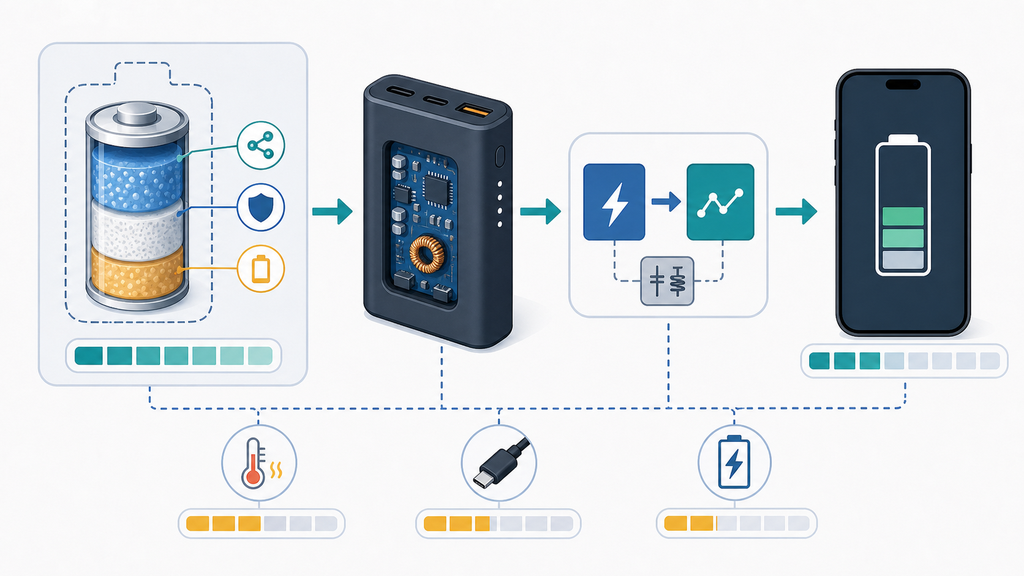
Battery capacity is often discussed in ampere-hours or milliampere-hours. Battery University explains battery capacity using ampere-hour language in its educational material about battery discharge and C-rate.1 For a power bank buyer, the practical idea is simple: mAh tells you how much charge the internal cells can store under a stated voltage condition. It is not the same as final usable output after the circuit boosts or changes voltage.
Most power bank cells are commonly rated around 3.6V or 3.7V. A phone may charge through USB at 5V, 9V, or another negotiated voltage. That means the power bank must convert the internal battery energy into the output voltage your device needs. Every conversion loses some energy. Heat, cable resistance, circuit efficiency, and device charging behavior all reduce the final energy that reaches the phone battery.
Here is the simple distinction:
| Term | What It Means | Why Buyers Misread It |
|---|---|---|
| mAh | Electric charge capacity | Looks like a direct phone-charge count |
| Wh | Energy capacity | Better for comparing across voltage |
| Output wattage | Charging power | Affects speed, not just total capacity |
| Efficiency | Energy kept after conversion | Explains why real output is lower |
I have seen many support questions that start with "My 10,000mAh power bank should charge my 5,000mAh phone twice." In practice, that is usually too optimistic. The phone battery rating and the power bank rating are not always measured at the same voltage. The power bank also loses energy during voltage conversion.
For consumers, the better expectation is this: a good 10,000mAh power bank may give a strong full phone charge and some extra, depending on the phone. A 20,000mAh power bank may give multiple phone charges, but not a perfect mathematical double. For brands, the better packaging language is "estimated charges vary by device and usage" rather than promising exact full charges for every phone.
This also affects product comparison. A buyer may see two 10,000mAh power banks at different prices and assume they are equal. They may not be. One may use better cells, a more efficient boost circuit, stronger USB-C output, better heat control, and clearer protection logic. Another may have the same mAh label but weaker output and poorer real-world efficiency. The mAh number starts the conversation, but it should not end it.
In my experience, this is where customer service can either reduce or create returns. If a product page says only "10,000mAh large capacity," users build their own expectations. If the page explains estimated phone charges, output wattage, Wh, and real-use factors, customers make better choices. That kind of honest explanation does not weaken the product. It makes the buyer trust the brand more.
How Do You Convert mAh To Wh?
If you want a more useful capacity number, convert mAh into watt-hours. This helps compare energy and understand travel limits.
To convert mAh to Wh, use this formula: Wh = mAh x voltage / 1000. For example, a 20,000mAh power bank at 3.7V is about 74Wh. A 27,000mAh power bank at 3.7V is about 99.9Wh.
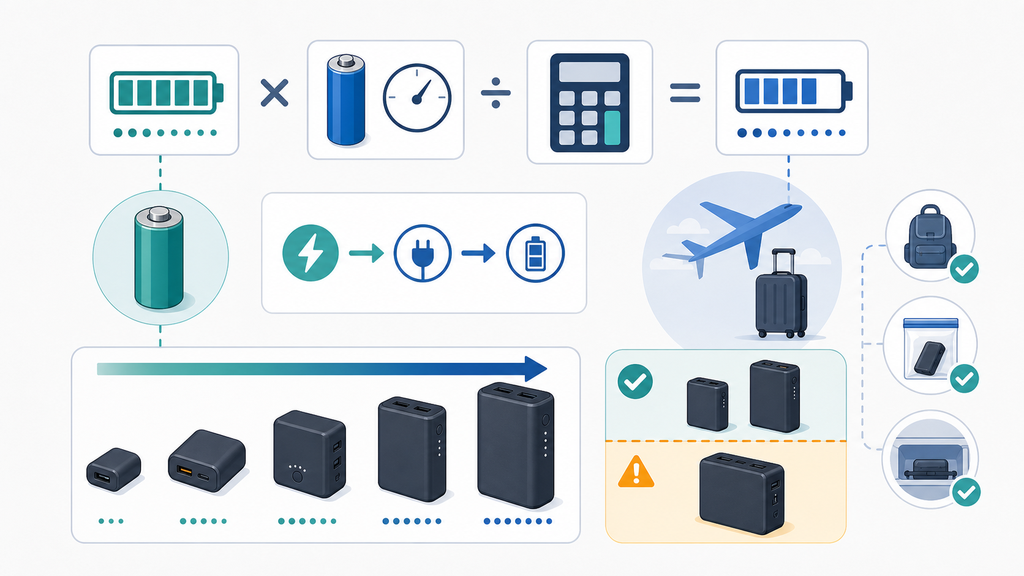
The formula is not difficult:
Wh = mAh x V / 1000
So:
10,000mAh x 3.7V / 1000 = 37Wh20,000mAh x 3.7V / 1000 = 74Wh27,000mAh x 3.7V / 1000 = 99.9Wh
Wh matters because it measures energy. If two products use different internal cell voltages or output voltages, Wh is usually a better comparison than mAh alone. This is also why airlines and regulators often use Wh when talking about lithium batteries.
The FAA’s PackSafe lithium battery guidance says spare lithium batteries, including power banks and cellphone battery charging cases, must be carried in carry-on baggage only. It also says lithium-ion batteries are limited to 100Wh unless airline approval applies for certain larger spare batteries.2 The TSA also says power banks containing lithium-ion batteries must be packed in carry-on bags.3
That is why you often see travel-friendly high-capacity power banks around 20,000mAh to 27,000mAh. The 27,000mAh class can sit near 100Wh when calculated at 3.7V. Brands need to be careful here. A small change in cell capacity or voltage can push the Wh value over the travel-friendly line.
| Labeled Capacity | Common Cell Voltage | Approximate Wh | Travel Position |
|---|---|---|---|
| 5,000mAh | 3.7V | 18.5Wh | Easy travel size |
| 10,000mAh | 3.7V | 37Wh | Common daily carry |
| 20,000mAh | 3.7V | 74Wh | Strong phone/tablet option |
| 27,000mAh | 3.7V | 99.9Wh | Near airline-friendly limit |
For manufacturing and packaging, I like to show both mAh and Wh. mAh is familiar to consumers. Wh is better for travel and energy comparison. Showing both reduces confusion and helps customer service answer questions faster.
Buyers should also check whether the product clearly marks Wh on the case or packaging. A power bank that only shows mAh may create airport or customer confusion. A clear label is not just a compliance detail. It is part of a better user experience.
Why Does A Power Bank Deliver Less Than The Label?
A power bank label is not a lie just because real-world output is lower. The label and the usable output measure different things.
A power bank delivers less than the labeled mAh because energy is lost during voltage conversion, heat generation, cable transfer, standby power, and device charging. Phone use during charging also reduces the amount of energy that becomes stored battery capacity.
Think of a power bank as an energy transfer system, not a simple bottle. The internal cells store energy. The circuit converts that energy into USB output. The cable carries it. The phone charging circuit accepts it and charges the battery. Each step has losses.
USB-C fast charging adds another layer. USB-IF explains that USB Power Delivery allows flexible power delivery over one cable and can support higher power when the device, charger, and cable support the right profiles.4 That is good for charging speed, but it also reminds us that modern charging is negotiated. It is not only a battery connected directly to another battery.
Common reasons for lower real output include:
| Loss Factor | What Happens | Buyer Impact |
|---|---|---|
| Voltage conversion | 3.7V cell energy becomes 5V, 9V, or higher output | Less usable energy than label suggests |
| Heat | Circuit and battery warm during charging | Energy is wasted as heat |
| Cable resistance | Weak or long cable loses more power | Slower or less efficient charging |
| Phone use | Screen, apps, and signal consume power | Battery rises more slowly |
| Battery protection | Charging slows near full battery | Last 20 percent may take longer |
I often find that users judge a power bank while using the phone heavily. They watch video, use navigation, or play games while charging. In that case, part of the power bank output runs the phone instead of increasing the battery percentage. The user sees fewer "charges" than expected.
For private-label buyers, this is why claims should be tested with real devices. Do not rely only on cell capacity. Test the finished product with common phones, tablets, and usage patterns. If the product is marketed for travel, test charging while the phone screen is on and while it is off. The results can guide better product copy.
EverGreat’s view is that honest capacity communication builds trust. A power bank does not need exaggerated claims to sell well. It needs clear capacity, realistic charge expectations, good output design, safe cells, and support language that helps users understand what they bought.
Conclusion
mAh is useful, but Wh, output wattage, conversion loss, and real device behavior explain what a power bank can actually deliver.
-
This Battery University page supports the article’s explanation of ampere-hour capacity language and battery discharge concepts. ↩
-
This FAA PackSafe page supports the carry-on-only rule and 100Wh / 101-160Wh lithium-ion spare battery limits for power banks. ↩
-
This TSA page supports the rule that power banks containing lithium-ion batteries must be packed in carry-on bags. ↩
-
This USB-IF page supports the explanation of USB Power Delivery and negotiated power delivery over USB-C. ↩