Are you tired of slow wireless charging disappointing your need for convenience? You want fast power, but don’t want cable clutter. Let’s find out if modern wireless truly balances speed and ease.
Wireless charging is no longer just slower. Thanks to advancements like Qi2 25W, it now offers a compelling balance of convenience and respectable speed. While wired charging still holds a peak speed advantage, new wireless technologies make it a practical and enjoyable daily power solution.
When I first considered wireless charging, I was skeptical. I had heard all the stories about how much slower it was, how it generated more heat, and honestly, I thought it was just a gimmick. But as I’ve watched the technology evolve, I’ve started to wonder if my initial assumptions were fair. Is there a new story emerging for wireless power, especially with power banks? Let’s dive in and explore what’s truly changed.
Is wireless charging slower than wired charging?
Problem: Are you worried wireless charging can’t keep up with your busy life? Agitation: You need speed, but don’t want to sacrifice convenience. Solution: Let’s compare current speeds to see where each technology stands.
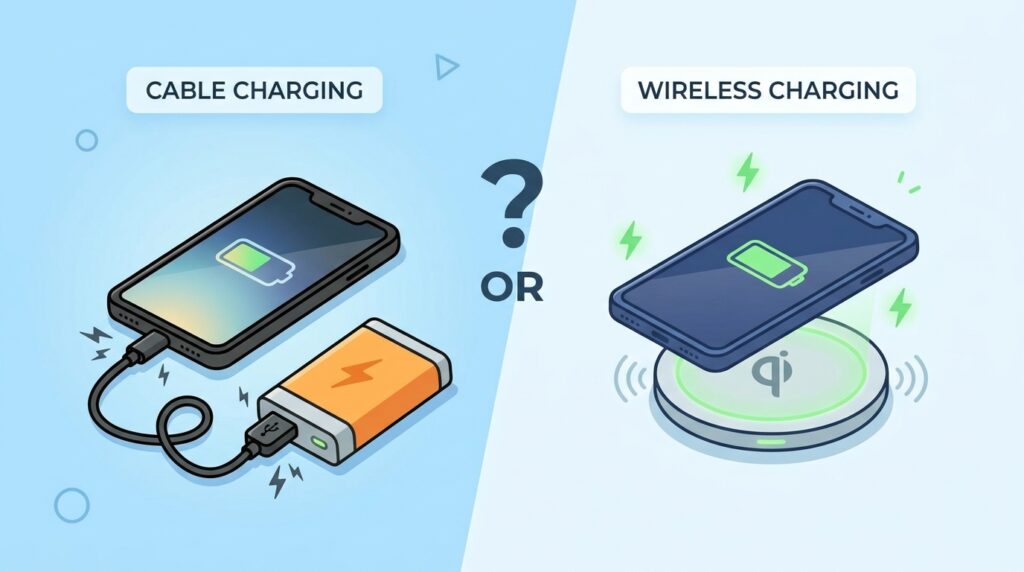
Yes, in many peak power scenarios, wired charging remains faster. Protocols like PD 3.1 deliver higher and more consistent speeds, often charging flagship phones 20-40% quicker than current wireless methods. However, Qi2 25W has significantly narrowed this gap, making wireless speeds very competitive for everyday use.
I remember when "wireless charging" meant a trickle charge, barely keeping my phone alive. It felt like a compromise, a trade-off where convenience completely outweighed any speed. But that perception is changing fast.
For the longest time, wired charging held a clear advantage in terms of raw speed. My wired power banks, especially those with advanced protocols like Power Delivery (PD) 3.1 or Programmable Power Supply (PPS), could consistently push high wattage to my devices. I could plug in my flagship phone, and in just 30 minutes, I’d see a significant jump, often 50% or more. This kind of performance is crucial when I’m in a rush. These wired connections maintain higher peak power and more consistent charging speeds throughout the cycle. It’s not uncommon for a wired setup to fully charge a premium smartphone 20% to 40% faster than older wireless methods. This difference really matters when every minute counts. USB PD 3.1, for example, can deliver up to 240W of power through USB-C cables, introducing Extended Power Range (EPR) with new voltage options (28V, 36V, and 48V). PPS, a feature of USB PD 3.0 and 3.1, allows real-time voltage and current adjustment, enhancing charging efficiency and preventing overheating, making it a safe fast-charging option.
The issue with older wireless charging was not just lower wattage, but also efficiency. There was a significant energy conversion loss, typically ranging from 15% to 30%. Some studies suggest wireless charging systems can lose 15-40% more energy than wired options, resulting in 60-80% energy transfer efficiencies compared to the 85-95% of wired chargers. This loss didn’t just mean slower charging; it also meant more heat. I recall placing my phone on a wireless pad and feeling it get noticeably warm, which always made me worry about long-term battery health. This heat often led to thermal throttling, where the phone would automatically reduce charging speed to cool down, further slowing the process. Wireless charging can increase device temperature by 10-20°C, and excessive heat (above 30°C) accelerates lithium-ion battery degradation and triggers thermal throttling, cutting CPU and GPU performance.
However, the landscape is evolving dramatically. The introduction of Qi2 25W, and the upcoming Qi2.2 standard, represents a significant leap forward. Developed by the Wireless Power Consortium (WPC), Qi2 includes features inspired by Apple’s MagSafe technology. The improved magnetic alignment, similar to Apple’s MagSafe, ensures better contact and greatly reduces efficiency losses. This means more power actually reaches the phone, with less wasted heat. Now, when I use a Qi2 25W power bank, I notice a much faster charge. It’s starting to close the gap with mid-range wired charging. While it might not always beat the absolute fastest wired options, it’s certainly no longer a "trickle charge." It’s a genuinely practical speed that offers a truly seamless experience without the constant worry of cables.
Let’s look at a simple comparison:
| Feature | Wired Charging (High-End) | Wireless Charging (Older 7.5W/15W) | Wireless Charging (Qi2 25W) |
|---|---|---|---|
| Peak Power | Up to 100W+ (PD 3.1) | 7.5W – 15W | 25W |
| Efficiency | Very High (90%+) | Moderate (70-85%) | Improved High (85-90%) |
| Charging Speed | Extremely Fast | Slow to Moderate | Respectable Fast |
| Heat Generation | Low | Moderate to High | Low to Moderate (Improved) |
| Convenience | Requires Cable Plug-in | Drop-and-Charge (Alignment needed) | Magnetic Drop-and-Charge |
This table helps me see that while wired still dominates peak power, Qi2 25W is pushing wireless into a much more competitive space, especially in terms of efficiency and convenience. It’s not just about raw watts; it’s about how effectively those watts are delivered. Qi2 improves upon the original Qi standard by using a ring of magnets for better alignment, enhancing charging efficiency and reducing overheating. It’s designed to be universally compatible across different brands and delivers up to 15W charging speeds (25W for Qi2 25W). iPhones 12 and newer support Qi2 charging, with iPhone 15 models fully implementing the magnetic profile, while the Samsung Galaxy S25 was one of the first Android phones to support it.
Is wireless charging more convenient in daily use?
Problem: Do tangled cables and searching for ports frustrate your daily routine? Agitation: You want effortless power, without the constant fumbling. Solution: Discover how modern wireless charging simplifies your tech life.
Yes, wireless charging offers superior convenience for daily use. The "just drop it on" experience, especially with magnetic alignment like MagSafe or Qi2, removes the hassle of plugging in cables. This makes it ideal for quick power top-ups and keeping your device charged throughout the day without interruption.
When I reflect on my daily habits, I realize how much small frictions can add up. My desk used to be a mess of cables – one for my phone, one for my earbuds, sometimes one for a tablet. Every time I needed to pick up my phone to answer a call or check a notification, I had to unplug it, and then plug it back in. It sounds minor, but it was a constant, repetitive annoyance. This is where wireless charging truly shines for me. The "just drop it on" experience is genuinely hassle-free.
With my Qi2 magnetic charger, whether it’s a stand on my desk or a pad by my bed, I simply place my phone on it. The magnets snap it into perfect alignment every single time. There’s no fumbling in the dark, no struggling to insert a cable correctly, and no wear and tear on my device’s charging port. This hands-free operation means I can easily pick up my phone, use it, and then place it back down to resume charging without a second thought. This continuous, effortless topping up is a game-changer compared to the interruptive nature of wired charging. I find myself charging my phone more frequently throughout the day, in short bursts, which often means I never hit critically low battery levels.
The convenience extends beyond just my phone. I also have wireless charging solutions for my earbuds and smartwatch. The ability to have a single charging pad that handles multiple devices, or simply drop each device onto its designated spot without cables, creates a much cleaner and more organized space. This simplification reduces clutter, not just physically but also mentally. I no longer waste time looking for the right cable or untangling a mess of wires. It’s a seamless integration into my workflow and personal space. For example, during calls or video conferences, I can keep my phone on a magnetic wireless stand, charging continuously, ensuring I never run out of battery mid-conversation. This level of effortless power delivery dramatically improves my daily experience. Multi-device wireless charging stations further enhance this convenience, allowing you to charge smartphones, smartwatches, and wireless earbuds simultaneously; some 4-in-1 wireless chargers can power up to four devices at once.
Consider these aspects of convenience:
| Aspect | Wired Charging | Wireless Charging (Qi2) |
|---|---|---|
| Effort | Requires plugging/unplugging cable | Just drop/snap on, no precise alignment needed with magnets |
| Clutter | Can create cable mess | Reduces cable clutter, cleaner aesthetic |
| Device Port Wear | Frequent plugging can wear out port | No physical contact, preserves port integrity |
| Accessibility | Easy to use while charging | Very easy to use while charging (e.g., on a stand) |
| Multi-device | Each device needs its own cable/port | Can charge multiple devices on a single pad or dedicated spots |
| "Grab and Go" | Unplug before leaving | Just pick up the phone and go |
For me, the ease of use and reduced friction are undeniable. It’s not just about removing a cable; it’s about removing a small, persistent annoyance from my daily routine.
Is wireless charging worth it for power banks?
Problem: Are you unsure if a wireless power bank is a smart investment? Agitation: You want efficient, portable power, but question its real-world value. Solution: Let’s explore when a wireless power bank truly pays off for you.
Yes, a wireless power bank is worth it if you prioritize convenience, especially with Qi2 25W. While wired remains superior for maximum speed, upgraded wireless power banks offer a compelling balance. They provide hands-free charging, MagSafe-style attachment, and improved thermal management, making them practical and enjoyable for daily use.
This is where my personal experience really shapes my opinion. For a long time, I wouldn’t have even considered a wireless power bank. Why? Because the older ones were slow, bulky, inefficient, and often heated up my phone uncomfortably. I felt like I was paying extra for a feature that barely worked and might even damage my device’s battery in the long run. My priority was always raw speed when I was out and about, and a wired power bank with PD was the undisputed champion. I just wanted my phone charged as fast as possible, and I didn’t care about a little cable.
However, the game has completely changed with Qi2 25W and modern magnetic power banks. For me, the decision now hinges entirely on my priorities. If my absolute, number one, non-negotiable priority is to get my phone from 5% to 80% in the shortest possible time, then yes, a high-wattage wired power bank is still the winner. There’s no denying the sheer speed of a 65W or 100W PD output.
But for almost every other scenario, especially my daily routine, a wireless power bank has become my go-to. The hands-free aspect, particularly with the magnetic attachment, is incredibly practical. I can snap my MagSafe-compatible power bank onto my iPhone, toss it in my bag, and know it’s charging without a cable dangling or risk of disconnecting. I can continue to use my phone normally — taking photos, browsing, or navigating — with the power bank seamlessly attached. This is something a wired power bank simply cannot offer without creating an awkward, unwieldy setup. Qi2 offers flexibility, while MagSafe offers seamless integration within the Apple ecosystem; MagSafe cases with built-in magnets work perfectly with Qi2 chargers at full 15W speeds.
Another crucial factor is temperature control. My older wireless power banks would often make my phone uncomfortably warm. I was always worried about battery degradation. But with the advanced thermal management in the new Qi2 models, I’ve noticed a significant improvement. The surface and phone temperatures stay much lower, even during sustained charging. This reduction in heat means less throttling, more consistent charging speeds, and a much safer experience for my phone’s battery health. It’s no longer a trade-off that compromises my device’s longevity. Brands like Baseus have even implemented triple-layer cooling systems in their power banks to manage heat.
Let’s look at the "worth it" factor:
| Priority | Wired Power Bank (High-Speed) | Wireless Power Bank (Qi2 25W) |
|---|---|---|
| Max Speed | ✅ Superior for peak output | ❌ Good, but not ultimate peak |
| Convenience | ❌ Requires cable management | ✅ Magnetic, hands-free attachment |
| Heat Control | ✅ Generally good | ✅ Significantly improved with Qi2 |
| Versatility | ✅ Charges various devices via cable | ✅ Charges compatible devices wirelessly |
| Hands-Free Use | ❌ Awkward with cables | ✅ Seamless, especially for phones |
| Clutter | ❌ Can add to cable mess | ✅ Reduces cable need |
So, is it worth it? Absolutely, if you value convenience, a cleaner setup, and seamless hands-free charging over absolute peak charging speed. For my daily life, the benefits far outweigh the slightly reduced maximum speed. It’s an investment in a smoother, more integrated charging experience.
Conclusion
Wireless charging has transformed from a slower alternative to a compelling option. With Qi2 25W, it now offers a practical balance of convenience and speed, making it a strong choice for modern users prioritizing simplicity.