Pass-through charging sounds convenient, but the wrong power bank, cable, or device combination can create slow charging, heat, or unexpected shutoff.
You can use some power banks while they are charging, but only when the model supports pass-through charging and the complete input, output, cable, device, and thermal conditions have been designed for it.
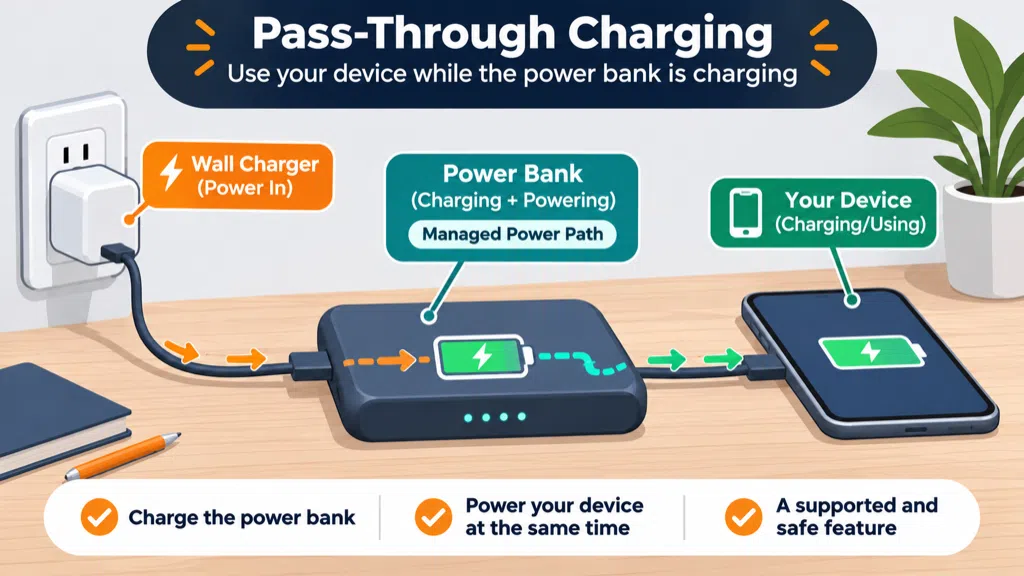
Many users assume that two connected cables automatically create a safe charging hub. In reality, the power bank must coordinate energy entering the battery system with energy leaving the output, and some models intentionally disable the output to protect the battery.
What Does Pass-Through Charging Mean?
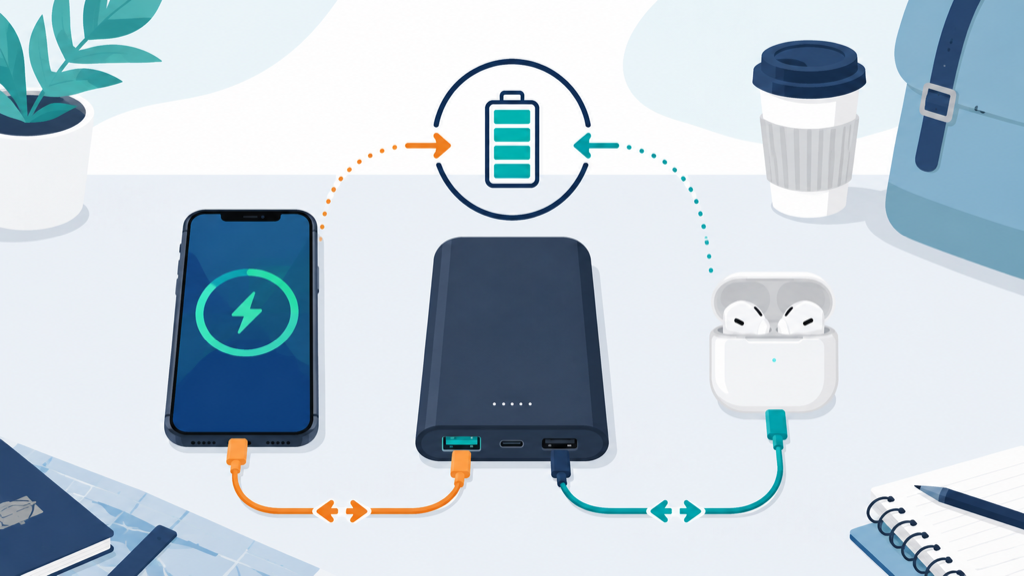
Pass-through charging means a power bank receives energy from a charger while also sending energy to a connected device.
In pass-through operation, the power bank manages an input source and an output load at the same time, so the result depends on the product’s circuit design, firmware, battery state, and supported power conditions.
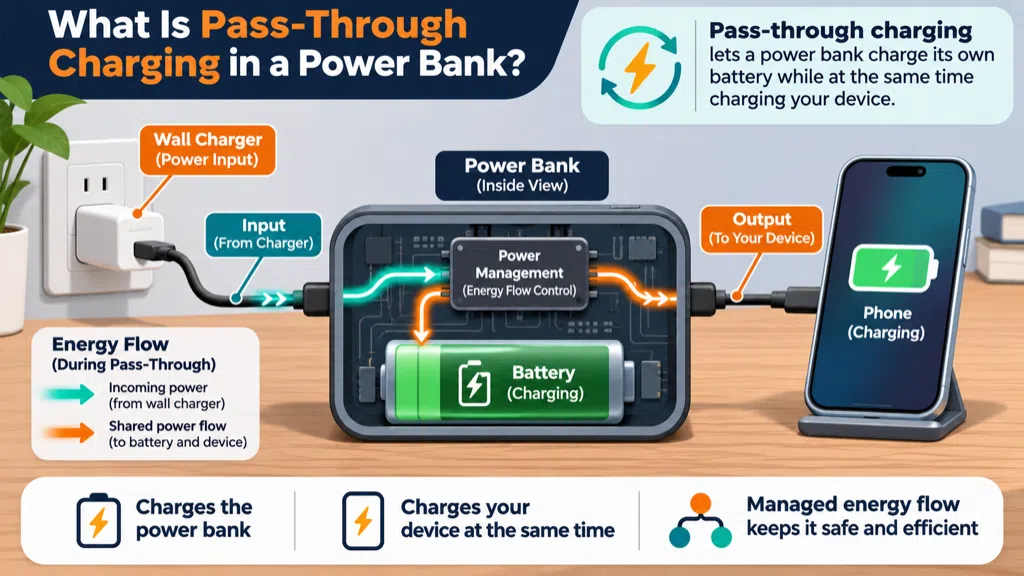
The simple setup has three parts: a wall charger or other input source connected to the power bank, the power bank’s internal charging and power-path circuit, and a phone or other device connected to its output. The output device may receive power from the input path, the battery, or a managed combination of both.
Do not confuse pass-through charging with charging a phone from a wall charger through an ordinary hub. A power bank contains a battery and protection system. It must decide how to charge the cell, supply the output, limit current, and react to faults.
Some power banks support pass-through only under limited conditions. They may require one specific input port, disable fast charging, reduce output power, stop when the battery reaches a threshold, or turn off when the load is small. These behaviors can be normal if they are documented and safe.
| User setup | What may happen | What to check |
|---|---|---|
| Charger into input, phone into output | Phone may charge while the bank recharges | Does the model support pass-through? |
| High-power input and output | System may reduce one or both powers | Check the combined power limit |
| Small accessory load | Output may shut off automatically | Test low-current behavior |
| Battery nearly full | Charging path may change | Observe indicator and output stability |
| Weak charger or cable | Input may be insufficient | Use a known-good source and cable |
| Hot environment | Charging may slow or stop | Test on a clear, cool surface |
USB Power Delivery supports flexible power delivery and power negotiation between connected port partners.1 If a power bank uses USB-C PD, the input source, power bank, cable, and output device still need a compatible implementation. A USB-C connector alone does not prove that pass-through or fast pass-through is available.
The product manual should state the supported arrangement. If the power bank has separate input and output ports, name them. If it supports only low-power pass-through, explain the limitation. If the feature is disabled for safety or battery protection, avoid promising it as a universal function.
Why Might Pass-Through Charging Be Slow Or Unstable?
Pass-through problems usually come from limited input power, shared conversion losses, cable limits, heat, low-current behavior, or a protection decision.
Pass-through charging can be slow or unstable when the input source cannot cover the output load and charging losses, the cable is limited, the system becomes hot, or the power bank’s protection logic interrupts the path.
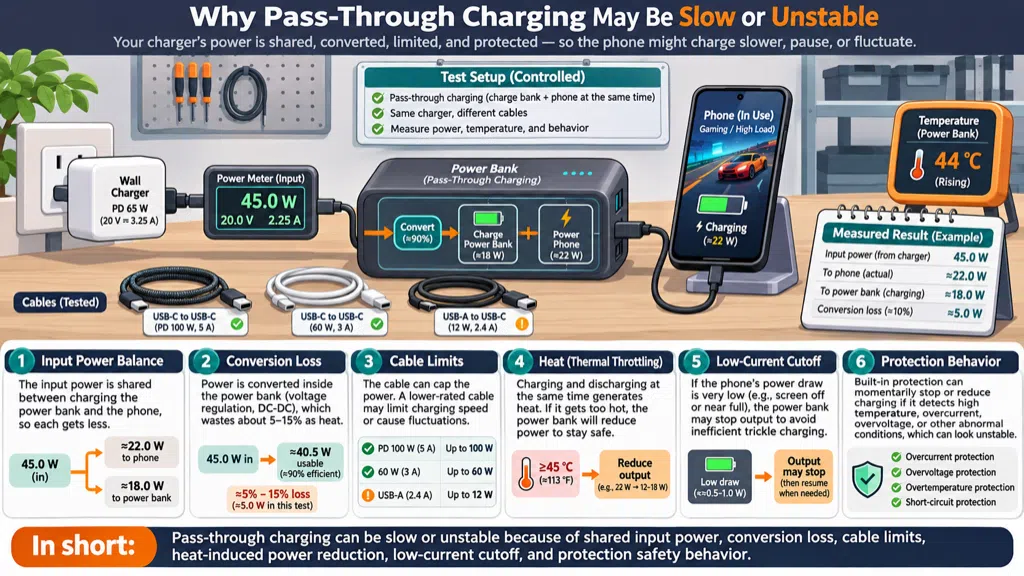
Start with the power balance. If the input source provides less power than the connected device needs, the battery may continue to discharge even though a charger is connected. The phone can show charging while the power bank percentage falls. That may be expected under a heavy load.
Conversion also consumes energy. Power entering the power bank is not delivered to the device with no loss. The battery charging path, boost or buck conversion, cable, connectors, and device all influence the result. A high-capacity battery does not fix a weak input or output path.
Heat is another important factor. The power bank may charge its cell and supply the output at the same time, causing more heat than either operation alone. The phone and wall charger may also become warm. A protection system may reduce current or stop a path when temperature rises.
| Symptom | Possible cause | Controlled test |
|---|---|---|
| Phone charges very slowly | Input power is shared or limited | Use a known-good charger and cable |
| Power bank percentage falls | Output exceeds usable input | Reduce the device load and compare |
| Output turns off | Low-current cutoff or protection | Test with a normal phone load |
| Charging restarts repeatedly | Cable, negotiation, or thermal interruption | Replace the cable and monitor temperature |
| Power bank becomes hot | Simultaneous conversion and charging | Stop if heat is abnormal and test in open air |
| Fast charging disappears | Pass-through limits the profile | Check the manual and negotiated behavior |
Cable quality and direction matter. A cable may fit both ports while supporting different current or protocol behavior. Use the manufacturer’s recommended cable or a cable with known specifications when comparing results.
The input charger also matters. A small charger may be adequate for overnight power-bank charging but unable to support a phone at the same time. A higher-wattage charger does not guarantee better results if the power bank has a lower combined limit.
Low-current accessories can trigger automatic shutoff. Wireless earbuds, smart bands, and small fans may draw below the power bank’s detection threshold. That is separate from pass-through support, but the two behaviors can be confused when users test different devices.
Battery state changes the result. A power bank may allow pass-through at medium charge, reduce output near empty, or stop charging the cell near full. These choices can protect the battery and simplify thermal control. The customer should see the behavior described in the manual rather than interpret every change as failure.
IEC 62133-2 specifies requirements and tests for the safe operation of portable sealed secondary lithium cells and batteries under intended use and reasonably foreseeable misuse.2 Pass-through adds a system condition that should be evaluated with the final cell, circuit, enclosure, firmware, and charging accessories.
How Should Brands And Users Test Pass-Through Safely?
A safe test uses the intended equipment, records the conditions, and stops when the product shows abnormal heat, smell, damage, or unstable behavior.
Test pass-through with the approved charger, cable, power bank, and device at different battery states, then record power, temperature, indicator behavior, and whether the output remains stable.
For users, begin with the product manual. Confirm that pass-through is supported, identify the input and output ports, and check whether the manufacturer limits fast charging or simultaneous use. If the manual is silent, do not assume the feature is approved.
Use a known-good wall charger and cable. Connect the charger to the input, connect one ordinary phone to the output, and place the power bank on a hard, uncovered surface. Avoid beds, bags, direct sun, or other places that trap heat.
Observe the setup for a reasonable period. Check whether the phone charges, whether the power bank indicator changes, whether cables or connectors become unusually hot, and whether charging repeatedly starts and stops. Stop if there is swelling, smoke, a burning smell, visible damage, or abnormal heat.
For brands, the test matrix should cover more than one phone. Include different input chargers, cables, battery states, output loads, low-current devices if relevant, and ambient conditions. Record the negotiated input and output profiles when the product supports USB PD.
| Test condition | Record | Approval question |
|---|---|---|
| Normal input and phone load | Input, output, temperature, time | Is charging stable? |
| Low power bank state | Indicator, output, recovery | Does the system shut down safely? |
| Nearly full battery | Charge termination and output | Does behavior match the manual? |
| Different cable | Current, negotiation, and heat | Are supported cables clear? |
| High phone workload | Device use and system temperature | Does output remain useful? |
| Small accessory | Cutoff and restart behavior | Is low-current use documented? |
| Warm environment | Surface and component temperature | Are limits acceptable? |
The product claim should state the tested setup. “Supports pass-through charging” is less useful than a clear description of supported input, output, combined power, cable, and device conditions. The package and manual should use the same information.
Manufacturers should validate the feature after any change to the cell, charging IC, controller firmware, port, cable, enclosure, or thermal material. A change that appears unrelated can alter power sharing or heat flow.
At EverGreat, we treat pass-through as a system feature rather than a checkbox. The decision should balance convenience with battery stress, temperature, component cost, firmware complexity, and customer expectations. If the feature creates more confusion than value, a simple and clearly documented charging mode may be the better product choice.
Conclusion
Use pass-through charging only when the power bank supports it, the complete system is tested, and input power, heat, cables, limits, and safe behavior are clearly documented.
-
USB Implementers Forum, USB Charger and USB Power Delivery information. ↩
-
International Electrotechnical Commission, IEC 62133-2 safety requirements. ↩