Custom power bank projects often appear simple at the quotation stage, then slow down when design decisions, testing, packaging, and approvals arrive late.
A custom power bank project usually moves through requirements, sample development, testing, certification planning, packaging, pilot production, and mass production. The exact schedule depends on customization depth, component readiness, sample revisions, and target markets.
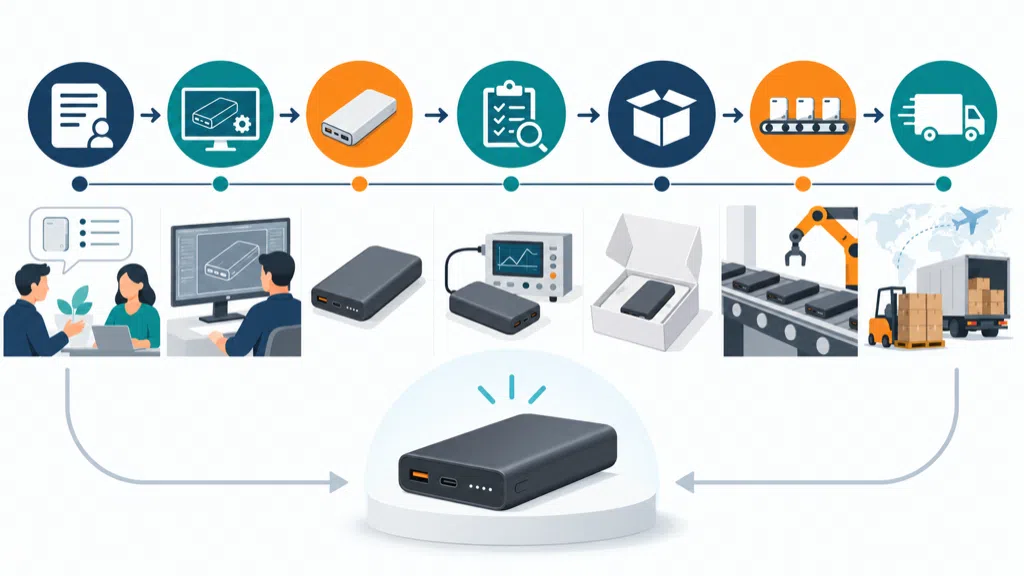
I have seen buyers ask for a delivery date before the product definition is complete. A reliable estimate starts with the number of decisions still open, not with a calendar promise from a supplier.
What Stages Make Up A Custom Power Bank Project?
A custom project normally includes product definition, engineering design, prototype samples, validation, compliance preparation, packaging approval, pilot production, and final production.
The main stages are requirements, design, prototype, testing, compliance, packaging, pilot run, and mass production. Each stage reduces a different type of risk, so skipping one often moves the problem later instead of removing it.
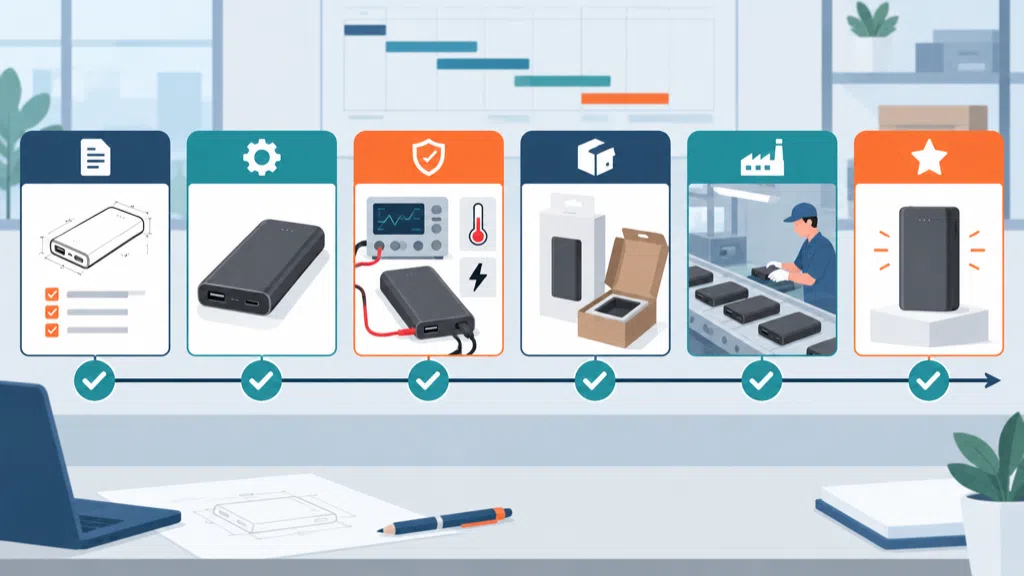
The first stage is a product requirement document. It should define capacity, dimensions, weight, input and output power, ports, cables, wireless features, display or indicators, materials, branding, packaging, quantity, destination markets, and target price.
The second stage turns those requirements into a product architecture. The supplier evaluates cells, protection circuit, charging controller, connectors, enclosure, thermal paths, and assembly method. A standard ODM platform may move faster because many decisions already exist. A new OEM design may require more engineering and tooling.
The prototype stage creates physical samples. These samples answer questions that drawings cannot: Does the product fit the hand? Is the connector easy to use? Is the magnetic ring aligned? Does the cable bend comfortably? Is the surface large enough for a logo? Does the packaging concept fit the product?
Testing begins before the final package is printed. Electrical tests check input, output, charging behavior, port combinations, indicators, and thermal performance. Mechanical tests check buttons, connectors, cable storage, drop resistance, and enclosure fit. User trials reveal problems that a bench test may miss.
| Stage | Main output | Risk reduced |
|---|---|---|
| Requirements | Approved product brief | Misaligned expectations |
| Architecture | Cell, circuit, and enclosure direction | Incompatible components |
| Prototype | Engineering sample | Poor ergonomics or fit |
| Validation | Test records and revisions | Unstable performance |
| Compliance | Required reports and submissions | Market-entry delay |
| Packaging | Approved artwork and carton | Claim or protection errors |
| Pilot run | Production-intent sample batch | Mass-production variation |
| Mass production | Finished goods | Delivery and quality risk |
Compliance planning should be part of the project, not an afterthought. IEC 62133-2 describes safety requirements and tests for portable sealed secondary lithium cells and batteries, including intended use and reasonably foreseeable misuse.1 Transport requirements are separate. The UNECE Manual of Tests and Criteria includes lithium battery test requirements and provisions for a test summary under section 38.3.2
The required work depends on the product and market. A basic power bank, a wireless product, a laptop-capable product, and a promotional product with a custom enclosure may have different testing and documentation needs. A supplier cannot give a responsible schedule without knowing those differences.
Packaging is often treated as the final creative task, but the artwork depends on confirmed specifications. If the cell changes, the Wh value may change. If the cable changes, the included-accessory panel may change. If the product dimensions change, the tray and carton may change. Printing too early can create rework.
Pilot production is the bridge between engineering and mass production. It checks whether the approved design can be assembled repeatedly with stable appearance and performance. The pilot may reveal adhesive problems, cable routing variation, welding inconsistency, button feel differences, or a display window that does not fit every unit.
A project is ready for mass production when the major decisions are frozen, not merely when one sample looks good.
What Factors Make A Custom Power Bank Project Faster Or Slower?
Project speed depends on customization depth, response time, component availability, sample revisions, tooling, testing scope, packaging readiness, and how quickly the buyer makes decisions.
Standard platforms, ready components, clear specifications, and fast approvals usually shorten a project. New molds, unusual materials, custom electronics, multiple revisions, and late certification or packaging changes usually lengthen it.
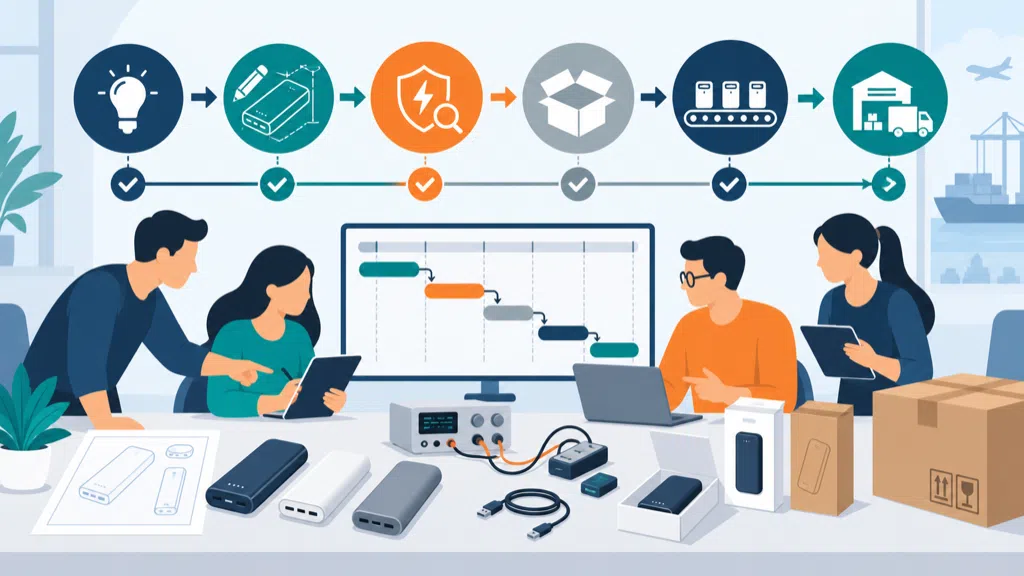
The biggest schedule mistake is confusing customization with logo printing. Adding a logo to an existing product is different from changing the shell, cell layout, circuit, cable, wireless coil, display, or firmware. The more parts that change, the more interactions require validation.
Component availability can also change the plan. A cell, controller, display, connector, or custom cable may have a different lead time from the finished product. If one component is unavailable, the supplier may suggest an alternative. That alternative must be evaluated for dimensions, current, heat, performance, and documentation before approval.
Buyer response time matters more than many teams expect. A sample can be ready, but the project cannot move if the buyer has not approved color, logo position, label wording, packaging dimensions, or a test change. Assign one decision owner and keep a written approval record.
| Schedule driver | Faster condition | Slower condition |
|---|---|---|
| Product base | Proven ODM platform | New architecture |
| Enclosure | Existing mold | New tooling and multiple revisions |
| Electronics | Standard controller | Custom display or firmware |
| Components | In-stock approved parts | New cell or cable sourcing |
| Branding | Simple logo application | Special finish or structural change |
| Testing | Known market and product | Several markets and feature combinations |
| Packaging | Final specifications early | Artwork starts before data is frozen |
| Communication | One decision owner | Conflicting approvals |
Testing scope is another major factor. A power bank with USB-C output has different questions from a magnetic wireless power bank. A product that supports higher-power USB Power Delivery needs the correct controller, cable, thermal design, and test plan. USB-IF explains that Power Delivery supports negotiated power levels and system-level power management within the available capabilities.3
A travel-oriented product adds documentation and logistics review. The FAA states that power banks are spare lithium-ion batteries for passenger travel, are subject to Wh limits, and must remain in carry-on baggage, while airlines may impose stricter rules.4 A product intended for travelers should therefore avoid last-minute capacity or labeling changes.
Tooling can be a hidden schedule risk. New molds require design review, machining, trial shots, dimensional checks, and possible modifications. A cosmetic issue may require only a finish adjustment. A structural issue can require a mold revision. The buyer should understand which changes are minor and which changes reopen the development cycle.
Language and time-zone differences can also create delays. A technical question that seems small may affect multiple teams. Use numbered questions, marked drawings, and written acceptance criteria. “Looks good” is not enough for a feature that affects production.
The fastest responsible path is not always the shortest calendar path. A rushed sample approval can create a failed pilot, incorrect packaging, or a certification problem. Rework is usually slower than making the decision correctly at the first review.
EverGreat helps customers separate fixed requirements from flexible preferences. For example, the target output and market may be fixed, while the shell texture or indicator style may remain flexible. That distinction helps the team protect the important features while keeping options open.
How Should Buyers Control The Project Before Mass Production?
Buyers should control the project with a written specification, stage approvals, test records, change management, and a clear definition of production readiness.
Before mass production, buyers should approve the requirements, engineering sample, validation results, compliance documents, packaging artwork, pilot sample, and final golden sample in writing.
Start with a responsibility table. Identify who owns product decisions, technical questions, artwork, certification, purchase orders, inspection, and shipping documents. A project slows down when everyone can comment but nobody can approve.
Use a change log for every revision. Record the old version, new version, reason, affected components, test impact, cost impact, and approval status. This is especially important when a supplier proposes a substitute cell, cable, connector, or controller.
A golden sample should represent the product that will be produced. Keep one approved unit, one approved package, and the final specification. Compare pilot and mass-production samples against them. The golden sample is not a substitute for inspection, but it gives the team a common reference.
| Approval checkpoint | Evidence to keep | Stop condition |
|---|---|---|
| Requirements | Signed product brief | Core feature is still unclear |
| Prototype | Sample comments and revision list | Ergonomic or fit issue remains |
| Validation | Electrical and mechanical records | Test result is unstable |
| Compliance | Reports and test summaries | Product version is not matched |
| Packaging | Final artwork and proof | Claim or accessory is inaccurate |
| Pilot | Production-intent inspection | Variation exceeds limits |
| Production | Golden sample and QC plan | Supplier change is unapproved |
Quality inspection should be agreed before mass production. Define cosmetic limits, charging performance, port function, battery labeling, packaging condition, quantity tolerance, and sampling method. A buyer should know what happens if the inspection finds a failed unit or a repeated issue.
Certification and transport files should match the shipped product. The UN test summary requirements include identifying the manufacturer, laboratory, report, model, mass, Wh rating, physical description, and test results.2 A document that describes a different cell or battery configuration may not support the actual shipment.
Packaging should be released only after the specification is stable. Check the title, capacity, output, connector descriptions, included accessories, dimensions, weight, safety instructions, and market marks. Then compare the package with the online listing and manual.
The buyer should also define what happens after approval. If a supplier changes a cell or controller, does the change require a new sample? If a cable is replaced, does it require a new power test? If a cosmetic material changes, does it require a new drop or abrasion check? Put these rules into the purchase agreement or quality document.
A realistic schedule includes review time, testing time, correction time, and buffer for component or shipping issues. I prefer an honest range with clear assumptions to a precise date that ignores open decisions.
EverGreat supports OEM and ODM projects by coordinating product development, certification planning, packaging, quality control, and production communication. The value is not only a factory capacity. It is keeping the decisions connected so one late change does not surprise another team.
A custom power bank project moves smoothly when every stage has a clear output and an approval owner. The project is not controlled by asking for speed repeatedly. It is controlled by removing uncertainty in the right order.
Conclusion
A custom power bank project takes as long as its open decisions and validation work require. Define, test, approve, and control changes before mass production.
-
International Electrotechnical Commission, IEC 62133-2 safety requirements. ↩
-
United Nations Economic Commission for Europe, UN Manual of Tests and Criteria. ↩ ↩
-
USB Implementers Forum, USB Charger and USB Power Delivery information. ↩
-
Federal Aviation Administration, Airline passengers and battery guidance. ↩