Your power bank looked full last month. Now it is half empty. That feels suspicious, but some standby loss is normal.
A power bank loses charge when not used because lithium batteries self-discharge and internal circuits keep consuming small amounts of power. Fast loss, swelling, heat, or failure to recharge may indicate an aging cell, poor PCB design, or unsafe storage.

I often hear this question from users and buyers after seasonal stock sits in a warehouse. The real issue is not only battery chemistry. It is also storage, quality control, and product design.
Is It Normal For A Power Bank To Lose Charge In Storage?
A small drop over weeks or months is normal, but a large drop in a few days is not.
Yes, a power bank can lose charge while stored because lithium-ion cells self-discharge and the protection circuit uses standby current. A healthy unit should not drain quickly. Sudden loss usually means aging cells, high standby consumption, poor storage, or internal faults.

Lithium batteries are not perfect sealed tanks. Even when a device is off, the cell chemistry slowly changes and the management circuit still monitors safety. That small background drain is why a power bank can show less capacity after sitting in a drawer.
The key question is speed. If a power bank drops from 100% to 90% after a long period, that may be acceptable. If it drops from full to empty in a week, I would not treat it as normal. I would check the cell quality, PCB standby current, LED display circuit, button design, and storage condition.
| Storage behavior | What it may mean | Buyer response |
|---|---|---|
| Small drop over months | Normal self-discharge | Recharge before use |
| Large drop in days | High standby drain or fault | Test batch samples |
| Empty after storage | Aging cell or weak design | Review supplier quality |
| Warm while unused | Possible internal problem | Stop using |
| Swollen after storage | Battery safety risk | Isolate and replace |
In my experience, cheap digital displays can be a hidden cause. A simple LED indicator usually sleeps well. A bright percentage display, poor firmware, or bad boost circuit can consume more standby power than expected. The customer only sees the battery percentage falling. The manufacturer sees a design issue.
Storage temperature also matters. Battery safety organizations warn users to avoid heat, damage, and unsafe charging behavior with lithium-ion batteries.1 A power bank stored in a hot car, direct sun, or a warehouse without temperature control may age faster. Heat does not only reduce capacity. It can increase risk.
For brands, this issue becomes serious when inventory sits before a seasonal launch. If units arrive at 70%, sit for four months, and reach customers at 20%, buyers may think the product is defective. The product may still work, but the first experience is already damaged.
That is why I prefer pre-shipment storage tests for power banks. Charge samples, store them for a defined period, and record voltage and displayed capacity. The test does not need to be complicated. It just needs to catch abnormal standby drain before mass production.
What Causes A Power Bank To Drain Faster Than Expected?
Fast standby drain usually comes from aging cells, poor circuit design, damaged components, high display consumption, or bad storage conditions.
A power bank drains faster than expected when its battery cells are old, its protection or display circuit consumes too much current, its cells are unbalanced, or it has been exposed to heat, moisture, impact, or low-quality charging accessories.
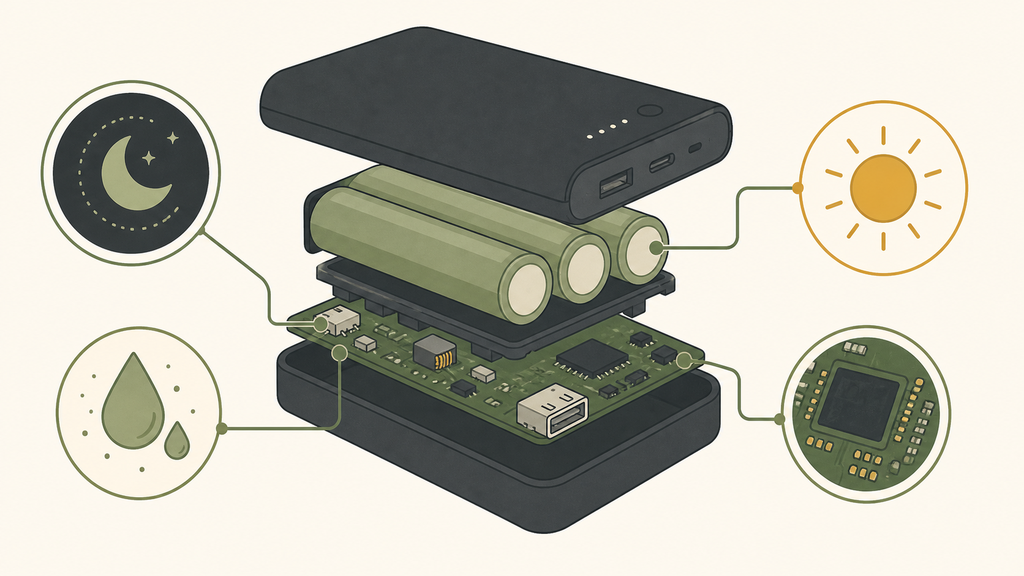
I separate the causes into three groups: battery, electronics, and environment. A user may only see one symptom. A manufacturer needs to trace which group is responsible.
Battery quality comes first. Low-grade cells may pass a basic capacity claim when new, but they can lose usable capacity quickly. Recycled or inconsistent cells are worse. They may show unstable voltage, faster self-discharge, and poor long-term reliability. For a brand, saving a small amount on cells can create many after-sales complaints.
Electronics are the second group. A power bank uses a protection circuit, boost converter, charging IC, display, and sometimes wireless charging components. If the standby current is high, the power bank quietly consumes its own energy. Some magnetic wireless power banks are especially easy to design poorly because they combine battery storage, wireless charging, magnets, USB-C, and standby detection.
| Cause | User symptom | Manufacturing check |
|---|---|---|
| Aging cell | Short runtime | Cycle and capacity test |
| High standby current | Drops while unused | PCB sleep current test |
| Poor display circuit | Percentage falls quickly | Firmware and LED test |
| Heat exposure | Capacity declines | Storage simulation |
| Moisture or impact | Random failure | Inspection and stress test |
Environment is the third group. A power bank stored fully charged for a long time in a hot place can age faster. A unit stored completely empty can also suffer because deep discharge can make recovery difficult. Many battery makers recommend storage at a partial state of charge for long-term inventory, though exact recommendations vary by cell and product design.
Safety matters here. The U.S. Consumer Product Safety Commission warns that lithium-ion batteries can create fire and injury risks if damaged, overheated, or poorly handled.1 UL also treats battery safety as a major product design and testing area.2 These sources are a reminder that standby drain is not only a convenience issue. It can be a quality and safety signal.
For importers, I recommend adding standby drain to the quality checklist. Do not only test whether the power bank charges a phone once. Test whether the unit still keeps charge after storage. Ask the supplier for cell brand, protection design, aging test process, and storage advice.
For users, the practical advice is simple. Store the power bank in a cool dry place. Recharge it every few months. Do not keep using it if it becomes hot, swollen, wet, or smells strange. A power bank is useful only when it can store energy safely.
How Can Brands Reduce Standby Drain Complaints?
Brands can reduce complaints by choosing better cells, testing standby current, controlling storage, and giving clear user instructions.
Brands should test standby drain before mass production, use consistent battery cells, check PCB sleep current, avoid power-hungry displays, store inventory properly, and explain that power banks should be recharged during long storage.
For a power bank brand, standby drain is easy to underestimate because it does not always appear during a quick sample review. A sample may look good on day one. The real problem appears after four weeks in a box.
I like to build a simple test plan. Charge ten samples to the same level. Record their voltage and displayed percentage. Store them under controlled conditions. Check them again after 7, 14, and 30 days. If one sample drops much faster than the others, investigate it. If all samples drop too quickly, review the design.
| Control point | Why it matters |
|---|---|
| Cell consistency | Reduces random battery behavior |
| Standby current test | Finds PCB drain before shipment |
| Display sleep mode | Prevents unnecessary energy loss |
| Storage instruction | Reduces customer misuse |
| Aging sample test | Catches weak batches early |
Packaging also matters. If the product is shipped with a very low charge, customers may receive a power bank that looks dead. If it is shipped fully charged and stored hot for months, aging can accelerate. A balanced factory charge and clear storage plan are better.
Airline and logistics rules also shape power bank handling. The FAA explains that spare lithium batteries and power banks must be carried in carry-on baggage, not checked baggage, for air travel.3 This does not directly explain self-discharge, but it shows how seriously lithium battery handling is treated in the supply chain and travel context.
From a product design perspective, I would avoid adding features that create standby risk unless the market clearly needs them. Always-on displays, decorative lights, and unnecessary Bluetooth features can make a simple product less reliable. Buyers like visible features. Customers judge the product when it works months later.
EverGreat often helps customers balance this tradeoff. A private-label buyer may want a premium digital display because it looks better online. I would still ask: how much standby current does it use, how stable is the firmware, and what happens after three months in a warehouse?
Customer support should also be ready. A good support script asks when the power bank was last charged, where it was stored, whether it became hot or swollen, and whether it can still recharge normally. These questions help separate normal self-discharge from a defective or unsafe unit.
For serious buyers, the best next step is to make standby drain part of the product specification. A supplier should be able to discuss it with real test data. If a supplier only says “all power banks do this,” I would ask for measurements.
Conclusion
Some standby loss is normal. Fast drain is a warning to check battery quality, circuit design, storage, and safety.
-
The U.S. Consumer Product Safety Commission gives lithium-ion battery safety guidance through its battery safety resources. ↩ ↩
-
UL Solutions describes battery safety testing and risk areas in its battery safety services. ↩
-
The FAA explains travel handling rules for spare lithium batteries and power banks in its PackSafe guidance. ↩