Many believe product quality comes down to final checks. But what if I told you most power bank quality is already set long before that last look? This is a common and costly misunderstanding in our industry.
For a power bank, real quality control starts with incoming materials, not just final inspection. By the time a power bank reaches final testing, its fundamental quality has already been locked in by the quality of its components, especially critical ones like battery cells and PCBs.
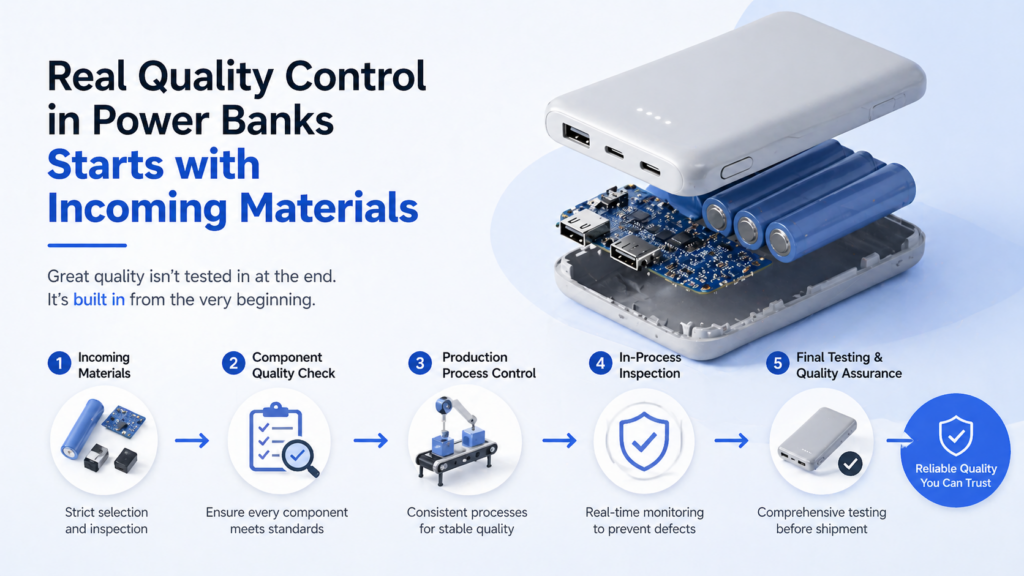
I’ve seen countless projects where brands focus heavily on outgoing quality assurance, only to be puzzled by inconsistent performance or early product failures. The truth I’ve learned from years in manufacturing is that you cannot inspect poor quality into good quality; you can only build quality in from the very beginning. This journey starts the moment raw materials arrive at our factory doors, before anything is assembled.
What Determines a Power Bank’s True Quality?
Are you wondering why some power banks feel solid and last forever, while others fail almost instantly? The difference is rarely about the brand name; it almost always comes down to the parts inside.
A power bank’s true quality is determined by its core components: the battery cells, the Printed Circuit Board (PCB), the housing materials, and the connectors. Overlooking the quality of any of these key parts means compromising the entire product’s performance, safety, and lifespan.
When I talk about quality, I am not just talking about how long the product works. I am also talking about safety, efficiency, and how it feels in your hand. Each part plays a major role. I’ve always stressed this to our clients at EverGreat Technology because ignoring any piece can bring down the whole product. Good design and careful assembly are vital, but they cannot fix bad parts.
The Critical Role of Core Components
- Battery Cells: The Powerhouse: These are perhaps the single most important component. They store energy and deliver it to your devices. Sub-par cells mean less capacity, faster degradation, and higher safety risks, often linked to unstable voltage output and inconsistent performance. I always check their internal resistance, cycle life, and discharge rates. We only select top-tier global suppliers for these.
- Printed Circuit Board (PCB): The Brain: The PCB controls charging, discharging, and safety functions. A good PCB has robust protection circuits against overcharge, over-discharge, overcurrent, and short circuits, which are critical for the safety of both the power bank and connected devices. Without a high-quality PCB, even the best battery cells are dangerous. I make sure our PCBs use reliable chips and components, carefully sourced.
- Housing and Enclosure: The Shield: The outer shell protects the internal components from physical damage and helps dissipate heat. The material choice affects durability, heat management, and the overall user experience. I consider ABS+PC for impact resistance and flame retardation. For even greater durability and superior thermal conductivity, especially crucial for managing heat during high-current operations, we also utilize aluminum alloy enclosures.
- Connectors and Cables: The Gateway: USB ports and internal wiring ensure stable power transfer. Poor quality connectors can lead to unreliable charging, slow charging speeds, loose connections, heat buildup at contact points, or even damage to devices due to increased resistance and intermittent connections. I verify these parts can withstand frequent use and provide reliable contact.
Here’s a simple comparison of what quality looks like in these components:
| Component | High Quality | Low Quality | Impact |
|---|---|---|---|
| Battery Cell | Reputable brand, high cycle life, stable output | Unknown brand, low cycle life, unstable | Longevity, safety (preventing overheating/swelling), actual capacity, stable performance |
| PCB | Multiple safety protections, efficient chips | Basic protection, cheap chips | Safety (overheating, short circuit, protection for devices), charging speed and efficiency |
| Housing | Durable ABS+PC, good heat dissipation | Flimsy plastic, poor heat management | Durability, safety, user experience, internal component protection |
| Connectors | Gold-plated, robust, snug fit | Loose, easily bent, poor conductivity | Charging reliability, device damage risk, prevention of heat buildup |
I often tell our partners that investing in these core components upfront saves a lot of headaches and customer complaints later. It’s the foundation of a truly reliable product.
Why Do Some Power Banks Degrade So Quickly?
Have you ever bought a new power bank that seemed great, only to find its charging capacity drop significantly after just a few months? This fast degradation isn’t random; it has a clear, hidden cause.
Many power banks degrade quickly because of low-quality battery cells, particularly those with poor cycle life, high internal resistance, or inconsistent manufacturing. The hidden impact of these sub-par cells is a rapid loss of capacity, reduced charging efficiency, and increased safety risks over a short period.
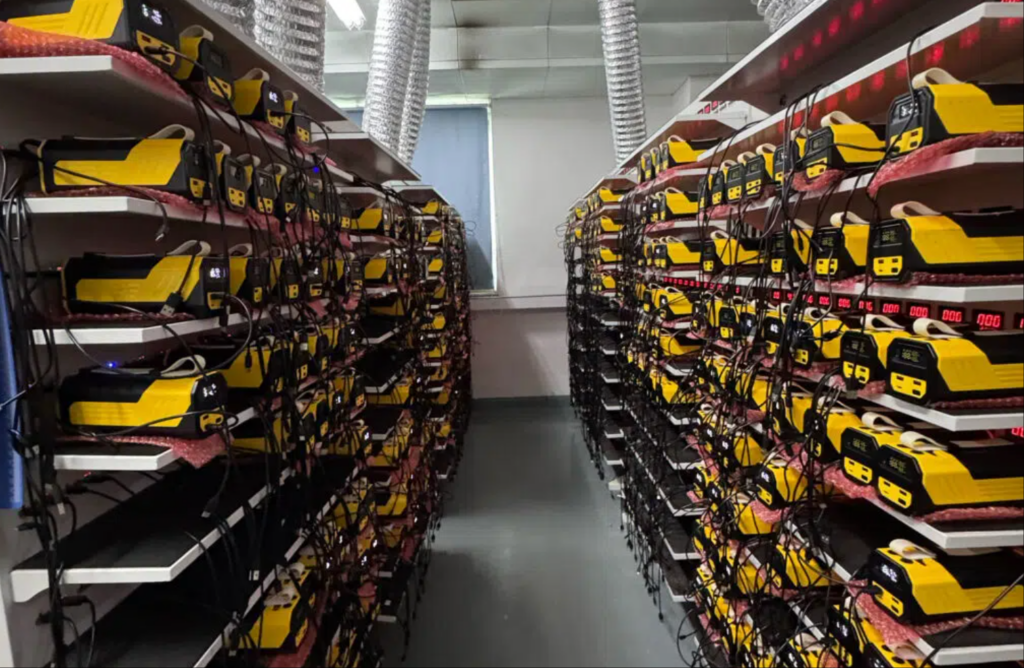
I’ve learned that battery cells are not all created equal. Even cells from the same factory can have different grades. Some manufacturers might use "B" or "C" grade cells to cut costs, which looks good on paper for a low price, but it means a product with a short life. I always emphasize that the real cost isn’t just the purchase price, but the total cost over the product’s lifespan, which includes potential warranty claims and reputational damage.
The Hidden Impact of Battery Cell Quality
- Cycle Life: Every battery has a limited number of charge and discharge cycles before its capacity significantly drops. While most power banks are rated for 300-500 full charge cycles, after which their capacity typically degrades to 60-80% of the original, high-quality cells can offer 500, 1000, or even 2000 to 3000 cycles. Cheap cells might only provide a hundred or two, meaning your power bank becomes less useful much faster. I always look for cells with a minimum of 500 full cycles to 80% original capacity.
- Internal Resistance: This refers to the opposition a battery cell presents to the flow of current. High internal resistance leads to more energy loss as heat during charging and discharging, reducing efficiency, limiting power output, and accelerating degradation. This thereby shortens its lifespan and increases safety risks due to potential overheating. It also means slower charging for your devices. I ensure our incoming cells meet strict internal resistance standards.
- Cell Grading: Battery manufacturers grade their cells based on performance, consistency, and defects. "A" grade cells are premium, meeting all technical parameters with high capacity, good cycle life, low self-discharge, and high safety. "B" grade cells have minor cosmetic flaws or slight performance variations, while "C" grade cells exhibit significant performance issues, rapid degradation, and higher safety risks, often used in very cheap products. "Recycled" or "refurbished" cells are even worse, with unknown history and potentially dangerous, sometimes sold as new. I insist on only using brand-new, "A" grade cells from trusted suppliers.
- Safety Features: High-quality battery cells often include built-in safety features, such as pressure relief devices (safety vents) and Positive Temperature Coefficient (PTC) resistors that act as a fuse. When combined with a robust PCB, these features create a much safer product, reducing risks like thermal runaway, swelling, leakage, or even explosion. I consider this a non-negotiable aspect of cell selection.
Here’s how different battery cell grades typically perform:
| Cell Grade | Source / Quality | Cycle Life (approx.) | Capacity Retention | Safety Risk | Typical Use |
|---|---|---|---|---|---|
| A-Grade | Top-tier, new, from reputable manufacturers | 500-1000+ | >80% after 500 | Very Low | Premium consumer electronics |
| B-Grade | Minor cosmetic flaws, slight performance variation | 200-500 | 70-80% after 200 | Low to Moderate | Budget-friendly products |
| C-Grade | Noticeable flaws, significant performance issues | <200 | <70% after 100 | Moderate to High | Very cheap, disposable |
| Recycled | Used, re-wrapped, unknown history, least reliable | Highly variable | Poor | High and Dangerous | Unreliable, dangerous |
I firmly believe that cutting corners on battery cells is the fastest way to undermine a power bank's perceived value and lead to customer dissatisfaction. It's a key area where "you get what you pay for" truly applies.
How Does a Factory Truly Control Quality from Start to Finish?
Have you ever wondered what goes on behind the scenes to make sure a power bank meets its quality promises? It’s not just one check at the end; it's a carefully structured process that touches every stage of production.
A factory truly controls quality from start to finish through a multi-stage process that begins with strict Incoming Quality Control (IQC) for all raw materials. This is followed by In-Process Quality Control (IPQC) during assembly, Final Quality Control (FQC) for finished goods, and Outgoing Quality Control (OQC) before shipment, ensuring consistent product excellence.

I’ve spent years refining our quality control system at EverGreat Technology because I understand that trust is built on consistency. Every step, from the moment a supplier delivers components to when the final product is packed, is an opportunity to either maintain or compromise quality. We don't just "check" for quality; we "build" it in. This systematic approach is what helps us deliver on our promise of reliable, high-performance power banks.
Quality Control: A Multi-Stage Fortress
- Incoming Quality Control (IQC): The First Line of Defense: This is where the foundation of quality is laid. When raw materials like battery cells, PCBs, and housing components arrive, our dedicated IQC team performs rigorous inspections. I check for material specifications, dimensions, functional tests, and supplier certifications. Any non-conforming materials are rejected. This step prevents bad components from even entering the production line.
- In-Process Quality Control (IPQC): Building Quality In: As components are assembled, IPQC monitors each stage. This includes checks during SMT (Surface Mount Technology) assembly for PCBs, battery cell welding, and housing assembly. I ensure that processes are followed correctly and that potential issues are caught early, rather than waiting for the final product. Regular calibration of equipment is also part of this.
- Final Quality Control (FQC): The Comprehensive Check: Once products are fully assembled, FQC performs comprehensive tests on every unit or a statistically significant sample. This includes capacity testing, charging/discharging efficiency, safety function verification (overcharge, short circuit), and cosmetic inspection. This is the last chance to catch any issues before packaging.
- Outgoing Quality Control (OQC): Pre-Shipment Assurance: Before products leave the factory, OQC conducts a final audit. This involves checking packaging integrity, labeling accuracy, and verifying that the correct quantities and models are being shipped. This step ensures that products arrive at the customer's door in perfect condition.
Here's a breakdown of our QC stages and their focus:
| QC Stage | Primary Focus | Key Activities | Goal |
|---|---|---|---|
| IQC (Incoming) | Raw Material & Component Quality | Specification checks, functional tests, supplier audits | Prevent defective parts from entering production |
| IPQC (In-Process) | Assembly Process & Workmanship | Line inspections, parameter monitoring, visual checks | Catch errors early, ensure correct assembly |
| FQC (Final) | Finished Product Performance & Safety | Full functional tests, capacity tests, safety checks | Verify product meets all design specifications |
| OQC (Outgoing) | Packaging, Documentation & Shipment Accuracy | Packing list verification, labeling, cosmetic check | Ensure product arrives safely and correctly |
I firmly believe that true quality control is an ongoing commitment, not a one-time event. It is a continuous loop of inspection, feedback, and improvement at every stage.
Conclusion
Real power bank quality starts long before the final inspection, rooted deeply in the quality of incoming materials like battery cells and PCBs. By focusing on stringent checks at every manufacturing stage, I ensure durable and safe products.