Are you frustrated when a new power bank quickly loses power? Many people think a higher mAh number means a better power bank, but this is often not true. This misunderstanding can lead to disappointment.
Battery quality often matters more than raw capacity in power banks. Two power banks with identical mAh ratings can deliver vastly different real-world performance because of differences in cell quality and the technology inside.
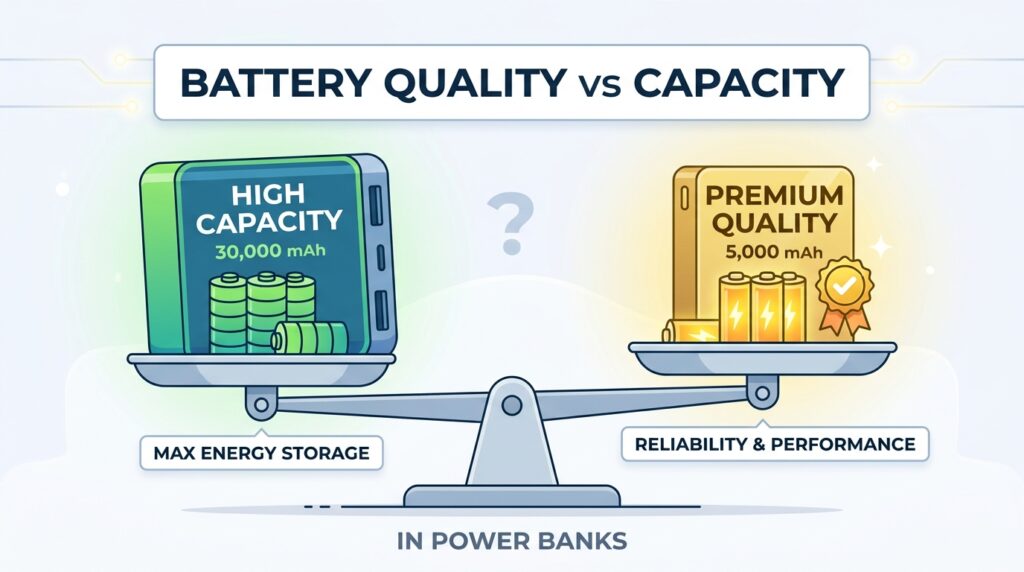
You might be wondering why some power banks seem to last forever while others, with the same advertised capacity, quickly die out. It all comes down to what is inside and how it works. Let me explain what really goes on inside these essential devices.
Why do some power banks with the same capacity perform differently?
Have you ever bought two power banks with the same mAh rating, only to find one charges your phone multiple times while the other barely manages one full charge? This is a common problem.
Power banks with the same capacity perform differently because of varied battery cell quality and internal circuit efficiency. Premium cells offer better energy storage and delivery, while efficient circuits minimize energy loss during charging and discharging.
When I talk about power banks, I always stress that capacity (mAh) is just one part of the story. The true performance comes from deeper elements. I have seen many instances where a power bank with an impressive number on the box delivers a poor experience. This happens because cell quality and conversion efficiency play big roles. These two things decide how much power actually reaches your device.
What is cell quality and why is it important?
Cell quality is the basic level of performance. It is the heart of any power bank. Cells are the individual batteries inside the power bank. There are different grades of these cells.
Premium Cells vs. Low-Grade Cells
Premium battery cells have better features. They offer higher energy density. This means they pack more power into a smaller space. They also have better stability, providing reliable and consistent performance. This helps them work safely and correctly for a long time. Their cycle life is much longer, often 800 to 1,200 or more charge cycles. This means you can charge and discharge them many times before they start to lose their capacity. Premium cells also have a lower risk of swelling. They are safer to use.
Low-grade cells are the opposite. They degrade faster. This means they lose their capacity quickly. You might notice your power bank not holding a charge as well after only a few months. They can also have safety issues. I have seen cases where these cells swell or overheat. This is dangerous. The choice of cells directly impacts the life and safety of your power bank.
| Feature | Premium Battery Cells | Low-Grade Battery Cells |
|---|---|---|
| Energy Density | High (more power in less space) | Lower (less power, larger size for same capacity) |
| Stability | High (reliable, consistent performance) | Lower (unreliable, unstable output) |
| Cycle Life | Long (800-1200+ cycles) | Short (degrades quickly) |
| Safety Risks | Low (less chance of swelling, overheating) | Higher (risk of swelling, overheating, short circuits) |
| Capacity Retention | Excellent (maintains capacity over time) | Poor (loses capacity fast) |
Conversion Loss and How It Affects Usable Capacity
Even with good cells, energy can still be lost. This is called conversion loss. It happens inside the power bank. When power moves from the internal battery to your device, it changes form. This change is not perfect.
Poor circuit design makes this loss worse. Inefficient voltage conversion means a lot of energy turns into heat instead of flowing to your phone. This can be a big problem. Some power banks lose 15-30% of their energy just in this process. This means if you have a 10,000 mAh power bank, you might only get 7,000 to 8,500 mAh of actual charge delivered to your devices. This is a big difference. I often remind customers that the number on the box is not always the amount you get. This loss is a key reason why power banks with the same stated capacity perform so differently.
Is power bank capacity (mAh) always accurate?
Do you trust the mAh number on a power bank’s box? Many people do, but I have learned to be very cautious. What you see is not always what you get in the world of power banks.
Power bank capacity (mAh) is not always accurate. Many budget power banks often inflate their ratings using inferior cells. This means the real usable capacity is often much lower than what is advertised on the packaging.
I have helped many brands over the years. One common issue I encounter is false capacity claims. This problem is very real. It can be misleading for consumers. When a power bank says it has a certain capacity, you expect it to deliver close to that. However, this is not always the case, especially with cheaper models. These claims lead to disappointment. They also make it hard to compare products fairly.
The Problem of False Capacity Claims
False capacity claims, are a big problem. Many budget power banks use this tactic. They print a much higher mAh rating on the label than the product actually has. They do this to seem more attractive to buyers. But inside, they use inferior cells. These cells might have a lower actual capacity. They also perform badly.
I have seen power banks advertised as 20,000 mAh that, in reality, deliver less than 10,000 mAh. This is a huge difference. This happens because the manufacturers use low-cost components. They want to cut down on production costs. This means the advertised capacity is a lie. It is not something you can rely on. As a consumer, you end up paying for a capacity you never receive. This is why I always tell people to look beyond just the number. Do not just trust the label.
How to Understand Real Usable Capacity
To really know a power bank’s capacity, you need to think about usable capacity. This is the amount of energy that actually reaches your device. It is different from the nominal capacity printed on the box. Usable capacity takes into account the conversion losses we discussed earlier.
A good power bank will have a high conversion efficiency. This means less energy is wasted. A bad power bank will lose a lot of energy. So, a 10,000 mAh power bank with 85% efficiency gives you 8,500 mAh. But a 10,000 mAh power bank with only 70% efficiency gives you 7,000 mAh. That is a 1,500 mAh difference from the same starting number. When I evaluate power banks, I look for transparency about efficiency. I also look for brands that focus on real-world delivery. This gives you a more honest picture of what you are buying.
What really determines the quality of a power bank battery?
So, if mAh is not the only thing, what truly makes a power bank good? It is more than just raw numbers. It is about how all the parts work together.
The quality of a power bank battery is determined by a combination of high-grade battery cells, minimal energy conversion losses, honest capacity labeling, and a capable Battery Management System (BMS). These elements together ensure safety, efficiency, and long-term reliability.
When I evaluate a power bank, I look at the whole package. It is like building a house. You can have good bricks, but if the foundation is weak, the house will not last. The same is true for power banks. Good cells are like good bricks. But you also need a strong foundation and a good building plan. This is where the other components come into play. A truly great power bank comes from thoughtful engineering and quality components working together.
The Critical Role of a Strong Battery Management System (BMS)
A strong Battery Management System (BMS) is very important. It is like the brain of the power bank. The BMS intelligently controls everything. It manages the charging and discharging processes. This means it makes sure the battery charges safely. It also makes sure your devices get a steady, safe charge.
Key Functions of a BMS
- Protection: A good BMS protects against many problems. It prevents overheat, which can be dangerous. It guards against overcurrent, which can damage your devices. It also stops short circuits. These protections keep you and your devices safe. I have seen how poor BMS systems can lead to ruined phones or even fire hazards. This is why I always emphasize the BMS.
- Stable Output: The BMS ensures stable output. This means your devices get a consistent power flow. This is important for fast and safe charging. Without a good BMS, the power might fluctuate. This can slow down charging. It can also harm your device’s battery over time.
- Efficiency and Longevity: An advanced BMS also makes the power bank more efficient. It manages power use, which means less energy is wasted. It also helps extend the battery’s cycle life. By controlling charges and discharges, it keeps the battery healthy longer. This makes your power bank last more years.
Beyond mAh: What to Look For
When I choose a power bank, I look for more than just capacity. It is about the complete package. A great power bank combines high-grade battery cells with minimal conversion losses. It also needs honest capacity labeling. Most importantly, it needs a capable Battery Management System.
These factors decide if a power bank works reliably. They decide if it disappoints you over time. I encourage you to focus on real-world delivered energy, charging efficiency, and safety features. Do not just look at the big number on the box. A smaller number might be better if it comes from a trusted brand with good components. Think about safety and long-term value.
Conclusion
Battery quality often beats raw capacity. Look for high-grade cells, low conversion loss, true capacity, and a strong BMS. These things make a power bank truly great.